



Though the end of the year is quickly approaching, there is still time to take advantage of some of the opportunities afforded under this landmark new tax law to reduce your 2025 tax liability.

Key Planning Tips and Tax Strategies in a New Tax Environment
This year has been very busy legislatively, with the passage of Public Law No: 119-21, also known as HR 1 as well as the “One Big Beautiful Bill Act,” (OBBBA) whether fondly or with irony, signed into law by President Donald Trump on July 4, 2025. This bill has reshaped tax compliance and planning and presents a range of new challenges and opportunities to consider for the balance of 2025, 2026 and beyond.
With its passage, Congress extended many of the provisions contained in the Tax Cuts and Jobs Act of 2017 (TCJA) that were set to expire at the end of 2025, in many instances with modifications, and touched nearly every aspect of the tax code with significant implications for individuals, businesses, investors and nonprofits. The OBBBA also introduced new deductions, along with phaseouts for higher-income taxpayers, including new deductions for workers and seniors, tax relief and enhanced credits for families, gain deferrals and exclusions for investors, immediate tax deductions for businesses, tax simplification measures for small businesses and permanent extension of the gift and estate tax exclusion.
Examples of a few key provisions of the new tax law, creating tax-planning opportunities for 2025, 2026 and beyond, include:
- Expansion of the state and local tax (SALT) deduction cap;
- New tip, overtime, car loan interest and senior deductions;
- New charitable and itemized deduction limitations set to hit in 2026;
- Permanent extension of 100 percent bonus depreciation for businesses;
- Significant revisions to the qualified opportunity zone program, including enhanced rural incentives;
- Expansion and modification of qualified small business stock gain exclusions; and
- Immediate expensing of domestic research and development expenditures.
These changes, and many more, can be found below in our overview of the OBBBA: Discover How the OBBBA Changes Your Tax Planning for 2025 and 2026. This section also includes a helpful table with a summary of the most impactful changes as a result of this legislation. As the tax changes are quite extensive, we hope you find this condensed summary useful.
Though the end of the year is quickly approaching, there is still time to take advantage of some of the opportunities afforded under this landmark new tax law to reduce your 2025 tax liability. Our 2025 Year-End Tax Planning Guide highlights select and noteworthy tax strategies and potential planning opportunities to consider for this year and, in many cases, 2026. We also highlight hidden pitfalls.
While we do not expect major new tax legislation in 2026, with tax legislation, nothing is certain of course. There may be attempts to expand the SALT deduction and there certainly will be the correction of technical deficiencies and unintended consequences of the OBBBA. We continue to carefully monitor and study changing tax legislation and IRS guidance on enacted legislation. As major tax developments and opportunities emerge, we are always available to discuss the impact on your personal or business situation. Please keep a watchful eye on our Alerts published throughout the year, which contain information on tax developments and are designed to keep you informed while offering practical insights and tax-saving opportunities.
In this 2025 Year-End Tax Planning Guide prepared by the CPAs, attorneys and IRS-enrolled agents of the Tax Accounting Group of Duane Morris LLP, along with contributions from the trust and estate attorneys of our firm’s Private Client Services Practice Group, we walk you through the steps needed to assess your personal and business tax situation in light of both existing law and potential law changes and identify actions needed before year-end and beyond to reduce your 2025, 2026 and future tax liabilities.
We hope you find this complimentary guide valuable and invite you to consult with us regarding any of the topics covered or your own unique situation. For additional information, please contact me, Michael A. Gillen, at 215.979.1635 or magillen@duanemorris.com, John I. Frederick or the practitioner with whom you are regularly in contact.
Wishing you and your loved ones a joyful holiday season and a healthy, peaceful and successful New Year.

Michael A. Gillen
Tax Accounting Group
About Duane Morris LLP
Duane Morris LLP, a law firm with more than 900 attorneys in offices across the United States and internationally, is asked by a broad array of clients to provide innovative solutions to today’s legal and business challenges. Evolving from a partnership of prominent lawyers in Philadelphia over a century ago, Duane Morris’ modern organization stretches from the U.S. to the U.K. and across Asia. Throughout this global expansion, Duane Morris has remained committed to preserving its collegial, collaborative culture that has attracted many talented attorneys. The firm’s leadership, and outside observers like the Harvard Business School, believe this culture is truly unique among large law firms and helps account for the firm continuing to prosper throughout changing economic and industry conditions. Most recently, Duane Morris has been recognized by BTI Consulting as both a client service leader and a highly recommended law firm. Additionally, multiple Duane Morris offices have received recognition as top workplaces for consecutive years.
At a Glance
- Offices in 22 U.S. cities in 12 states and the District of Columbia
- Offices in Asia and the United Kingdom and liaisons in Latin America
- More than 1,600 people
- More than 900 lawyers
- AM Law 100 since 2001
In addition to legal services, Duane Morris is a pioneer in establishing independent affiliates providing nonlegal services to complement and enhance the representation of our clients. The firm has independent affiliates employing more than 100 professionals engaged in other disciplines, such as the tax, accounting and litigation consulting services offered by the Tax Accounting Group.
About the Tax Accounting Group
The Tax Accounting Group (TAG) was the first ancillary practice of Duane Morris LLP and is one of the largest tax, accounting and litigation consulting groups affiliated with any law firm in the United States. Approaching our 45th anniversary in 2026, TAG has an active and diverse practice with over 60 service lines in more than 45 industries, serving as the entrusted advisor to clients in every U.S. state and 25 countries through our regional access, national presence and global reach. In addition, TAG continues to enjoy impressive growth year over year, in large part because of our clients’ continued expression of confidence and referrals. To learn more about our service lines and industries served, please refer to our Quick Reference Service Guide.
TAG’s certified public accountants, certified fraud examiners, attorneys, financial consultants and advisors provide a broad range of cost-effective tax compliance, planning and consulting services as well as accounting, financial and management advisory services to individuals, businesses, estates, trusts and nonprofit organizations. TAG also provides an array of litigation consulting services to lawyers and law firms representing clients in regulatory and transactional matters and throughout various stages of litigation. Our one-of-a-kind CPA and lawyer platform allows us to efficiently deliver one-stop flexibility, customization and specialization to meet each of the traditional, advanced and unique needs of our clients, all with the convenience of a single-source provider.
We serve clients of all types and sizes, from high-net-worth individuals to young and emerging professionals, corporate executives to entrepreneurs, multigenerational families to single and multifamily offices, mature businesses to startups, global professional service firms to local companies, and foundations and nonprofits to governmental entities. We assist clients with a wide range of services, from traditional tax compliance to those with complex and unique needs, conventional tax planning to advanced strategies, domestic to international tax matters for clients working abroad as well as foreign businesses and individuals working in the United States, traditional civil tax representation to those criminally charged, those in need of customary accounting, financial and management advisory services, to those requiring innovative consulting solutions and those in need of sophisticated assistance in regulatory and transactional matters and throughout various stages of litigation.
With our service mission to enthusiastically provide effective solutions that exceed client expectations, and the passion, objectivity and deep experience of our talented professionals, including our dedicated senior staff with an average of over 25 years working together as a team at TAG (with a few having more than 35 years on our platform), TAG is truly distinctive. Being “truly distinctive and positively effective” is not just our TAGline, it is our passion.
Whether you are a client new to TAG or are among the many who have been with us for nearly 45 years, it is our honor and privilege to serve you.
For the first time in nearly a decade, a significant portion of the tax code is not facing imminent sunset or expiration. We have greater tax certainty in the near term than we have enjoyed in years. However, this year, with Congress setting the precedent of scoring costs based on a current policy baseline as opposed to a current law baseline, the long-term future of tax law has never been more uncertain. Future congresses will be able to change tax law much more easily—and on a permanent basis.
For the past several years, Congress has needed continuing resolutions to pass budgets, and we have recently endured the longest government shutdown in history. As a result, we expect very little bipartisan cooperation moving forward, with few tax bills introduced or progressing, other than potential adjustments to the SALT limitation or technical corrections of the OBBBA. Overall, we do not anticipate the introduction of new major tax legislation pertaining to 2026.
Accordingly, there has never been a better time to plan. As we approach year-end, we are again fielding calls, outreaches and multiyear tax modeling requests from existing and new clients regarding year-end as well as multiyear tax planning strategies available to individuals, businesses, estates, trusts and nonprofits.
These discussions have centered around the new tax law and how it impacts each client’s individual scenario. As enacted, the OBBBA accomplished six main objectives:
- Permanently (for now) extending the key tax breaks under the TCJA set to expire at the end of 2025;
- Permanently (for now) eliminating and reducing certain deductions suspended or reduced under the TCJA;
- Introducing new tax provisions and deductions of its own, primarily to support working Americans;
- Introducing new limitations on existing deductions to pay for tax cuts;
- Enhancing existing deductions and credits; and
- Eliminating Biden-era energy credits.
In summary, the OBBBA:
- Extended TCJA tax benefits such as lowered individual tax rates;
- Increased standard deductions;
- Added larger alternative minimum tax exemptions;
- Solidified the qualified business income deduction for pass-through entities;
- Doubled the estate, gift and generation-skipping transfer tax exemption to $15 million for 2026;
- Eliminated deductions that were initially suspended by the TCJA, including the Pease limitation on itemized deductions, miscellaneous itemized deductions subject to the 2 percent floor, and personal exemptions (though the Pease limitation was replaced with a new 2/37ths limitation, see strategy 2);
- Modified several itemized deductions such as the SALT deduction limitation and the mortgage interest deduction limitation, however, with both having taxpayer-friendly enhancements;
- Introduced new deductions including “no tax on tips,” “no tax on overtime,” the senior deduction and the car loan interest deduction, all subject to limitations and phaseouts based on income;
- Added additional limitations for both the individual and corporate charitable contribution deductions (0.5 percent and 1 percent floors for each, respectively), gambling losses (only allowed to deduct 90 percent of losses), and itemized deductions generally (2/37ths limitation);
- Enhanced existing credits, such as raising the child tax credit to $2,200 and increasing the credit percentage and income phaseout ranges for the child and dependent care credit; and
- Effectuated the early termination of a number of energy credits for individuals and businesses, including residential energy credits, vehicle credits, and solar and wind credits.
These robust changes to the tax code offer a litany of opportunities to plan for tax savings, while also creating new pitfalls. While you can depend on TAG for cost-effective tax compliance, planning and consulting services—as well as critical advocacy and prompt action in connection with your long-term personal and business objectives—we are also available for any immediate or last-minute needs you may have or those that Congress may legislate that impact your personal or business tax situation.
With the same tax rates expected for 2026, the tried-and-true strategy of deferring income and accelerating deductions may be beneficial in reducing tax obligations for most taxpayers in 2025. With minor exceptions, December 31 is the last chance to develop and implement your tax plan for 2025, but it is certainly not the last opportunity.
For example, if you expect to be in the same tax bracket in 2026 as 2025, deferring taxable income and accelerating deductible expenses can possibly achieve overall tax savings for both 2025 and 2026. However, by reversing this technique and accelerating 2025 taxable income and/or deferring deductions to plan for a possible higher 2026 tax rate, your two-year tax savings may be higher. This may be an effective strategy for you if, for example, you have charitable contribution carryovers to absorb, your marital status will change next year or your head of household or surviving spouse filing status ends this year. This analysis can be complex, and you should seek professional guidance before implementation. Examine our “Words of Caution” section below for additional thoughts in this regard.
This guide provides practical insights and tax planning strategies for corporate executives, businesses, individuals―including high-income and high-wealth families―nonprofit entities and estates and trusts. We hope that this guide will help you leverage the tax benefits available to you presently, reinforce the tax savings strategies you may already have in place, or develop a tax-efficient plan for 2025 and 2026.
To help you prepare for year-end, below is a reference table of key OBBBA changes with a reference to our corresponding planning strategy number, organized by several common individual scenarios, which can help you reach your tax-minimization goals—as long as you act before the clock strikes midnight on New Year’s Eve. Not all of the action steps will apply in your particular situation, but you could likely benefit from many of them. You may want to consult with us to develop and tailor a customized plan with defined multiyear tax modeling to focus on the specific actions that you are considering. We will be pleased to help you analyze the options, avoid pitfalls and decide on the strategies that are most effective for you, your family and your business.
As we predicted last year, 2025 was a watershed year for tax policy in the United States. The OBBBA is one of the biggest tax overhauls in years and touches almost every part of the tax system—individuals, families, small businesses and even multinational companies. At its core, the legislation attempts to keep in place many of the tax cuts Americans have used since 2017, while also expanding certain benefits and tightening others. Over the past year, everyone else (not only tax practitioners) has learned what the term “SALT” meant—as the state and local tax deduction limitation got a much-needed increase for some from $10,000 to $40,000. Beginning in 2026, tax brackets will stay lower than they were scheduled to be, major family credits get a boost and several long-awaited changes, like broader 529 benefits and Form 1099 threshold increases, finally arrive.
For families, the bill increases the child tax credit, expands the child and dependent care credit, and makes it easier to save for education or pay for student loans using employer benefits. It also creates taxpayer-friendly provisions like no tax on tips or overtime pay, larger standard deductions and new “Trump accounts” for family savings. At the same time, some longstanding deductions, including unreimbursed employee expenses and certain casualty losses, are permanently (for now) eliminated for most taxpayers, unless very specific conditions are met.
For business owners, OBBBA extends the 20 percent qualified business income deduction, restores full expensing for domestic R&D, provides more favorable rules for depreciation and investment, and adjusts the interest-deduction limits in a way that will matter for highly leveraged operations. There are also changes to fringe benefits: some become more generous (i.e., employer-provided child care), while others (i.e., employer-provided meals) become more limited or nondeductible.
In short, the OBBBA impacted a broad swathe of the tax code, and the table below summarizes its most important impacts, with a reference to a deeper discussion on those topics later in this guide.
Quick-Look Reference Table of Key OBBBA Changes
|
OBBBA Change |
Impact |
When |
Strategy |
|
0.5% floor for charitable deductions |
A portion of charitable gifts are no longer deductible for itemizers. |
2026 |
1 |
|
2/37ths itemized deductions limitation |
Itemized deductions are less valuable for taxpayers in the highest bracket. |
2026 |
2 |
|
$40,000 SALT cap |
The SALT deduction cap is temporarily increased and is reduced to $10,000 at higher incomes. |
2025 |
4 |
|
$6,000 senior deduction |
Additional deduction is available to seniors, subject to phaseout. |
2025 |
5 |
|
No tax on tips |
Tipped workers can deduct up to $25,000 of eligible tips, subject to phaseout. |
2025 |
6 |
|
No tax on overtime |
Workers can deduct up to $12,500 of eligible overtime, subject to phaseout. |
2025 |
7 |
|
$10,000 car loan interest deduction |
Personal new car loan interest is now deductible, for purchases of new domestic cars. |
2025 |
8 |
|
Charitable deduction for nonitemizers |
Nonitemizers can deduct up to $1,000 (single)/$2,000 (married) of cash donations in a calendar year. |
2026 |
9 |
|
90% gambling loss limitation |
Gambling losses are now limited to 90% of losses, or 100% of winnings, whichever is less. |
2026 |
10 |
|
Opportunity zone gain deferral |
The opportunity zone program is made permanent with eligible investments taking place on a rolling 10-year basis. |
2027 |
11 |
|
Trump accounts |
New tax-advantaged custodial accounts for children. |
2026 |
12 |
|
Energy credits |
Most home, vehicle and clean-energy credits will sunset in/after 2025. |
2025 - 2027 |
13 |
|
Qualified production property |
New domestic real property generally used in agriculture or manufacturing qualifies for 100% bonus depreciation. |
2025 |
14 |
|
100% bonus depreciation |
100% bonus depreciation is made permanent, allowing the write-off of qualifying assets. |
2025 |
15 |
|
1% floor for corporate charitable giving |
Charitable deductions by corporations are only allowed for the amounts above 1% of income. |
2026 |
16 |
|
1099-MISC/NEC thresholds |
1099-MISC and 1099-NEC threshold will be raised from $600 to $2,000 in 2026; fewer small businesses will have to prepare 1099s. |
2026 |
17 |
|
1099-K threshold |
1099-K threshold is raised to $20,000 or 200 transactions per year; fewer 1099-Ks issued to small businesses. |
2025 |
18 |
|
Disaster-loss deduction |
Above-the-line disaster-loss deduction is made permanent and will now include state-declared disasters. |
2026 |
19 |
|
New student-loan repayment programs |
New 2026 repayment plan replaces old IDR repayment system and tries to better tie payments to income. |
2026 |
21 |
|
Employee retention credit |
IRS now has six years to audit ERC claims and can assess additional penalties on ERC promoters. |
2025 |
22 |
|
Standard deduction |
The larger standard deduction has been permanently extended and indexed for inflation. |
2025 |
24 |
|
Child and dependent care credit |
Dependent care credit expanded with enhanced benefits for low- and middle-income taxpayers in 2026. |
2026 |
27 |
|
Child tax credit |
The credit has been increased to $2,200 per qualifying child and indexed for inflation. |
2025 |
28 |
|
Adoption credit |
The adoption credit increased, with partial refundability added to the credit. |
2025 |
29 |
|
Mortgage-insurance premiums deduction |
PMI premiums are permanently deductible again beginning in 2026. |
2026 |
32 |
|
Qualified small business stock |
The gain exclusion has been increased, as has the asset maximum of the corporation, and holding periods of less than five years offer greater benefit. |
2025 |
41 |
|
529 plans |
Qualified expenses now include more types of expenses, vocational expenses and $20,000 of K-12 expenses per year (up from $10,000). |
2026 |
60 |
|
Alternative minimum tax (AMT) |
Permanent AMT relief, but a quicker phase-out means that AMT will capture more higher-income taxpayers. |
2026 |
72 |
|
Qualified business income (QBI) deduction |
The QBI deduction was extended permanently, and more income allowed before phaseout of the deduction. |
2026 |
83 |
|
Excess business losses |
The limitation on business loss deductions was permanently extended. |
2025 |
87 |
|
Business interest deductions |
Several changes to calculation of the deduction, but most importantly, depreciation and amortization are now added back to taxable income, resulting in larger deductions for many. |
2026 |
88 |
|
Employer provided meals |
Employer-provided meals for the convenience of the employer and snacks become nondeductible. |
2026 |
94 |
|
R&D expenses |
Domestic R&D can now be immediately deducted rather than amortized over 15 years. |
2025 |
97 |
|
Home office deduction |
Employees can no longer deduct employee expenses, including home office. |
2025 |
104 |
|
Employer child care credit |
Credit for employers increased from $150,0000 to $500,0000, among other broadening measures. |
2026 |
108 |
|
Hobby expenses |
Hobby expenses are now nondeductible permanently. |
2025 |
115 |
|
Employer student-loan repayment |
Employer student-loan assistance exclusion from gross income was permanently extended and indexed for inflation. |
2025 |
123 |
|
Estate and gift tax |
Estate and gift tax exemption permanently raised to an inflation indexed $15 million per individual. |
2026 |
130 |
|
Foreign tax credit |
Revised sourcing rules may reduce credit for certain foreign taxes. |
2025 |
148 |
Garnering many of the headlines during election season and as the bill made its way through Congress were the new tax deductions based on President Trump’s campaign promises to exempt certain categories of income. While exemptions were ultimately not in the cards, the final version of the OBBBA contained four new deductions that addressed the themes discussed during the election that shared many similarities. Though each will be discussed in greater depth at strategies 5-8 herein, see this side-by-side comparison of the four new provisions and who they potentially benefit, including modified adjusted gross income (MAGI) phaseouts.
New Individual Deductions Under the OBBBA
|
New Deduction |
Maximum Annual Deduction |
MAGI Phaseout Range (Single) |
MAGI Phaseout Range (MFJ) |
|
Senior (65+) |
$6,000 per eligible individual |
$75,000 - $175,000 |
$150,000 - $250,000 |
|
Tips |
$25,000 |
$150,000 - $400,000 |
$300,000 - $550,000 |
|
Overtime |
$12,500 if single; $25,000 if filing jointly |
$150,000 - $275,000 |
$300,000 - $550,000 |
|
Car-loan interest |
$10,000 |
$100,000 - $150,000 |
$200,000 - $250,000 |
The remaining days of 2025 (as well as the first four and a half months of 2026 in some circumstances) offer a great opportunity for you to review these OBBBA changes with your tax advisor and determine which strategies may apply. Of course, many of the same perennial planning strategies remain available as well. However, your changing circumstances may warrant a new look at some tried and true strategies that may not have been applicable in the past.
Whether you should accelerate taxable income or defer tax deductions between 2025 and 2026 largely depends on your projected highest (aka marginal) tax rate for each year. While the highest official marginal tax rate for 2025 is currently 37 percent, you might pay more tax than in 2024 even if you were in a higher tax bracket due to credit fluctuations, compositions of capital gains and dividends, and a myriad of other reasons.
The chart below summarizes the most common 2025 tax rates together with the corresponding taxable income levels presently in place. Effective management of your tax bracket can provide meaningful tax savings, as a change of just $1 in taxable income can shift you into the next higher or lower bracket. These differences can be further exacerbated by other income thresholds throughout the Internal Revenue Code, discussed later in this guide, such as those for determining eligibility for the child tax credit and qualified business income deductions, among others. Income deferral and acceleration, while being mindful of bracket thresholds, can be accomplished through numerous income strategies discussed in this guide, such as retirement distribution planning, bonus acceleration or deferral, and harvesting of capital gains and losses.
2025 Federal Ordinary Income Tax Rate Schedule
|
Tax Rate |
Single |
Head of Household |
Married Couple |
|
10% |
$0 – $11,925 |
$0 – $17,000 |
$0 – $23,850 |
|
12% |
$11,926 – $48,475 |
$17,001 – $64,850 |
$23,851 – $96,950 |
|
22% |
$48,476 – $103,350 |
$64,851 – $103,350 |
$96,951 – $206,700 |
|
24% |
$103,351 – $197,300 |
$103,351 – $197,300 |
$206,701 – $394,600 |
|
32% |
$197,301 – $250,525 |
$197,301 – $250,500 |
$394,601 – $501,050 |
|
35% |
$250,525 – $626,350 |
$250,500 – $626,350 |
$501,051 – $751,600 |
|
37% |
Over $626,350 |
Over $626,350 |
Over $751,600 |
While reviewing this guide, please keep the following in mind:
- Never let the tax tail wag the financial dog, as we often preach. Always assess economic viability. This guide is intended to help you achieve your personal and business financial objectives in a “tax efficient” manner. It is important to note that proposed transactions should make economic sense in addition to generating tax savings. Therefore, you should review your entire financial position prior to implementing changes. Various nontax factors can influence your year‑end planning, including a change in employment, your spouse reentering or exiting the work force, the adoption or birth of a child, a death in the family or a change in your marital status. It is best to look at your tax situation for at least two years at a time with the objective of reducing your tax liability for both years combined, not just for 2025. In particular, multiple years should be considered when implementing “bunching” or “timing” strategies, as discussed throughout this guide.
- Be very cautious about accelerated timing causing you to lose too much value, including the time value of money. That is, any decision to save taxes by accelerating income must consider the possibility that this means paying taxes on the accelerated income earlier, which would require you to forego the use of money used to satisfy tax liabilities that could have been otherwise invested. Accordingly, the time value of money can make a bad decision worse or, hopefully, a good decision better―a delicate balance, indeed.
- While the traditional strategies of deferring taxable income and accelerating deductible expenses will be beneficial for many taxpayers, you can often achieve overall tax efficiency by reversing this technique. For example, waiting to pay deductible expenses such as mortgage interest until 2026 would defer the tax deduction to 2026. Or, waiting to pay SALT until 2026 if you have already exceeded your SALT deduction cap in 2025 could also be worthwhile. You should consider deferring deductions and accelerating income if you expect to be in a higher tax bracket next year, you have charitable contribution carryovers to absorb, your marital status will change next year or your head of household or surviving spouse filing status ends this year. This analysis can be complex, and you should seek professional guidance before implementation.
- Both individuals and businesses have many ways to “time” income and deductions, whether by acceleration or deferral. Businesses, for example, can make different types of elections that affect the timing of significant deductions. Faster or slower depreciation, including electing in or out of bonus depreciation, is one of the most significant. This type of strategy should be considered carefully as it will not simply defer a deduction into the following year but can push the deduction out much further or spread it over a number of years.
- For quite some time, the alternative minimum tax (AMT) was unimportant for many taxpayers. OBBBA may have changed that starting in 2026. The AMT is a separate, yet parallel, federal income tax calculation designed to ensure that certain high-income individuals and corporations pay at least a minimum amount of tax, even if they have many deductions or credits that would otherwise significantly lower their regular income tax. If the AMT exceeds your regular tax, you owe the larger AMT amount. For 2026 and beyond, AMT exemptions for higher-income taxpayers may be phased out faster resulting in more taxpayers owing the AMT for 2026 and beyond. See strategy 72.
With these words of caution in mind, the following are observations and specific strategies that can be employed in the waning days of 2025 regarding income and deductions for the year, where the tried-and-true strategies of deferring taxable income and accelerating deductible expenses will result in maximum tax savings.
Below is a quick and easy reference guide outlining practical action steps that can help you reach your tax-minimization goals, as long as you act before year-end. In this guide, we have identified the best possible action items for you to consider, depending on how your income shapes up as the year draws to a close.
Not all of the action steps will apply in your particular situation, and some may be better for you than others. In addition, several steps can be taken before year-end that are not necessarily “quick and easy” but could yield even greater benefits. For example, perhaps this is the year that you finally set up your private foundation or a donor-advised fund to achieve your charitable goals (see strategies 126 and 35, respectively) or maybe you decide it is time to review your estate plan in order to utilize the current lifetime gift and estate tax exemption (see strategies 130-145). Consultation to develop and tailor a customized plan focused on the specific actions that should be taken is paramount.
To help guide your thinking and planning in light of the multiple situations in which you may find yourself at year-end, we have compiled the below quick-strike action steps that follow different themes depending on several common situations. You may wish to consider several potential actions and identify the most relevant and significant steps for your particular situation.
Quick-Strike Action Step Themes
|
Situation |
Reason |
Theme |
Potential Action |
|
You expect to pay higher ordinary income tax rates in 2026 |
Increased income—either from a liquidation event, entering the workforce, or a large bonus in 1Q26 Getting married, subject to marriage penalty Head of household or surviving spouse filing status ends after 2025 |
Accelerate income into 2025 Defer deductions until 2026 |
Accelerate installment sale gain into 2025 (strategy 117) Defer SALT payments to 2026 (strategy 31) Bunch itemized deductions in 2026 (strategy 33) Recognize bond interest (strategy 42) Reduce or delay pre-tax retirement contributions (strategy 53) |
|
You expect to pay lower ordinary income tax rates in 2026 |
Retirement Decreased income Head of household status eligibility in 2026 A child escaping the “kiddie tax” regime in 2026
|
Accelerate deductions into 2025 Defer income until 2026 |
Defer income until 2026 (strategy 23) Maximize medical deductions in 2025 (strategy 30) Prepay January mortgage (strategy 32) Consider deduction limits for charitable contributions (strategies 34 and 35) Bunch itemized deductions in 2025 (strategy 33) Sell passive activities (strategy 51) Increase basis in partnership and S corporation to maximize losses (strategy 52) Maximize pre-tax retirement contributions (strategy 53) Maximize contributions to FSAs and HSAs (strategies 66 and 67) Defer debt cancellation events (strategy 71) Delay retirement plan distributions or contribute retirement distributions to charity (strategy 58) |
|
You have high capital gains in 2025 |
Business or property sold An investment ends Employee stock is sold |
Reduce or defer gains |
Invest in qualified opportunity zones (strategies 11 and 20) Invest in Section 1202 small business stock (strategy 41) Perform a like-kind exchange (strategy 48) Harvest losses (strategy 40) |
|
You have low capital gains in 2025 |
Carry forward losses Large current year loss |
Increase capital gains |
Maximize preferential gains rates (strategy 37) Sell principal residence (strategy 47) Harvest gains without regard to wash sale rules (strategy 39) |
1. Accelerate charitable contributions into 2025 to avoid the new charitable floor in 2026. As a result of the OBBBA, beginning in tax year 2026, charitable contributions deducted as an itemized deduction will be subject to a “floor” of 0.5 percent of a taxpayer’s adjusted gross income (AGI). This means that taxpayers can only deduct the portion of their total charitable contributions that exceed this floor. For example, if a taxpayer’s AGI is $500,000 and the total cash contributions made for the year was $30,000, they would only be able to deduct $27,500 for the year ($500,000 x 0.5 percent = $2,500; $30,000 - $2,500 = $27,500).
This limitation also operates in conjunction with the charitable contribution “ceiling” already in place. For most charitable contributions made in the form of cash, other than to a private foundation, the limitation on the deduction is 60 percent of the taxpayer’s AGI. If total charitable contributions exceed the 60 percent ceiling, the excess is disallowed as a deduction for the current year and is carried forward to the following year.
Under OBBBA, the portion of the charitable contributions disallowed by the 0.5 percent floor is also carried forward if total contributions exceed the 60 percent ceiling. In the first example, the $2,500 that is disallowed is permanently lost, since total charitable contributions do not exceed the ceiling. For a taxpayer with AGI of $500,000 and total cash contributions of $315,000 for the year (assuming all are subject to the 60 percent ceiling), the total deduction for the year is $297,500, with $17,500 carried forward to the following year, as demonstrated below:
- 60 percent of AGI limitation (ceiling) → $500,000 (AGI) x 60 percent = $300,000
- Deductible amount → $300,000 (ceiling) - $2,500 (floor) = $297,500
- Carryforward amount → $315,000 (total cash contributions) - $297,500 (current year deduction) = $17,500
Overview of New Rules for Charitable Giving for Individual Taxpayers Starting in 2026
|
Total Charitable Contributions |
Current Year Deduction
|
Carryforward to the Following Year |
|
Contributions < 0.5% of AGI |
None |
None |
|
0.5% of AGI < Contributions < 60% of AGI |
Current year contributions less 0.5% of AGI |
None |
|
Contributions > 60% of AGI |
60% of AGI (ceiling) less 0.5% of AGI (floor) = 59.5% of AGI |
Current year contributions not deducted in the current year (total contributions less 59.5% of AGI) |
2. Shift itemized deductions into 2025 to avoid the 2/37ths reduction in 2026. The OBBBA ended the suspended “Pease limitation” (named after the late Congressman Donald Pease, which was an overall limitation on the amount of itemized deductions that high-income taxpayers can claim on their federal income taxes) that was in effect prior to tax year 2018 and replaced it with a new provision that limits the tax benefit of itemized deductions beginning in 2026, and is informally being referred to as the “2/37ths limitation.” With this new limitation for high-income taxpayers, itemized deductions are reduced by 2/37ths of the total amount of itemized deductions or the amount of the taxable income before itemized deductions exceeding the 37 percent bracket threshold, whichever is less. Basically, this limitation limits the benefit itemized deductions provide to taxpayers in the highest income tax bracket. For taxpayers in the highest (37 percent) bracket, itemized deductions will only have a tax benefit of 35 percent.
In 2025, if a taxpayer has taxable income before itemized deductions of $1.5 million, and total itemized deductions of $100,000, the actual tax saved is 37 percent of the itemized deductions—in this case $37,000. However, in 2026, after applying this new limitation, the tax benefit is only $35,000, as follows: $100,000 x 2/37 = $5,405 → $100,000 - $5,405 = $94,595 → $94,595 x 0.37 (37 percent) = $35,000. Total itemized deductions are reduced to $94,595, and in turn, this limitation results in the same tax savings to the taxpayer in the higher bracket as to the taxpayer in the second highest bracket. See the chart below to determine what amount is subject to this limitation:
Calculation of 2/37ths Limitation Based on Amount of Taxable Income
|
Taxable Income Before Itemized Deductions |
Total Itemized Deductions Before Limitation |
Amount Subject to 2/37ths Limitation |
|
Taxable income < highest bracket threshold |
N/A
|
N/A
|
|
Taxable income > highest bracket threshold |
Itemized deductions < taxable income less highest bracket threshold |
Total itemized deductions
|
|
Taxable income > highest bracket threshold |
Itemized deductions > taxable income less highest bracket threshold |
Taxable income less highest bracket threshold |
It is important to note that this provision does not carve out any exceptions for income taxed at preferential rates. If income taxed at ordinary rates is below the highest bracket threshold, but income taxed at preferential rates brings total taxable income into the highest bracket, this limitation will still apply even though the tax savings is less than 37 percent. In such situations, the limitation will result in itemized deductions having a tax savings of even less than 35 percent of the total.
3. Brace for a potential hit to your take-home pay if you are 50 or older (though it could be a good thing in the long run). Beginning in 2026, retirement plan catch-up contributions must be made on an after-tax (Roth) basis if the taxpayer’s wages exceeded $145,000 in the prior year (indexed for inflation).
This after-tax requirement only affects participants of employer-sponsored 401(k) plans age 50 and over by the end of the tax year who contribute what are known as “catch-up contributions” to their 401(k)-plan account. Catch-up contributions are contributions in addition to the standard statutory contribution limit for the year. The regular 401(k) contribution limit for 2025 is $23,500 and the catch-up contribution limit is $7,500. This means that an individual participant who turns 50 in 2025 can contribute a total of $31,000 in 2025.
Starting in the year 2025, participants aged 60-63 are eligible to make a higher catch-up contribution of $11,250. This means that an individual who is between 60 and 63 at the end of 2025 is able to contribute a total of $34,750 during the year, rather than $31,000.
Beginning in 2026, both the standard catch-up and the higher catch-up are subject to this new after-tax rule. Since it is entirely optional for a plan to offer participants the ability to make catch-up contributions, some employers have already amended their plan documents to no longer permit participants from making catch-up contributions to avoid compliance with the new rule.
However, it is important to understand that the after-tax rule is based only on the participant’s prior year Federal Insurance Contributions Act (FICA) wages from the plan sponsor (the employer which the 401(k) plan is through). This means that if their FICA wages from the plan sponsor were equal to or less than $145,000 in 2025, but they had FICA wages from another employer resulting in total FICA wages over $145,000, the employee would not be subject to this rule and would still be able to make before-tax catch-up contributions in 2026. There are limited exceptions and somewhat nuanced rules for multiple employers of a controlled group, but generally the employer is not responsible for collecting other types of data from their employees to comply with this new rule.
For any W-2 employee that this affects, you may want to consult with your employer to determine what you will need to do to (if anything) to change your contribution allocations. The employer may automatically designate applicable catch-up contributions as Roth, or you may no longer have the ability to make catch-up contributions entirely.
4. Unlock a larger SALT deduction for 2025. The SALT deduction limit has been a hot topic for a number of years since it originated in the 2017 TCJA. Prior to the TCJA, no such limit existed and taxpayers could deduct the full amount of SALT paid during the year. However, the TCJA limited the amount of SALT claimed as an itemized deduction to $10,000 (or $5,000 in the case of taxpayers married filing separately). This provision went into effect beginning for tax year 2018 and was originally scheduled to sunset after 2025.
During the 2024 campaign, President Trump indicated that he was in favor of eliminating this provision entirely, while other politicians believed it was necessary to leave the limitation in place in order to offset other tax cuts. The SALT provision that made it into the final version of the OBBBA is a bit of a compromise between the two.
The OBBBA did not eliminate the SALT limit but did temporarily modify it. Beginning for tax year 2025, the limit increases to $40,000 (or $20,000 in the case of taxpayers married filing separately) and is indexed to increase by 1 percent every year until 2030, when it is set to revert back to $10,000. This limit phases down by 30 percent of a taxpayer’s MAGI over $500,000 (or $250,000 in the case of taxpayers married filing separately), but never below the original $10,000 limit. So, essentially there is a modified MAGI phaseout range, which for taxpayers other than those who are married filing separately, is $500,000 - $600,000, as illustrated below.
SALT Deduction Cap Phaseout by MAGI
|
Tax Year |
SALT Deduction Cap |
Phaseout Range Begins at |
Phaseout Range Ends at |
|
2025 |
$40,000 |
$500,000 |
$600,000 |
|
2026 |
$40,400 |
$505,000 |
$606,333 |
|
2027 |
$40,804 |
$510,050 |
$612,730 |
|
2028 |
$41,212 |
$515,151 |
$619,191 |
|
2029 |
$41,624 |
$520,302 |
$625,716 |
|
2030 |
$10,000 |
N/A |
N/A |
If your income fluctuates around the phaseout range, to the extent possible, you should time your tax payments so that you pay more SALT in a year when your income is lower and you are subject to a higher limitation.
5. Leverage the new senior deduction for 2025 tax relief. For tax years 2025 through 2028, the OBBBA introduced a new deduction for seniors. Taxpayers reaching age 65 before the last day of the taxable year or older may claim an additional deduction of $6,000 per individual or $12,000 for a married couple where both spouses qualify. The additional deduction is available to taxpayers claiming either the standard deduction or itemized deductions. However, the senior deduction begins to phase out when MAGI exceeds $75,000 for single filers or $150,000 for joint filers. The deduction is completely phased out when MAGI reaches $175,000 for single filers or $250,000 for joint filers.
6. Take advantage of the new qualified tips deduction. As with the senior deduction, for tax years 2025 through 2028, employees and self-employed taxpayers may now deduct up to $25,000 of qualified tips received during the taxable year, regardless of whether the taxpayer itemizes their deductions or not. Regulations released by the IRS in late September provided a list of occupations that customarily receive tips and would be eligible for the deduction, along with rules as to what constitutes a “qualified” tip. For example, qualified tips must be voluntarily paid by the customer, so an automatic gratuity charge added to a customer’s bill will not qualify as a qualified tip for purposes of the deduction, as the customer did not have the option to not pay. The deduction is subject to phaseouts when MAGI reaches $150,000 for single taxpayers or $300,000 for married couples filing jointly.
7. Claim the new qualified overtime deduction. Effective for 2025 through 2028, eligible taxpayers may deduct up to $12,500 of qualified overtime (or $25,000 for married couples filing jointly). Qualified overtime is the portion of pay that exceeds their regular pay rate required by the Fair Labor Standards Act—effectively the “half” portion of “time-and-a-half” overtime compensation. Beginning for the 2026 tax year, employers and other payors will be required to file information returns with the IRS and Social Security Administration indicating the total qualifying overtime compensation for the year. For 2025, the portion of income that is qualified overtime earnings can be estimated by a reasonable method. For 2026, employers will need to track actual amounts of overtime paid and report it accordingly on 2026 wage and tax statements (Forms W-2). Just like the no tax on tips deduction, this deduction is available to both itemizing and nonitemizing taxpayers and is subject to phaseouts when MAGI reaches $150,000 for single taxpayers or $300,000 for married couples filing jointly.
8. Deduct car loan interest on the purchase of a new domestic car. Effective for 2025 through 2028, individuals may deduct interest paid on a loan used to purchase a qualified vehicle, provided the vehicle is purchased for personal use and meets other eligibility criteria. Lease payments do not qualify. The maximum annual deduction is $10,000, and phases out for taxpayers with MAGI over $100,000 ($200,000 for joint filers). In addition, the deduction is available for all taxpayers regardless of if they take the standard deduction or itemize.
To qualify for the deduction, the interest must be paid on a loan that is:
- Originated after December 31, 2024;
- Used to purchase a new vehicle originally used by the taxpayer and have its final assembly in the U.S.;
- For a personal use vehicle (not for business or commercial use); and
- Secured by a lien on the vehicle.
9. Utilize the new charitable deduction for nonitemizing taxpayers. Beginning in the 2026 tax year, a new deduction allows taxpayers to claim a deduction for charitable contributions worth up to $1,000 for single filers or $2,000 for married filing jointly. Only direct cash donations to eligible charities will qualify for purposes of this deduction; donations to donor-advised funds and private foundations and noncash donations do not qualify. This provision is permanent and is not indexed for inflation. The deduction is available to all taxpayers who do not itemize, regardless of income level.
We believe this new deduction will be reported as an “above the line” (and more favorable) deduction, reducing AGI. During the COVID pandemic, a similar deduction was available. For tax year 2020, the deduction was “above the line” and lowered AGI, though in 2021, the deduction was moved after the AGI calculation, following the standard or itemized deductions. We await IRS guidance to determine with certainty the location of this new deduction.
10. Turn losses into tax savings with the wagering losses deduction. In addition to being only able to deduct gambling losses to the extent of winnings, starting in 2026, you can only deduct at most 90 percent of your losses. This updated gambling loss rule is permanent.
Wagering Loss Deduction Illustration
|
Scenario |
2025 and Prior |
2026 and After |
|
Winnings: $100,000 |
Deduction: $100,000 |
Deduction: $90,000 |
|
Winnings: $90,000 |
Deduction: $80,000 |
Deduction: $72,000 |
|
Winnings: $40,000 |
Deduction: $40,000 |
Deduction: $40,000 |
For professional gamblers, the wagering loss deduction (subject to the same 90 percent limitation) can be claimed directly on a Schedule C (Profit or Loss from Business) along with their gambling income. Even though the deductions on the Schedule C will not be subject to the same itemized deduction limitations of a recreational gambler, they will likely still recognize phantom taxable income due to the 90 percent loss limitation, if their losses do not exceed 111 percent of winnings.
11. Plan ahead for new permanent and rolling qualified opportunity zones (QOZ) in 2027. The OBBBA permanently extended and modernized the QOZ program, originally enacted under the TCJA. While the TCJA program was scheduled to expire after 2026, the OBBBA created a permanent and rolling framework beginning January 1, 2027. As a result, careful timing is now critical when considering a QOZ investment, since different rules apply for 2025-2026 versus 2027 and later years.
Rules for 2025 and 2026: Under the TCJA rules, taxpayers could defer eligible capital gains by investing the gains in a qualified opportunity fund (QOF) within 180 days of realization. Deferred gains had to be recognized by December 31, 2026, with potential tax basis step-ups of 10 percent after five years and 15 percent after seven years.
Since the mandatory inclusion date of December 31, 2026, arrives before those holding periods can be satisfied, only investments made before 2021 could achieve a tax basis step-up. Any investments made after 2021 benefit only from temporary deferral until 2026. For 2025 investments, that translates to roughly a one-year deferral; no meaningful benefit remains for 2026 investments. However, both 2025 and 2026 would still benefit from an election to increase basis in the QOF investment to fair market value if held for 10 years or until 2047.
Rules for 2027 and future years: Beginning January 1, 2027, the OBBBA establishes a permanent, rolling opportunity zone program. Zones are now subject to decennial redesignation, with the first new determination date of July 1, 2026, and redesignations occurring every 10 years thereafter (July 1, 2036; 2046; etc.). Each new designation becomes effective on January 1 of the following year and remains in force for 10 years.
Under the new rules:
- Deferred gain is recognized at the earlier of a sale/exchange or five years after investment.
- If the investment is held five years, the basis increases by 10 percent of the deferred gain.
- If the investment is held 10 years, the basis equals the fair market value at sale—or automatically equals fair market value after 30 years if still held—eliminating post-investment appreciation from federal tax up to that 30-year mark. However, any appreciation occurring after the 30-year automatic step-up will be subject to capital gains tax when the investment is ultimately sold.
Qualified Opportunity Zone Rules by Year
|
Year of Investment |
2025 |
2026 |
2027 |
2027 |
|
Type of QOZ |
Normal QOZ |
Normal QOZ |
Normal QOZ |
Qualified rural opportunity zone |
|
Deferral Period |
Until Dec. 31, 2026 |
Until Dec. 31, 2026 |
Until earlier of sale/exchange or 5 years after investment |
Until earlier of sale/exchange or 5 years after investment |
|
Basis Adjustment After 5 Years (in Deferred Gain) |
Not applicable (cannot reach 5 years) |
Not applicable (cannot reach 5 years) |
10% of deferred gain ($100,000) |
30% of deferred gain ($300,000) |
|
Basis Adjustment After 7 Years (in Deferred Gain) |
Not applicable (cannot reach 7 years) |
Not applicable (cannot reach 7 years) |
Not applicable (no 7-year step-up under new rules) |
Not applicable (no 7-year step-up under new rules) |
|
Basis Adjustment After 10 Years (in QOF Investment) |
May elect fair market value basis until 2047 |
May elect fair market value basis until 2047 |
May elect fair market value basis for up to 30 years |
May elect fair market value basis for up to 30 years |
|
Deferred Gain Taxed |
Full $1,000,000 recognized in 2026 |
Full $1,000,000 recognized in 2026 |
$900,000 recognized in 2032 (after basis increase) |
$700,000 recognized in 2032 (after basis increase) |
12. Plant the seeds for your children’s future with “Trump accounts.” The OBBBA created a new savings account for children that will grow on a tax deferred basis, similar to a traditional IRA. For U.S. citizens born after December 31, 2024, and before January 1, 2029, establishing such an account will entitle the child to an initial $1,000 deposit from the government. Children born before or after this period are also eligible to set up these accounts as long as they are under 18 when they do so.
Parents, relatives and the children themselves can contribute up to an aggregated total $5,000 per year to the account, and employers may make an annual contribution of up to $2,500 to an account (which will not be included in the employee’s taxable income). The one-time $1,000 from the government does not count toward the yearly $5,000 limit, but employer contributions will reduce the annual limit. Contributions can be made until December 31 of the year they turn 18. These accounts are expected to be made available on July 4, 2026, and must be invested in an S&P 500 or a similar index fund. Upon the beneficiary attaining 18 years of age, the account will convert into a traditional IRA and is subject to all traditional IRA rules, including the 10 percent penalty for early withdrawal before age 59½, subject to the traditional IRA exceptions.
13. Act fast to utilize energy credits and deductions. Under the OBBBA, the majority of energy credits have been terminated. Some deadlines have already passed and more are set to end at the end of 2025 and early 2026. Now may be your last chance to receive a credit for energy efficient home improvements and electric vehicles. See the table below for important dates for taking advantage of energy credits before they expire.
Expiring Energy Credits
|
Credit |
Description |
New Sunset Date of Credit |
Planning Takeaways |
|
Clean vehicle credits |
A tax credit for individuals based on new and used vehicle purchases that are electric, plug-in hybrid and fuel cell. |
Vehicles must be acquired on or before September 30, 2025. |
N/A |
|
Credit for qualified commercial clean vehicles |
A tax credit for businesses purchasing clean vehicles for commercial use. |
Vehicles must be acquired on or before September 30, 2025. |
There is no limit on the number of credits your business can claim. For businesses, the credits are nonrefundable, so you can't get back more on the credit than you owe in taxes. |
|
Residential clean energy credit |
A tax credit for individuals for purchase of systems such as solar panels, wind turbines, battery storage and geothermal heat pumps. |
Qualifying expenditures (solar and water heating) must be made on or before December 31, 2025. |
Only applies to your main home or a second home that is not rented and located in the U.S. |
|
Energy efficient home improvement credit |
A tax credit for individuals for purchase of home improvement items such as windows, doors, insulation and hot water heaters. |
Eligible property must be placed in service on or before December 31, 2025. |
To qualify, building envelope components must have an expected lifespan of at least 5 years. This credit also includes labor costs for the installation. |
|
Alternative fuel vehicle refueling property credit (personal) |
A tax credit for individuals for purchase of electric vehicle chargers installed in your home. |
Eligible property must be placed in service on or before June 30, 2026. |
Install qualifying EV charging equipment before June 30, 2026, as long as you are located in eligible census tract (usually rural or low-income areas). |
|
Alternative fuel vehicle refueling property credit (business) |
A tax credit for businesses for purchase of electric vehicle chargers installed at a business or organization. |
Eligible property must be placed in service on or before June 30, 2026. |
Businesses and exempt organizations that meet prevailing wage and apprenticeship requirements are eligible for a 30% credit with a $100,000 per-item limit. |
|
Energy efficient commercial buildings deduction |
A tax deduction for commercial building owners purchasing interior lighting systems, heating/cooling, ventilation, and hot water systems. |
Eligible property must begin construction on or before June 30, 2026. |
Commence work before June 30, 2026, for significant tax savings. |
|
New energy efficient home credit |
A tax credit for eligible contractors who build or substantially reconstruct new, qualified energy-efficient homes, and own and have a basis in the home during construction, and then sell or lease it as a residence. |
Eligible property must be sold on or before June 30, 2026. |
Maximize your credit and sell a certified zero energy ready home. |
|
Clean electricity investment credit and clean electricity production credit |
A tax credit for businesses building and operating qualified facilities and energy storage technology. |
Solar and wind facilities must be placed in service on or before December 31, 2027, unless construction begins with 12 months of enactment of the OBBBA. Other types of energy facilities, such as nuclear, hydro and fuel cell remain eligible through 2033. |
The taxpayer claiming the credit must own the facility. Taxpayers cannot claim both investment credit and production credit for the same facility. |
|
Clean fuel production credit |
A tax credit for fuel producing businesses. Fuel produced after December 31, 2025, must be exclusively derived from feedstock produced or grown in the United States, Mexico or Canada. |
Extended through December 31, 2029. |
The maximum credit is $1 per gallon for nonaviation fuel and $1.75 per gallon for sustainable aviation fuel if all requirements are met. |
14. Claim 100 percent bonus depreciation on qualified production property (QPP). The OBBBA creates a new category of depreciable property known as QPP, which is eligible for 100 percent bonus depreciation.
QPP is generally nonresidential real property that is integral to a qualified production activity such as manufacturing, production or refining, resulting in a substantial transformation of a qualified product. In order to qualify for the 100 percent bonus depreciation, the construction must begin sometime between January 20, 2025, and December 31, 2028, and must be placed in service before January 1, 2031.
This new category of fixed assets creates an incentive to build manufacturing facilities in the United States. The incentive works by allowing the immediate deduction of certain real property (i.e., things like buildings and structures that are not movable) that otherwise would be depreciable evenly over 39 years.
Prior to the OBBBA, only limited types of real property known as qualified improvement property (QIP) were eligible for bonus depreciation. This includes interior improvements such as drywall, plumbing, electrical wiring, etc. that are added after a building has already been placed in service. Assets that are not considered QIP include enlargements/expansion and modifications to the internal structural framework of a building. QIP also specifically excludes elevators and escalators. QPP now makes up for this by essentially including everything that QIP excludes if it is an integral part of a qualified production activity.
Due to the expansion of bonus depreciation to QPP, taxpayers may want to consider the benefits of a cost segregation study when constructing a new multiuse facility where a portion of the activity will be devoted to qualified production activity. See strategy 98.
15. Turn year-end purchases into major tax savings with 100 percent bonus depreciation. In addition to QPP, the OBBBA has also permanently restored bonus depreciation to 100 percent of qualified new or used property placed in service after January 19, 2025. Bonus depreciation generally applies to qualified tangible personal property with a recovery period of 20 years or less (such as machinery, equipment, vehicles, computer equipment, office furniture and fixtures). Under the TCJA, bonus depreciation was scheduled to drop to 40 percent of qualified new or used property for 2025, which is still the case for property placed in service between January 1, 2025, and January 19, 2025.
|
Tax Year |
Bonus Depreciation Percentage |
|
2018-2022 |
100% |
|
2023 |
80% |
|
2024 |
60% |
|
January 1, 2025 – January 19, 2025 |
40% |
|
January 20, 2025, and thereafter |
100% |
16. Maximize corporate giving impact by contributing before year-end. In addition to the charitable floor for individual taxpayers discussed in strategy 1, the OBBBA also introduced a new 1 percent floor on charitable contribution deductions for corporations. Starting with the 2026 tax year, the new law provides that corporate taxpayers may claim a charitable deduction only to the extent that its charitable contributions exceed 1 percent of its taxable income.
17. Save on compliance expenses thanks to increased 1099 reporting thresholds. Forms 1099-MISC and 1099-NEC have long remained at a reporting threshold of $600, but that is set to change in 2026. For 2026, the OBBBA has increased the threshold to $2,000 for all qualified payments. Additionally, for calendar years after 2026 the threshold is indexed to increase for inflation.
18. Learn how new Form 1099-K rules affect your app-based income. For users of Venmo, PayPal, CashApp, Uber, DoorDash, Airbnb and similar apps, many taxpayers received Forms 1099-K for the first time with respect to the 2024 tax year as the threshold for Form 1099-K reporting was $5,000. This threshold was set to be further reduced to $2,500 in 2025, but the OBBBA retroactively set the threshold back to $20,000 in gross payments made over more than 200 transactions for transactions to a payee. This retroactive change applies to calendar year 2025 and onward and specifically applies to payments received through a third-party settlement organization. Excluded from this threshold are payments received through payment card transactions. Therefore, any payment received via credit cards, debit cards and store-value cards should produce a related Form 1099-K, regardless of the amount.
19. Claim a deduction for casualty and disaster losses. Thus far in 2025, there have been at least 115 federally declared natural disasters in the United States. A few examples include severe storms and flooding in Texas, Alaska and North Dakota, as well as tropical storms in North Carolina.
Prior to the TCJA, taxpayers were essentially able to deduct all personal casualty and theft losses as an itemized deduction. The TCJA restricted it so that such losses can only be deducted if they are attributable to a federally declared natural disaster, with limited exceptions. The original provision in the TCJA was temporary and was scheduled to sunset after 2025. The OBBBA made this permanent and expanded it to also include state declared disasters beginning in tax year 2026.
20. Prepare for 2026 opportunity zone gain recognition. Since 2018, taxpayers have had the option to defer the capital gains by reinvesting those gains into a QOF within 180 days of the sale. Under the TCJA opportunity zone rules, gains invested in QOFs are deferred until the QOF investment is sold or until December 31, 2026, whichever occurs earlier. For many taxpayers, large, deferred gains will be recognizable starting in 2026.
As mentioned in strategy 11, the deferred gains were allowed basis step-ups of 10 percent if held for five years and 15 percent if held for seven years. While the opportunity to take advantage of this basis increase has passed, investing in a QOF in 2025 still provides taxpayers the opportunity to defer capital gains until December 31, 2026, or until the investment is sold, whichever event occurs first. In addition, tax on the appreciation of the QOF may be avoided if the investment is held for over 10 years.
All 50 states have communities that now qualify for QOF investment plans. Besides investing in a fund, taxpayers may also take advantage of this opportunity by establishing a business in the QOZ or by investing in QOZ property.
21. Review new student loan rules and repayment options under the OBBBA. Beginning July 1, 2026, the OBBBA restructures federal lending and repayment programs. OBBBA replaces the current income-driven repayment plans with a new Repayment Assistance Plan (RAP), terminates Grad PLUS loans, establishes new annual and aggregate borrowing limits for Federal Direct Unsubsidized Stafford Loans for graduate and professional students and imposes new annual and aggregate limits on Parent PLUS borrowing per dependent student.
22. Consider withdrawing erroneous employee retention credit claims. The employee retention credit (ERC) was introduced to taxpayers during COVID-19, incentivizing businesses who keep employees on their payroll during times of economic turmoil with the opportunity to receive the credit. This credit saw widespread fraud by third-party promoters encouraging ineligible businesses to file improper ERC claims. In response to the surge in fraudulent ERC claims over the years, the IRS has increased enforcement, using the additional funding from the Inflation Reduction Act of 2022 to hire and train employees on investigating abuses of this credit. This resulted in several lawsuits against these unscrupulous promotors, both by the IRS and their clients. Any business with a pending ERC claim that they subsequently realized was ineligible can voluntarily withdraw the claim as long as the following conditions are met:
- An amended employment tax return was filed to claim the ERC (Forms 941-X, 943-X, 944-X, CT-1X).
- The amended return has no other changes besides claiming the ERC.
- The withdrawal is for the entire amount of the ERC claim for the quarter.
- If the IRS has already processed the returns and paid the claim, the refund checks have not been received, cashed or deposited.
Once the withdrawal is filed, the IRS will send a letter stating whether the withdrawal request was accepted or rejected. Without the acceptance letter, the withdrawal request is not considered completed. If the withdrawal is accepted, an amended income tax return may be needed.
Interestingly, the OBBBA has extended the government’s statute of limitations to assess ERCs filed for the third and fourth quarters of 2021. For these periods, the IRS’ limitations period was extended to five years under the American Rescue Plan Act of 2021, rather than the normal three years the IRS has to assess tax. The OBBBA further extended the period to six years from the date the original return was filed or the date the ERC claim was filed, whichever is later.
In addition, the IRS is now statutorily prohibited from allowing or refunding any ERCs for the third and fourth quarters of 2021 that were filed after January 31, 2024, even if all eligibility requirements have been met. The OBBBA has also tightened restrictions on ERC promoters by imposing fines and penalties on promoters who failed to satisfy all due diligence requirements.
If you filed ERCs before the January 31, 2024, cutoff and still receive Letter 105-C, Claim Disallowed, you have the right to appeal to the IRS Independent Office of Appeals. Additional information on how to respond with an appeal can be found on the IRS website.
Nearly all cash-basis taxpayers can benefit from strategies that accelerate deductions or defer income, since it is generally better to pay taxes later rather than sooner (especially if income tax rates are not scheduled to increase). For example, a check you send in 2025 generally qualifies as a payment in 2025, even if it is not cashed or charged against your account until 2026. Similarly, deductible expenses paid by credit card are not deductible when you pay the credit card bill (for instance, in 2026), but when the charge is made (for instance, in 2025).
With respect to income deferral, cash-basis businesses, for example, can delay year-end billings so that they fall in the following year or accelerate business expenditures into the current year. On the investment side, income from short-term (i.e., maturity of one year or less) obligations like Treasury bills and short-term certificates of deposit is not recognized until maturity, so purchases of such investments in 2025 will push taxability of such income into 2026. For a wage earner (excluding an employee-shareholder of an S corporation with a 50 percent or greater ownership interest) who is fortunate enough to be expecting a bonus, he or she may be able to arrange with their employer to defer the bonus (and tax liability for it) until 2026. However, if any of this income becomes available to the wage earner, whether or not cash is actually received, the bonus will be taxable in 2025. This is known as the constructive receipt doctrine.
23. Defer income until 2026 to take advantage of inflation adjustments to tax brackets. For 2025, the top individual tax rate remains 37 percent and is applied to joint filers with taxable income greater than $751,600 and single filers with taxable income greater than $626,350. More importantly, for 2026, the OBBBA preserved these brackets enacted under the TCJA and made them permanent. The thresholds for the top 37 percent bracket will rise in 2026 to $768,700 for joint filers and $640,600 for single filers. It might be advantageous for many taxpayers to accelerate their deductions into 2025, reducing their potential tax liability this year. Additionally, for those who are able, taxpayers should plan to defer income into 2026 to take full advantage of the threshold increases to the tax brackets. While there are many ways to defer your income, waiting to recognize capital gains or exercise stock options are popular options that would not only lower your investment income, but your taxable income as well. Depending on your situation, these strategies could reduce tax due for 2025 and potentially 2026 as well.
2025 and 2026 Federal Tax Brackets
|
Tax Rate |
Single – 2025 |
Single – 2026 |
Married Filing Jointly – 2025 |
Married Filing Jointly – 2026 |
|
10% |
$0 – $11,925 |
$0 – $12,400 |
$0 – $23,850 |
$0 – $24,800 |
|
12% |
$11,926 – $48,475 |
$12,401 – $50,400 |
$23,851 – $96,950 |
$24,801 – $100,800 |
|
22% |
$48,476 – $103,350 |
$50,401 – $105,700 |
$96,951 – $206,700 |
$100,801 – $211,400 |
|
24% |
$103,351 – $197,300 |
$105,701 – $201,775 |
$206,701 – $394,600 |
$211,401 – $403,550 |
|
32% |
$197,301 – $250,525 |
$201,776 – $256,225 |
$394,601 – $501,050 |
$403,551 – $512,450 |
|
35% |
$250,526 – $626,350 |
$256,226 – $640,600 |
$501,051 – $751,600 |
$512,451 – $768,700 |
|
37% |
Over $626,350 |
Over $640,600 |
Over $751,600 |
Over $768,700 |
24. Be aware of the increased standard deduction. As a result of the OBBBA, the increased standard deduction taxpayers enjoyed over the past seven years has been permanently extended and indexed for inflation so that the 2025 standard deduction is $31,500 for a joint return (an increase of $2,300) and $15,750 for a single return (an increase of $1,150). Taxpayers 65 years or older and those with certain disabilities may claim additional standard deductions, including the new senior deduction discussed in strategy 5.
|
Standard Deduction (based on filing status) |
2024 |
2025 |
|
Married filing jointly |
$29,200 |
$31,500 |
|
Head of household |
$21,900 |
$23,625 |
|
Single (including married filing separately) |
$14,600 |
$15,750 |
25. Weigh the pros and cons of filing separately this year. A great majority of the time, it is more advantageous for a married couple to file a joint return as opposed to filing separately. However, there are limited circumstances where it may be more beneficial to file separately, such as when one spouse does not want to be responsible for the other’s tax debts, when student loan repayments can be reduced under an Income-Driven Repayment Plan (see strategy 21), where there is a concern about accuracy or completeness of the other spouse’s tax information or to avoid a “marriage penalty.” A marriage penalty occurs typically when both spouses have relatively high income but are still individually within the lower brackets so that the effective tax rate on their income is less when filing separately than it is when filing jointly. This scenario only occurs in very limited circumstances—when both spouses’ individual income amounts fall within the exact right area.
Conversely, many tax deductions and credits are completely disallowed for taxpayers married filing separately, including:
- The child and dependent care credit;
- The earned income credit;
- The credit for the elderly and disabled;
- The “American opportunity” credit;
- The lifetime learning credit;
- The credit for adoption expenses;
- The student loan interest deduction;
- The new $6,000 deduction for seniors over the age of 65;
- The new no tax on tips deduction; and
- The new no tax on overtime deduction.
Further, the mortgage debt limit for which a taxpayer can deduct mortgage interest as an itemized deduction is cut in half for a taxpayer that is married filing separately. Also, keep in mind that if filing separately and one spouse elects to itemize their deductions instead of taking the standard deduction, the other spouse must also itemize their deductions even if in total they are less than the standard deduction.
If you do intend to file separately for a nontax reason, make sure you communicate that intention to your tax return preparer. In most cases, your tax preparer will analyze which filing status creates optimal tax results and discuss advantages and disadvantages of each filing status.
26. Reduce fraud risk with an Identity Protection PIN. Perpetrators of fraud or identify theft schemes have become more aggressive and continue to develop new ways of obtaining taxpayers’ information. The Identity Protection (IP) PIN is a six-digit number assigned by the IRS (and known only by the IRS and the taxpayer) that adds an additional layer of protection to the taxpayer’s sensitive tax information. Using an IP PIN prevents someone else from filing a return just by using your Social Security number or Individual Taxpayer Identification Number. Rather, the return must also include your unique IP PIN. Therefore, receiving and using an IP PIN will further protect your tax information whether you have previously been a victim of identity theft or just want to take precautions to plan ahead and avoid potential identity theft in the future. After you receive your IP PIN from the IRS, it is valid for one calendar year and, for each subsequent year, a new IP PIN will be generated and must be obtained. For greater detail, we previously wrote on this topic in an Alert. Additionally, the IRS has an FAQ about the IP PIN.
27. Turn dependent care costs into tax savings. For tax year 2025, you may be able to claim the nonrefundable child and dependent care credit if you pay qualified expenses when you (and your spouse if filing a joint return) work. This credit is generally not allowed for married filing separately taxpayers. Your dependent must be under the age of 13 or an individual who was physically or mentally incapable of self-care with certain conditions. The maximum qualifying expenses you may use to calculate the credit are $3,000 for one qualifying individual and $6,000 for two or more qualifying individuals. In 2025, there is no limit to a taxpayer’s AGI in qualifying for the credit; however, the percentage of expenses available for credit would be reduced to 20 percent for most middle-income taxpayers whose AGI exceeds $43,000. As a result of the OBBBA, for 2026, there will be a significant increase in the maximum credit and applicable percentages available.
Percentage of Expenses Available for Dependent Care Credit (Based on Income)
|
|
50% |
49% to 36% |
35% |
34% to 21% |
20% |
|
2025 Single Taxpayers |
N/A |
N/A |
$0 to $15,000 |
$15,001 to $43,000 |
$43,001-plus |
|
2026 Single Taxpayers |
$0 to $15,000 |
$15,001 to $43,000 |
$43,001 to $75,000 |
$75,001 to $103,000 |
$103,001-plus |
|
2025 Married Filing Jointly |
N/A |
N/A |
$0 to $15,000 |
$15,001 to $43,000 |
$43,001-plus |
|
2026 Married Filing Jointly |
$0 to $15,000 |
$15,001 to $43,000 |
$43,001 to $150,000 |
$150,001 to $206,000 |
$206,001-plus |
28. Get the most from the child tax credit. For 2025, the OBBBA increased the maximum child tax credit to $2,200 per dependent under the age of 17 (up from $2,000 in 2024). This credit will now be adjusted annually for inflation, beginning in 2026. The refundable portion of the credit can reach $1,700 per qualifying child (unchanged from 2024), depending on your income, and you must have earned income of at least $2,500 to be eligible for the refund. Similar to 2024, the credit begins to phase out at incomes above $400,000 for married filing jointly taxpayers and $200,000 for any other filing status. It is important to note, the actual income level at which the credit phases out entirely depends on the number of qualifying children a taxpayer has. The table below assumes one qualifying child.
Phaseout Range of Child Tax Credit by MAGI
|
Single/Married Filing Separately |
Head of Household |
Married Filing Jointly |
|
$200,000 - $240,000 |
$200,000 - $240,000 |
$400,000 - $440,000 |
29. Be aware of the enhanced adoption credit. If you adopted a child in 2025, you may be eligible for the adoption credit. The maximum credit is $17,280 for 2025 (up from $16,810 in 2024), but it begins to phase out when MAGI exceeds $259,190 for all taxpayers and is eliminated when MAGI reaches $299,190. This credit amount is indexed for inflation, increasing every year. As a result of the OBBBA, starting in 2025, up to $5,000 of this credit is now refundable, and the refundable amount will also be adjusted annually for inflation starting in 2026.
Itemized Deduction Planning
30. Pay any medical bills in 2025. The medical expense deduction floor remains at 7.5 percent of AGI for taxpayers who itemize their deductions. Additionally, the deduction is not an AMT preference item, meaning that even taxpayers who are subject to the AMT benefit from deductible medical expenses.
Therefore, be sure to pay all medical costs for you, your spouse and any qualified dependents in 2025 if, with payment, your medical expenses are projected to exceed 7.5 percent of your 2025 AGI, as this will lower your tax liability for 2025. You also may wish to accelerate any qualified elective medical procedures into 2025 if appropriate and deductible, particularly if you expect your 2026 income to rise.
31. Defer your SALT payments until 2026. The limitation of the SALT deduction was one of the most notable changes enacted by the TCJA in 2017. In 2024, the deduction limit for state and local income or sales and property taxes was $10,000 per return ($5,000 in the case of a married individual filing separately). In 2025, the OBBBA has increased the cap to $40,000 per return ($20,000 in the case of a married individual filing separately). The new $40,000 SALT cap phases down to $10,000 after crossing $500,000 of MAGI, as discussed at strategy 4.
As a result, a newer type of pass-through entity (PTE) tax strategy has been enacted by many states since the SALT cap was established by TCJA. By imposing an income tax directly on the PTE on behalf of the respective owners, a state’s tax on PTE income now becomes a deduction for the PTE for federal income tax purposes. Generally, states with PTE elections fall within two categories: a deduction for previously taxed income (reducing state taxable income on the owner’s individual return), or a credit for the tax liability incurred by the PTE (reducing the state tax liability dollar-for-dollar on the owner’s individual return).
Currently, 36 states and one locality assess such a tax: Alabama, Arizona, Arkansas, California, Colorado, Connecticut, Georgia, Hawaii, Idaho, Illinois, Indiana, Iowa, Kansas, Kentucky, Louisiana, Maryland, Massachusetts, Michigan, Minnesota, Missouri, Mississippi, Montana, Nebraska, New Jersey, New Mexico, New York, New York City, North Carolina, Ohio, Oklahoma, Oregon, Rhode Island, South Carolina, Utah, Virginia, West Virginia and Wisconsin. The legislature of Pennsylvania has proposed PTE tax bills in the state Senate and House several times; however, the bills remain pending.
32. Prepay your January mortgage payment if you will be under the mortgage interest limitation. For acquisition indebtedness incurred after December 15, 2017, the mortgage interest deduction is limited to interest incurred on up to $750,000 of debt ($375,000 in the case of a married individual filing a separate return). The mortgage interest from both a taxpayer’s primary and secondary residences remains deductible up to this balance limit on newer debt. For debt existing prior to December 15, 2017, the limit remains at the pre-TCJA amount of $1 million for original mortgage debt. The OBBBA has made the $750,000 limitation permanent.
Regardless of the date incurred, home equity indebtedness not used to substantially improve a qualified home is no longer deductible. However, if a portion of the funds taken from home equity indebtedness are used to improve the property, a percentage of the interest paid on that debt may be deductible, subject to tracing rules.
33. Consider paying SALT, mortgage interest, medical expenses, charitable gifts, etc. (subject to limits noted within this guide) in the same year as opposed to spreading the payments over two years. By bunching deductions and deferring taxable income along with using AGI‑reducing techniques, you increase the value of all deductions and reduce your overall tax liability.
In considering the strategies noted below, however, keep in mind that if you pay a deductible expense in December 2025 instead of January 2026, you reduce your 2025 tax instead of your 2026 tax, but you also lose the use of your money for one month. Generally, this will be to your advantage from a tax perspective, unless in one month you can generate a better return on use of the funds than the tax savings. In other words, you must decide whether the cash used to pay the expense early should be for something more urgent or more valuable than the increased tax benefit.
Taxpayers can also elect to deduct sales and use tax in lieu of income taxes. Accelerating the purchase of a big-ticket item into this year is a good way to achieve a higher itemized deduction for sales taxes.
The following chart illustrates the tax treatment of selected types of interest.
Interest Expense Deduction Summary*
|
Type of debt |
Not deductible |
Itemized deduction |
Business or above-the-line deduction |
|
Consumer or personal interest |
✔ |
|
|
|
Taxable investment interest [1] |
|
✔ |
|
|
Qualified residence interest [2] |
|
✔ |
|
|
Tax-exempt investment interest |
✔ |
|
|
|
Trading and business activities interest |
|
|
✔ |
|
Passive activities interest [3] |
|
|
✔ |
* Deductibility may be subject to other rules and restrictions.
[1] Generally limited to net investment income.
[2] For 2025, including debt of up to $750,000 ($1 million for debt incurred prior to December 16, 2017) associated with primary and one secondary residence. Home equity loan interest deduction is suspended, unless the loan proceeds are used to buy, build or substantially improve the taxpayer’s home securing the loan.
[3] Subject to passive activity rules.
Charitable Contributions
You may wish to consider paying 2026 pledges in 2025 to maximize the “bunching” effect, perhaps through a donor-advised fund, which is a charitable giving vehicle that can assist with bunching of charitable contributions into a given year. This can be useful when you are able to make a donation but have yet to determine the timing of the distributions out of the donor-advised fund or which charities will receive the gift.
In addition to achieving a large charitable impact in 2025, this strategy could produce a larger two-year deduction than two separate years of itemized deductions, depending on income level, tax filing status and giving amounts each year. This strategy is also beneficial to avoid, or at least mitigate the adverse impact of the new 0.5 percent floor on charitable contributions beginning in tax year 2026. See strategy 1.
Investment Interest
This is interest on loans used to purchase or carry property held for investment purposes (e.g., interest on margin accounts, interest on debt used to purchase taxable bonds, stock, etc.). Investment interest is fully deductible to the extent of net investment income, unless incurred to purchase securities that produce tax-exempt income. Net investment income is equal to investment income less deductible investment expenses. Sources of investment income include income from interest, nonqualified dividends, rents and royalties. Investment expenses include depreciation, depletion, attorney fees, accounting fees and management fees. However, most miscellaneous itemized deductions suspended by the TCJA and made permanent under the OBBBA―such as advisory fees, investment management fees, custodial fees and most attorney and accounting fees―are no longer deductible for individuals and, therefore, do not reduce net investment income for purposes of the investment interest limitation.
By rearranging your borrowing, you may be able to convert nondeductible interest to deductible investment interest. In addition, you may be able to increase your otherwise nondeductible investment interest by disposing of property that will generate a short‑term capital gain. The extra investment interest deduction may even offset the entire tax on the gain. Disposing of property that will generate long‑term capital gain will not increase your investment income unless you elect to pay regular income tax rates on the gain. Accordingly, you should review your debt and investment positions before disposing of such property.
Medical and Dental Expenses
As discussed in strategy 30, a medical deduction is allowed only to the extent that your unreimbursed medical outlays exceed 7.5 percent of your AGI. To exceed this threshold, you may have to bunch expenses into a single year by accelerating or deferring payment as appropriate.
Charitable Giving
34. Understand the substantiation requirements and deduction limits when donating noncash charitable contributions. Donating appreciated securities such as stocks, bonds and mutual funds directly to charity allows a taxpayer to avoid taxes on these capital gains, though the deduction for capital gain property is generally limited to 30 percent of AGI.
For personal property, the charitable deduction for airplanes, boats and vehicles may not exceed the gross proceeds from their resale. Form 1098-C must be attached to tax returns claiming these types of noncash charitable contributions. Furthermore, donations of used clothing and household items, including furniture, electronics, linens, appliances and similar items, must be in “good” or better condition to be deductible. You should maintain a list of such contributions together with photos to establish the item’s condition. To the extent they are not in “good condition,” you will need to secure a written appraisal to deduct individual items valued at more than $500.
Noncash Contribution Substantiation Guide by Donation Amount
|
Type of donation |
Less than $250 |
$250 to $500 |
$501 to $5,000 |
Over $5,000 |
|
Publicly traded stock |
•Receipt |
•Acknowledgment |
•Acknowledgment |
•Acknowledgment |
|
Nonpublicly traded stock |
•Receipt |
•Acknowledgment |
•Acknowledgment |
•Acknowledgment |
|
Artwork |
•Receipt |
•Acknowledgment |
•Acknowledgment |
•Acknowledgment |
|
Vehicles, boats and airplanes |
•Receipt |
•1098-C or |
•1098-C |
•1098-C |
|
All other noncash donations |
•Receipt |
•Acknowledgment |
•Acknowledgment |
•Acknowledgment |
|
Volunteer out-of-pocket expenses |
•Receipt |
•Acknowledgment |
•Acknowledgment |
•Acknowledgment |
Conservation easements can have additional benefits that extend beyond federal charitable deductions. At least 16 states have programs that will provide a state tax credit. These programs can be quite involved, and proper procedures with the state must be implemented correctly and timely. However, where a taxpayer receives a state tax credit in exchange for a conservation easement, the IRS views the credit as a quid-pro-quo benefit that reduces the federal charitable deduction by the value of the credit received (or expected to be received). Accordingly, it is essential to consult a qualified tax professional to properly determine the allowable federal charitable deduction.
It is also important to consider that a conservation easement will have an effect on the tax basis of the property. If selling the property, it is important to remember the impact of the easement on the tax basis when calculating gain. If changing tax service providers, it is important to hand your tax advisor all documents related to any prior year easements no matter how long ago the easement was obtained.
35. Contribute appreciated stock to unlock bigger charitable deductions. With many stocks gaining ground in 2025, gifts of appreciated stock remain a great way to maximize charitable gifting while also avoiding capital gains taxes. Do not give away loser stocks (those that are worth less today than what you paid for them). Instead, sell the shares and take advantage of the resulting capital loss to shelter your capital gains or income from other sources, as explained above. Then give cash to the charity since you just sold the stock and will have the cash on hand. As for winner stocks, donate them directly to charity instead of donating cash, as long as you have held the stock for more than one year. Under either situation, you recognize multiple tax benefits. When gifting appreciated stock to charity, you not only avoid paying taxes on capital gains, gifts and estates, but you may be able to deduct the value of the stock for income tax and AMT purposes as well. As always, be aware that gifts to political campaigns or organizations are not deductible.
Charitable donations are subject to the same AGI limitations in 2025 as for 2024.
Deductions Allowable for Contributions of Various Property
|
|
Cash |
Tangible personal property |
Appreciated property |
|
Public charity |
60% of AGI |
50% of AGI |
30% of AGI |
|
Private operating foundation |
60% of AGI |
30% of AGI |
30% of AGI |
|
Private nonoperating foundation |
30% of AGI |
30% of AGI |
20% of AGI |
|
Donor-advised fund |
60% of AGI |
30% of AGI |
30% of AGI |
36. Consider an investment in a special-purpose entity. Certain states also employ special-purpose entities, which allow taxpayers to make charitable contributions to certain nonprofits (usually schools) while claiming a state tax credit for the contribution. While the taxpayer generally does not receive a federal charitable contribution deduction for the amount of the contribution for which they will receive a state credit, taxpayers often receive a much greater return in tax benefits dollar-for-dollar than contributions made outside of these special-purpose entity programs. In Pennsylvania, for example, the educational improvement and opportunity scholarship tax credits (EITC/OSTC) allow taxpayers to effectively divert state tax payments to donations to private schools, scholarship organizations, pre-K programs and other education initiatives.
To illustrate, using the Pennsylvania EITC/OSTC program, assume a taxpayer contributes $50,000 to a special-purpose LLC, which in turn contributes the funds to the EITC/OSTC program. As a member of the LLC, at year end, the taxpayer would receive a K-1 from the entity reporting a Pennsylvania state tax credit for either 75 percent or 90 percent of the contribution, depending on whether they commit to making this contribution for one or two years, respectively. Assuming a two-year commitment, the taxpayer will receive a $45,000 nonrefundable credit on their Pennsylvania income tax return, reducing the tax owed by $45,000. In addition, the taxpayer would receive a federal income tax charitable contribution deduction for the remaining $5,000. Assuming a 37 percent federal tax bracket, this would result in a federal tax benefit (reduction in tax) of $1,850. Thus, on top of the $45,000 state tax benefit, the total tax benefit from a $50,000 contribution to an EITC/OSTC would be $46,850. As the credit is nonrefundable, this assumes that the taxpayer’s state tax liability exceeds the amount of the credit. By comparison, a contribution to a non-EITC/OSTC qualifying scholarship program would realize a tax benefit of only $18,500 (37 percent of $50,000).
|
|
EITC/OSTC contribution |
“Normal” charitable contribution |
|
Amount of contribution (A) |
$50,000 |
$50,000 |
|
Pennsylvania tax credit (B) |
$45,000 |
$0 |
|
Contribution for which no state credit is given (C=A-B) |
$5,000 |
$50,000 |
|
Federal tax rate (D) |
37% |
37% |
|
Federal tax savings (E=CxD) |
$1,850 |
$18,500 |
|
Total federal and state tax benefit (B+E) |
$46,850 |
$18,500 |
Tax-Efficient Investment Strategies
For 2025, the long-term capital gains and qualifying dividend income tax rates, ranging from zero percent to 20 percent, are based on taxable income and have increased incrementally, as shown below.
|
Long-Term Capital Gains Rate |
Single |
Married Filing Jointly |
Head of Household |
Married Filing Separately |
|
0% |
Up to $48,350 |
Up to $96,700 |
Up to $64,750 |
Up to $48,350 |
|
15% |
$48,351 to $533,400 |
$96,701 to $600,050 |
$64,751 to $566,700 |
$48,351 to $300,000 |
|
20% |
Over $533,400 |
Over $600,050 |
Over $566,700 |
Over $300,000 |
In addition, a 3.8 percent tax on net investment income applies to taxpayers with MAGI that exceeds $250,000 for joint returns ($200,000 for singles). See strategy 75 for more information. Here are some ways to capitalize on the lower rates as well as other tax planning strategies for investors.
37. Maximize preferential capital gains tax rates. In order to qualify for the preferential lower capital gains tax rates of 20 percent, 15 percent and zero percent, a capital asset is required to be held for a minimum of one year. That is why it is paramount that, when you sell off your appreciated stocks, bonds, investment real estate and other capital assets, you are mindful of the asset’s holding period. If you have held the asset for less than one year, consider delaying the sale so that you can meet the holding period requirement (unless you have losses to offset any potential gain). Also, consider timing the sales strategically to stay within the lower tax brackets and take advantage of the zero percent or 15 percent long-term capital gains rates when possible. While it is generally unwise to let tax implications be your only determining factor in making investment decisions, you should not completely ignore them either. Also, keep in mind that realized capital gains may increase your AGI, which consequently may reduce your AMT exemption and therefore increase your AMT exposure―although this is to a much lesser extent than in prior years, given the increased AMT exemptions in recent years.
38. Lower your tax burden with qualified dividends. Similarly, the advantageous capital gain tax rates (20 percent, 15 percent or zero percent) also enhance the appeal of certain dividend-paying stocks subject to these preferential lower rates. Keep in mind that to qualify for the lower tax rate for qualified dividends, the shareholder must own the dividend-paying stock for more than 60 days during the 121-day period beginning 60 days before the stock’s ex-dividend date. For certain preferred stocks, this period is expanded to 90 days during a 181-day period. In addition, mutual funds may pay capital gain distributions at or after year-end, which may be treated as long-term capital gains and taxed at the preferential lower rates. You should anticipate these distributions and plan accordingly. See our discussion on mutual fund distributions at strategy 45.
39. Utilize specific identification method to reduce the recognized gain or increase the recognized loss. When selling off any securities, the general rule is that the shares acquired first are the ones deemed sold first, also known as the first in, first out method. However, if you opt to, you can specifically identify the shares you are selling when you sell less than your entire holding of any securities. By notifying your broker of the shares you wish to have sold at the time of the sale, your gain or loss from the sale is based on the identified shares. Additionally, many self-directed brokerage accounts also allow you to choose which shares to sell first. This sales strategy gives you more control over the amount of your gain or loss and whether it is long- or short-term. A pitfall of the specific identification method is that you cannot use any different methods (e.g., average cost method or first in, first out method) to identify shares of that particular security in the future. Rather, you will have to specifically identify shares of that particular security throughout the life of the investment, unless you obtain permission from the IRS to revert to the first in, first out method.
40. Harvest your capital losses. You should periodically review your investment portfolio to determine if there are any “losers” you should sell off. As the year comes to a close, selling securities or other capital assets that have declined in value may be your last chance to offset capital gains recognized during the year or to take advantage of the $3,000 ($1,500 for married separate filers) limit on deductible net capital loses, as potentially up to $3,000 of net losses can be used to offset any ordinary income reported during the year. However, please be mindful of the wash-sale rule that could negate any capital losses realized, discussed later in strategy 43.
Additionally, you may want to project what your taxable income is going to be for the year before selling assets at a loss to offset long-term capital gains. For taxpayers in the lower two brackets (see chart above strategy 37), their capital gains rate is zero percent. It does not make sense to offset capital losses against long-term capital gains in a year in which you are in a lower tax bracket, as gains subject to the zero percent rate are not taxed, so the deduction for the capital loss would essentially be wasted.
Why Capital Loss Harvesting Is Ineffective for Lower Tax Bracket Taxpayers
|
Reason |
Explanation |
|
Zero long-term capital gains tax rate |
Taxpayers in the 10% and 15% brackets pay no tax on long-term capital gains, so harvesting losses does not reduce tax liability. |
|
Limited ordinary income offset |
Only $3,000 of excess capital losses can be deducted against ordinary income per year, which provides minimal benefit in low brackets. |
|
Carryover limitations |
Unused capital losses can be carried forward indefinitely, but if the taxpayer remains in a low bracket, future benefits remain limited. |
|
Transaction costs |
Realizing losses may incur transaction costs (commissions, bid-ask spreads) that outweigh the small tax benefit. |
|
No benefit for short-term gains |
Short-term capital gains are taxed as ordinary income, but low-bracket taxpayers have low ordinary rates, so offsetting gains yields little savings. |
|
Losses expire at death |
Any unused capital loss carryover is lost upon the taxpayer’s death and cannot be transferred to heirs. On a married filing jointly return, capital loss carryforwards are attributed to the spouse who generated them. Unless the surviving spouse can substantiate that he or she incurred the losses, the carryforwards could expire at the first spouse’s death. |
41. Take advantage of the expanded Section 1202 small business stock gain exclusion. Prior to the enactment of the OBBBA, Section 1202 of the Internal Revenue Code allowed for a potential exclusion of up to 100 percent of the gain recognized on the sale of qualified small business stock (QSBS) that is held by the taxpayer for more than five years, depending on when the QSBS was acquired. While the “old” rules are still in effect, the OBBBA brings three substantial enhancements to the Section 1202 gain exclusion for stock issued after July 4, 2025:
- Up to $15 million of 1202 gain can now be excluded from income (up from $10 million);
- The limit on a corporation’s aggregate gross assets at the time of stock issuance has increased from $50 million to $75 million; and
- The holding period requirements have been lowered by implementing a tiered exclusion based on the number of years the taxpayer holds the QSBS: 50 percent exclusion if held for three years, 75 percent if held for four years and 100 percent if held for five or more years.
See the chart below. As an alternative, if the stock is held for more than six months and sold for a gain, you can elect to roll over and defer the gain to the extent that new QSBS stock is acquired during a 60-day period beginning on the date of the sale.
Qualified Small Business Stock Exclusion
|
Stock Issuance Date |
Holding Period (in Years) |
1202 Exclusion Percentage |
Per-Issuer Gain Exclusion Limit |
|
From August 14, 1993, to February 18, 2009 |
5 or more |
50% |
$10 million |
|
From February 19, 2009, to September 27, 2010 |
5 or more |
75% |
$10 million |
|
From September 28, 2010, to July 3, 2025 |
5 or more |
100% |
$10 million |
|
After July 3, 2025 |
3 |
50% |
$15 million (indexed for inflation) |
|
4 |
75% |
$15 million (indexed for inflation) |
|
|
5 or more |
100% |
$15 million (indexed for inflation) |
42. Beware of the “kiddie tax.” The kiddie tax is an important consideration for families with children who have unearned income, such as interest, dividends, capital gains and other investment income. For 2025, if your child is under age 19 (or under age 24 and a full-time student) and has unearned income but no earned income, the first $1,350 of unearned income is not taxable, sheltered by the child’s standard deduction. The next $1,350 of unearned income will be taxed at the child’s tax rate. Any amount in excess of $2,700 is taxed at the marginal tax rate of the child’s parents. This rule is designed to prevent income-shifting strategies that reduce overall family tax liability. In certain circumstances, you may be able to elect to report your child's investment income on your own return using Form 8814, which can simplify filing but may affect your AGI and related deductions. Consider strategies such as investing in tax-exempt or tax-deferred vehicles, or shifting income to earned income through family employment, to help minimize the impact of the kiddie tax.
Tax Rate on a Child’s Unearned Income
|
Unearned Income Amount |
Tax Rate Applied |
|
First $1,350 |
Child's tax rate, or 0% (if no earned income) |
|
Next $1,350 |
Child's own tax rate |
|
Income exceeding $2,700 |
Parent's highest marginal tax rate, up to 37% |
- Owners of Series EE and Series I bonds may defer reporting any interest (i.e., the bond’s increase in value) until the year of final maturity, redemption or other disposition. (If held in the parent’s name and used for qualified higher education expenses, and assuming certain AGI requirements are met, the income is not taxed at all.)
- Municipal bonds produce tax-free income (although the interest on some specialized types of bonds may be subject to the AMT).
- Growth stocks that pay little dividends and focus more on capital appreciation should be considered. The child could sell them after turning 24 and possibly benefit from being in a low tax bracket. Selling them before then could convert a potential zero percent income tax on the gain into a 20 percent income tax.
- Funds can be invested in mutual funds that concentrate on growth stocks and municipal bonds that limit current income and taxes. They may also limit risk through investment diversification.
- Unimproved real estate that will appreciate over time and does not produce current income will limit the impact of the kiddie tax.
- Section 529 plans offer investors the opportunity to experience tax-free growth, so long as distributions are used to fund qualified education expenses, discussed later at strategy 60. In addition, contributions to a 529 plan may qualify the donor for a deduction on his or her state income tax return.
- Market discount obligations are good choices to defer interest income recognition until the child “ages out” of the kiddie tax regime.
43. Navigate the wash-sale rules to preserve your tax losses. Frequently overlooked, the wash-sale rule makes it so that no deduction is allowed for a loss if you acquire substantially identical securities within a 61‑day period beginning 30 days before the sale and ending 30 days after the sale. Instead, the disallowed loss is added to the cost basis of the new security. However, there are ways to avoid this rule. For example, you could sell a security at a loss and use the proceeds to acquire similar but not substantially identical investments. If you desire to preserve an investment position and realize a tax loss, consider the following options:
- Sell the loss securities and then wait 31 days to purchase the same securities. The risk in this strategy is that any potential appreciation in the stock that occurs during the waiting period will not benefit you.
- Sell the loss securities and then reinvest the proceeds in shares of a mutual fund that invests in securities similar to the one you sold or reinvest the proceeds in the stock of another company in the same industry. This approach considers an asset’s industry as a whole, rather than a particular stock. After 30 days, you may wish to repurchase the original holding. This method can reduce the risk of missing out on any potential appreciation during the waiting period.
- Buy additional shares of the same security (double up), wait 31 days and then sell the original lot, thereby recognizing the loss. This strategy will allow you to maintain your position but also increases your downside risk.
Keep in mind that the wash-sale rule typically will not apply to sales of debt securities (such as bonds) since such securities usually are not considered substantially identical due to different issue dates, rates of interest paid and other terms.
44. Consider tax-exempt opportunities from municipal bonds, municipal bond mutual funds or municipal exchange-traded funds. If you are in a high tax bracket, it may make sense to invest in municipal bonds. Tax‑exempt interest is not included in AGI, so deduction items based on AGI are not adversely affected. As long as your investment portfolio is appropriately diversified, greater weight in municipal bonds may be advantageous. However, be mindful of the AMT impact on income from private activity bonds, which is still a preference item for AMT purposes. In general, a private activity bond is a municipal bond issued after August 7, 1986, whose proceeds are used for a private (i.e., nonpublic) purpose. Accordingly, review the prospectus of the municipal bond fund to determine if it invests in private activity bonds. Anyone subject to the AMT, including those with incentive stock options, should avoid these funds. Although AMT rules in 2025 remain the same as in 2024, more taxpayers may owe the AMT for 2026 and beyond due to the increase in exemption phaseout percentage by the OBBBA. See our discussion of the AMT later at strategy 72.
45. Avoid surprise capital gains from mutual fund distributions. Before investing in any mutual funds prior to February 2026, you should contact the fund’s manager to confirm whether dividend payouts attributable to 2025 are expected. If such payouts do occur, part of your potential investment could be subject to tax in the prior year. In order to minimize 2025 tax implications, investments with such payouts should be avoided, especially if they will include large capital gain distributions. Additionally, not all dividends from mutual funds are considered “qualified” dividend income and therefore could be subject to your marginal income tax rate, rather than the preferential 20 percent, 15 percent or zero percent capital gains tax rates.
46. Determine if there is worthless stock in your portfolio. Stock that becomes worthless is deductible (typically as a capital loss) in the year that it becomes worthless. The loss is calculated based on your basis in the stock, though you may need a professional appraiser’s report or other evidence to prove the stock has no value. In order to avoid going through the appraisal process, consider selling the stock to an unrelated person for at least $1 or writing a letter to the officers of the company stating that you are abandoning the stock. Doing so will eliminate the need for an appraiser’s report and further substantiates a loss deduction.
Additionally, if the stock qualifies as Section 1244 small business stock, a loss of up to $50,000 for single and $100,000 for married filing jointly taxpayers can offset ordinary income, with any excess treated as a capital loss.
47. Understand the home sale gain exclusion rules before you sell. Federal law (and that of many but not all states) allows an individual to exclude, every two years, up to $250,000 ($500,000 for married couples filing jointly) of gain realized from the sale of their principal residence. To calculate the gain and support an accurate tax basis, maintain records of original cost, improvements and additions. The exclusion ordinarily does not apply to a second home or a vacation home. However, with careful planning, you may be able to apply the exclusion to multiple homes. Note that losses on the sale of a personal residence are generally not deductible.
48. Defer real estate gain through like-kind exchanges. A like-kind exchange (aka a Section 1031 exchange) provides a tax-free alternative to selling real property held for investment or for productive use in a trade or business. The traditional sale of property may cause recognition of any gain resulting in tax on the sale. Conversely, a like-kind exchange avoids the recognition of gain through the exchange of qualifying like-kind properties. The gain on the exchange of like-kind property is effectively deferred until the property received in exchange is sold or otherwise disposed. Since 2018, like-kind exchanges are only available for real property sales. If, as part of the exchange, other (not like-kind) property or money is received, gain must be recognized to the extent of the other property and money received. Gain can also occur if the replacement property is over-mortgaged. Losses cannot be recognized. Also keep in mind that real property in the United States is not considered like-kind to real property outside the United States.
- You wish to avoid recognizing taxable gain on the sale of property that you will replace with like-kind property;
- The expected tax rate when you eventually sell the like-kind property will be lower compared to the current tax rate;
- You wish to diversify your real estate portfolio without tax consequence by acquiring different types of properties using exchange proceeds;
- You wish to take advantage of a very useful estate planning technique (when beneficiaries inherit like-kind property, their cost basis in the property is stepped up to the fair market value of the property on the date of inheritance); or
- You would generate an AMT liability upon recognition of a large capital gain in a situation where the gain would not otherwise be taxed. (The like-kind exchange shelters other income from the AMT.)
If the exchange includes money or non-like-kind property, gain is recognized only to the extent of the additional consideration received. Losses in such exchanges are not recognized.
49. Understand the tax implications of transactions involving digital assets. Exchanges of digital assets and cryptocurrencies now occur through either traditional centralized exchanges or decentralized exchanges (DEXs). Traditional exchanges operate as regulated financial institutions that collect know-your-customer information, including identification, proof of income and address. DEXs, by contrast, are peer-to-peer marketplaces where transactions occur directly between individuals without intermediaries. Taxpayers using centralized platforms can typically expect to receive trade documentation (such as Excel exports or brokerage-style statements), whereas DEX users must self-track their own transactions to ensure accurate reporting.
Gains and losses from the sale, use or disposition of digital assets must be reported on your tax return, just like sales of stock or other capital assets. Properly recording basis is essential to minimize future taxable gain, especially as enhanced reporting obligations begin to phase in.
The current rules do not yet apply to DEX platforms, but the Treasury Department has signaled additional rulemaking is forthcoming. Future regulations are expected to require DEXs that earn income from facilitating trades to collect know-your-customer information and report transactions between users. Because DEXs were largely built to avoid data collection, compliance could require significant restructuring—or force users to sacrifice pseudonymity to remain on such platforms.
50. Determine your level of participation in activities to either avoid or qualify for passive activity loss treatment. In general, losses from a passive activity are subject to more limitations (and therefore are less beneficial) than nonpassive losses. Passive activities generally occur when the taxpayer does not materially participate in the activity. The IRS regulations and statutory authority lay out a number of factors that determine whether an activity should be considered passive. Typically, when an individual spends more than 500 hours participating in an activity during the year, the activity will not be considered passive. This 500-hour requirement can include your spouse’s participation even if they do not own any interest in the activity or if you and your spouse file separate returns. There are also other exceptions that allow passive activities to be classified as active, including participation during five of the preceding 10 tax years or having spent more than 100 hours on the activity during the year, which equals or exceeds the involvement of any other participant. You may also want to generate passive income to utilize passive losses, which would otherwise be suspended.
As for real estate professionals, eligible taxpayers may deduct losses and credits from rental real estate activities in which they materially participate since they will not be treated as passive and may be used to reduce nonpassive income. For these purposes, an eligible taxpayer spends more than 750 hours of services during the tax year in real property trades or businesses. In addition, more than 50 percent of the personal services that a taxpayer performs in all trades or businesses combined during the tax year must be performed in real property trades or businesses in which the taxpayer materially participates. On the other hand, a taxpayer’s personal use or rental to others of a vacation home during the last few days of the year may have a substantial tax impact.
You may also be able to group certain activities together to meet the 500-hour test—though complex rules apply, so consult with us or your qualified tax professional.
Passive vs. Nonpassive Activities – Key Distinctions
|
Category |
Passive Activity |
Nonpassive (Active) Activity |
|
Definition |
Activity in which you do not materially participate (generally < 500 hours per year). |
Activity in which you materially participate on a regular, continuous and substantial basis. |
|
Examples |
Traditional rental real estate, limited-partnership interests and certain equipment leases. |
Sole proprietorships, partnerships, S corporations, rental real estate in which the taxpayer materially participates or self-rented property. |
|
Treatment of Losses |
Losses generally suspended and carried forward until the activity generates passive income or is disposed of in a taxable transaction. |
Losses may be currently deductible against wages, interest, dividends and other ordinary income. |
|
Material Participation Tests |
Failure to meet one of seven tests (e.g., 500-hour, 5-of-10-year, 100-hour-and-most-involved tests). |
Meets any one of the material participation tests. |
|
Special Rules for Real Estate Professionals |
Rental losses remain passive unless the taxpayer qualifies as a real estate professional and materially participates. |
If qualified, rental losses may offset other nonpassive income. |
|
Short-Term Rental or Service-Intensive Activities |
May be excluded from “rental” definition but still passive if material participation not met. |
Can be treated as a trade or business if material participation is established. |
|
Offset Rules |
Passive losses can only offset passive income. |
Nonpassive losses can offset any income, subject to other limits. |
|
Disposition of the Activity |
On a fully taxable disposition, suspended losses become deductible in full. |
No suspended-loss concept—losses recognized annually as incurred. |
- Maintain detailed records: Keep contemporaneous logs of all time spent on the activity, including specific tasks such as property inspections, repairs, marketing and tenant communications.
- Intentional year-end activities: If you are close to meeting the material participation thresholds, plan year-end activities—such as property inspections, repairs or meetings—to ensure you exceed the applicable hour tests.
- Strategic participation: If you wish to preserve passive classification to offset passive income, avoid unnecessary involvement late in the year that could convert the activity to nonpassive status.
51. Realize tax savings by selling your passive activities to make use of suspended losses. Taxpayers may offset nonpassive income with passive losses in the tax year in which they dispose of their entire interest in the activity in a taxable transaction. The release of suspended losses can create a significant one-time deduction opportunity, whether the disposition produces a gain or a loss.
You may also want to limit involvement in a particular activity that generates income so that you do not reach the 500-hour threshold discussed above. This way, the income remains passive and you are able to utilize passive losses that would otherwise be suspended.
52. Make the most of your pass-through entities’ losses by ensuring you have adequate tax basis in your S corporations or partnerships. Losses can only be claimed from a flow-through entity if you have sufficient tax basis in the entity. In order to maintain your basis and potentially free up losses, you may wish to contribute cash to the entity by either increasing your equity or debt in the venture. Keep in mind that loans made by a third-party lender to an S corporation and guaranteed by an S corporation shareholder do not increase the shareholder’s basis. The loan must be made directly from the shareholder to the S corporation in order to increase their debt basis. Form 7203 can be helpful in determining tax basis.
If a loss can’t be claimed in the year which it occurs, the loss can be carried forward indefinitely until the owner has basis to take the loss. Should you decide to liquidate your investment in the S corporation or partnership, any recognized gains can be offset with carried forward losses.
Planning for Retirement
53. Participate in and maximize payments to 401(k) plans, 403(b) plans, simplified employee pension plans, IRAs, etc. These retirement plans enable taxpayers to convert a portion of taxable salary or self‑employed earnings into tax-deductible contributions. In addition to being deductible themselves, these items increase the value of other deductions since they reduce AGI. In tax year 2025, deductible contributions to IRAs remain limited to $7,000 for taxpayers under the age of 50. An additional $1,000 catch-up will continue to be available for taxpayers age 50 and over. Higher amounts can be contributed to 401(k) plans, 403(b) plans and simplified employee pension plans. For 2025, the deduction for IRA contributions starts being phased out if you are covered by an employer-sponsored retirement plan and your AGI exceeds $79,000 for single filers and $126,000 for married joint filers. The deduction will be completely phased out when your AGI exceeds $89,000 for single filers and $146,000 for married joint filers. Of course, nondeductible contributions to an IRA can made regardless of AGI, creating basis for later distributions.
In 2025, $23,500 may be contributed to a 401(k) plan as part of the regular limit of $70,000 that may be contributed to a defined contribution (e.g., money purchase, profit‑sharing) plan. This limit includes both employer and employee contributions. These limits are reflected in the table below.
IRAs can be established and contributed to as late as April 15 of the subsequent year, and contributions can be made to an existing IRA up until the due date of your return. In addition, simplified employee pension plans can be established and contributed to as late as the due date of your return—including extensions, as late as October 15, 2026, for tax year 2025.
A 401(k) plan can also be converted into a Roth IRA, but there are potential tax considerations. Please see strategy 57 for more information.
Annual Retirement Plan Contribution Limits
|
Type of plan |
2024 |
2025 |
2026 |
|
Traditional and Roth IRAs |
$7,000 |
$7,000 |
$7,500 |
|
Catch-up contributions (age 50-plus) for traditional and Roth IRAs |
$1,000 |
$1,000 |
$1,100 |
|
Roth and traditional 401(k), 403(b) and 457 plans |
$23,000 |
$23,500 |
$24,500 |
|
Catch-up contributions (ages 50-59 and 64-plus) for 401(k), 403(b) and 457 plans |
$7,500 |
$7,500 |
$8,000 |
|
Catch-up contributions (ages 60-63) for 401(k), 403(b) and 457 plans |
$7,500 |
$11,250 |
$11,250 |
|
SIMPLE plans |
$16,000 |
$16,500 |
$17,000 |
|
Catch-up contributions (ages 50-59 and 64-plus) for SIMPLE plans* |
$3,500 |
$3,500 |
$4,000 |
|
Catch-up contributions (ages 60-63) for SIMPLE plans |
$3,500 |
$5,250 |
$5,250 |
|
Simplified employee pension plans and defined contribution plans** |
$69,000 |
$70,000 |
$72,000 |
*In 2024, SIMPLE elective deferral limits were increased by 10 percent of the amount shown above for employers with 25 or fewer employees or 26 to 100 employees when the employer contributes either 3 percent of compensation or 4 percent of an employee’s elective deferrals. For 2024, this 10 percent increase translates to $17,600 for employees under 50 and $21,450 for employees age 50 or older. The new limits introduced in 2024 remain applicable to 2025.
**Annual limits for compensation must be taken into account for each employee in determining contributions or benefits under a qualified retirement plan. For 2025, the annual compensation limit for qualified retirement plans as adjusted for inflation is $350,000.
54. Take advantage of increased retirement plan contributions in 2025 for individuals between 60 and 63. Starting in 2025, individuals age 60 to 63 years old are allowed to make even higher catch-up contributions. In tax year 2025, most 401(k), 403(b), governmental 457 plans and the federal government’s Thrift Savings Plans will allow catch-up contributions for those 50 and over of $7,500. For those taxpayers who are ages 60 to 63 in 2025 or 2026, the catch-up limit is $11,250.
Additionally, taxpayers age 50 and over can contribute catch-up contributions to SIMPLE plans of $3,500 for 2025. However, for those ages 60 to 63, the catch-up contribution limit is $5,250.
55. Contribute to an IRA even after traditional retirement age. Before 2020, taxpayers were restricted and no longer able to make further contributions to their traditional IRA when they reached the age of 70½. When the original SECURE Act in 2019 was passed, it officially removed the age limit for individuals who choose to make additional contributions toward a traditional IRA. In order to contribute to a traditional IRA, a taxpayer needs to have earned income from a job or self-employment, so this only affects seniors that are continuing to work after age 70½. The contribution limit for IRAs remains at $7,000 ($8,000 for those age 50 and over) for 2025, and the deductibility of contributions may be limited based on income or your eligibility for an employer plan.
56. Avoid potential penalties for not taking a required minimum distribution (RMD). When an account owner reaches age 73, they must begin taking required RMDs from traditional IRA, simplified employee pension plan (considered as an IRA), and retirement plan accounts. Generally, you must take your RMDs by December 31 of each year. However, you may delay your first RMD until April 1 of the year after you reach 73. For example, if you turned 73 during 2025, you would have until April 1, 2026, to take your first RMD. However, if you opted into delaying your first RMD until the first quarter of 2026, be aware that you will have to be take two years’ worth of RMD in calendar year 2026, both the 2025 and 2026 RMDs, which will increase your 2026 taxable income. Remain mindful of the penalty for not taking an RMD or not taking the full amount of the RMD. RMD penalties can be excessive: 25 percent of the required distribution that is not taken by the deadline. However, if you can rectify the missed RMD within two years, the penalty could be limited to only 10 percent of the amount not taken.
Certain individuals still employed at age 73 are not required to begin receiving minimum required distributions from qualified retirement plans (traditional 401(k), profit sharing, defined benefit plans, 403(b)s, etc.) until after they retire, representing another often overlooked method of deferring tax on retirement savings. Since 2024, Roth 401(k), 403(b) and Roth 457 plans are no longer subject to RMDs until the death of the plan participants.
57. Maximize wealth planning through Roth conversions. Converting a traditional retirement account such as a 401(k) or IRA into a Roth 401(k) or Roth IRA will create taxable income upon conversion and allow tax-free distributions in retirement. There are many good reasons (and a few bad ones) for converting a 401(k) or traditional IRA to a Roth account. Good reasons include:
- You have special and favorable tax attributes that need to be consumed such as charitable deduction carryforwards, investment tax credits and net operating losses, among others;
- You expect the converted amount to grow significantly and tax-free growth is desired;
- Your current marginal income tax rate is likely lower than at the time of distribution (retirement);
- You have sufficient cash outside the 401(k) or traditional IRA to pay the income tax due as a result of the conversion;
- The funds converted will not be required for living expenses or other needs for a long period of time;
- You do not expect to need the distributions from the IRA in retirement, since Roth IRAs do not require RMDs;
- You expect your spouse to outlive you and will require the funds for living expenses;
- You expect to owe estate tax, as the income tax paid in connection with the conversion would reduce the taxable estate;
- Your assets in the traditional IRA currently may have depressed in value; and
- You wish to pass the assets on to your beneficiaries, as beneficiaries do not pay income tax on Roth IRA distributions.
If you make the decision to rollover or convert from a 401(k) or traditional IRA to a Roth account and you also expect your AGI and tax bracket to remain more or less constant, you should consider staggering the total amount you plan to shift over a period of years. For example, a taxpayer who plans to convert a total of $190,000 from a regular IRA to a Roth IRA should consider converting $38,000 per year for five years. This strategy may prevent the conversion from pushing a taxpayer into a higher tax bracket, since the conversion is fully taxable on the amount converted.
Keep in mind that a conversion cannot be recharacterized afterward, so careful planning is needed.
There is a potential downside of a backdoor Roth conversion in that the conversion may increase MAGI for purposes of the NIIT, subjecting investment income to a 3.8 percent tax. While the conversion will create taxable income, that income would not be subject to the NIIT; however, it could effectively subject other investment income to that tax. In addition, Roth conversions may increase Medicare Part B and Part D premiums since these premiums can increase based on taxable income. Further, increasing AGI could push your income over the thresholds to claim multiple deductions. Be sure to discuss a possible conversion with us or your qualified tax professional to determine the holistic impact.
58. Make charitable contributions directly from 2025 IRA distributions. For 2025, retirees can now exclude up to $108,000 (up from $105,000) from gross income for certain distributions from a traditional IRA when contributed directly to a qualified tax-exempt organization to which deductible contributions can be made. For married couples, each spouse can make a $108,000 distribution from their respective retirement account for a potential total of $216,000 for year 2025, which will continue to be indexed for inflation in subsequent tax years. This special treatment will only apply to distributions made on or after the date the IRA owner reaches age 70½, and the distribution must be made directly from the IRA trustee to the charitable organization. Qualified charitable distributions (QCDs), as these are called, may be especially beneficial for those charitably minded taxpayers who claim the standard deduction or whose taxable Social Security benefits are affected by AGI thresholds. Distributions that are excluded from income under this provision are not allowed as a charitable deduction.
The SECURE Act 2.0 also allows IRA owners age 70½ to make a one-time election to transfer a QCD of $54,000 for 2025 (the contribution limit is indexed for inflation) to a split-interest entity, such as a charitable remainder unitrust, charitable remainder annuity trust or charitable gift annuity. The split-interest entity is required to pay a fixed percentage of 5 percent or greater. Payments received from the split-interest entity is taxable as ordinary income.
59. Plan to stretch IRA distributions to your beneficiaries. Under the SECURE Act and SECURE Act 2.0, there has been a partial elimination of the “stretch IRA” strategy, whereby IRA owners would utilize their retirement accounts as a means to transfer wealth to the next generation. For deaths of plan participants or IRA owners occurring before 2020, beneficiaries (both spousal and nonspousal) were generally allowed to stretch out the tax-deferral advantages of the plan or IRA by taking distributions over the beneficiary’s life or life expectancy. This strategy is particularly beneficial for taxpayers with Roth IRAs, as beneficiaries do not have to pay taxes on withdrawals from the Roth.
For deaths of plan participants or IRA owners beginning in 2020, distributions to most nonspousal beneficiaries are generally required to be distributed within 10 years of the plan participant or IRA owner’s death. So, for those beneficiaries, the “stretching” strategy is no longer permitted. However, there is a way to work around the 10-year rule as noted in the planning tip below.
- The surviving spouse of the plan participant or IRA owner;
- A child of the plan participant or IRA owner who has not reached the age of majority;
- A chronically ill individual; or
- Any other individual who is not more than 10 years younger than the plan participant or IRA owner.
Distributions to any beneficiaries who qualify under any of these exceptions may generally take their distributions over their life expectancy, rather than 10 years. Whether one is in the process of naming beneficiaries for their IRA or receiving payments from an inherited IRA, a knowledgeable tax advisor can assist in ensuring the required distributions are taken while minimizing the tax due in light of other, nontax concerns, such as need for cash flow.
Planning for Higher Education Costs
Many tax-saving opportunities exist for education-related expenses. If you or members of your family are incurring these types of expenses now or will be in the near future, it is worth examining them. Here are some strategies to consider as year-end approaches.
60. Retain control and plan ahead for tax-free growth with 529 qualified tuition plans. Section 529 plans are well known for their tax benefit: Distributions of contributions and earnings are tax-free when utilized for qualified higher education expenses. However, another feature of Section 529 plans that taxpayers usually overlook is that the ownership and control of the plan lies with the donor (typically the parent or grandparent of the beneficiary student) and not with the beneficiary. Having donor control and ownership means the plan is not considered an asset of the student for financial aid purposes, generally resulting in higher financial aid.
While many states allow deduction in the year of contributions, 529 plan contributions, which are made on an after-tax basis, do not provide federal tax savings. However, the more significant federal tax benefit is that contributions and earnings on contributions that are subsequently distributed for qualified higher education expenses (including tuition, room and board, and other costs) at accredited schools anywhere in the United States are free of federal income tax and may be free of state income tax.
Distributions from 529 plans can also be used tax-free for up to $10,000 of eligible expenses at elementary and secondary schools, in addition to colleges and universities. Since the SECURE Act was passed in December 2019, tax-free distributions can now also be used to pay for eligible expenses related to an apprenticeship program, and up to $10,000 of distributions can be used to pay principal or interest on a qualified education loan of the beneficiary or a sibling of the beneficiary.
With the passage of the OBBBA, starting in 2026, the annual limit on tax-free withdrawals for elementary and secondary education is doubling to $20,000 per child. Further, eligible expenses for these K-12 students also now include tutoring, books and standardized testing fees. The OBBBA also expanded the definition of eligible expenses to include expenses for industry-recognized credentials and licenses and their associated vocational programs. This expansion, effective immediately, generally includes fees for continuing education, required testing to obtain or maintain a recognized postsecondary credential, and equipment required for the enrollment in a recognized postsecondary credentialing program.
To the extent that distributions are not used for qualified higher education expenses, regular income tax plus a 10 percent penalty may apply to the earnings portion of the distribution. As contrasted with the other education strategies discussed below, contributions may be made regardless of the donor’s AGI. To combat this potential penalty issue for any surplus funds not being used on qualifying expenses, as discussed in detail in strategy 61, account owners can now roll unused 529 plan assets into a beneficiary’s Roth IRA account, up to a lifetime limit of $35,000.
Other benefits of a 529 plan include being able to: (1) transfer up to $19,000 annually from a 529 to an ABLE (achieving a better life experience) account for a disabled beneficiary, tax-free; (2) use up to $10,000 of 529 funds to repay student loans; and (3) reassign funds to other family members.
An election can also be made to treat a contribution to a 529 plan as having been made over a five-year period (commonly referred to as “superfunding” the account). Consequently, for 2025, a married couple can make a $190,000 contribution to a 529 plan without incurring any gift tax liability or utilizing any of their unified credit since the annual gift exclusion for 2025 is $19,000 per donor and the contribution can be split with the donor’s spouse. It is important to note that additional gifts made in the five-year period to the same recipients have a high chance of triggering a gift tax filing obligation.
In general, to the extent that contributions to a 529 plan are not distributed for the benefit of the beneficiary, the account may be transferred to a member of the beneficiary’s family, penalty-free. As long as the amounts transferred are used for qualified education expenses, they will still be free from federal income tax, as noted above. However, any change in beneficiary may be subject to the federal gift tax, so proper planning considerations should still be reviewed.
61. Take advantage of a 529 to Roth rollover. Since 2024, beneficiaries of 529 college savings accounts can now make up to $35,000 of direct trustee-to-trustee rollovers from a 529 account to their Roth IRA without tax or penalty during their lifetime. In order to qualify, two requirements must be met:
- The 529 account must have been open for more than 15 years; and
- The rollover must consist of amounts contributed to the 529 account more than five years prior to the conversion, plus earnings on those contributions.
Additionally, rollovers are subject to the Roth IRA annual contribution limits but are not limited based on the taxpayer's AGI. Therefore, if a married couple has earned income in 2025 of at least $7,000, they can begin transferring up to the annual contribution limit ($7,000) from the 529 plan account to a Roth IRA, assuming the other provisions above are met. They can make these rollover contributions each year until they max out at the lifetime cap of $35,000. This new provision helps to alleviate any worry taxpayers may have about any surplus 529 plan funds going to waste or being taxed and penalized on distribution. It allows for 529 contributions to potentially be beneficial for more than just a child’s education and help start saving for retirement.
If the beneficiary of a 529 plan has determined that they have already spent as much as they need to on their education and they will not incur any additional education expenses, in addition to rolling it into a Roth IRA, there are several options to utilize the remaining funds in their account:
- Transfer to a qualified family member of the original beneficiary. Qualified family members include siblings, cousins, aunts and uncles, and even parents. They can even transfer it to their own children if it is an investment-based savings plan that they can hold onto indefinitely. Be careful though, as some states offer a certain type of 529 plan commonly referred to as a prepaid tuition plan that eventually expires.
- Pay up to $10,000 on student loans of the original plan beneficiary or the student loans of any of the original beneficiary’s siblings, up to $10,000 per person. (Please note, this option is limited to siblings only).
62. Take advantage of education credit options. If you pay college or vocational school tuition and fees for yourself, your spouse and/or your children, you may qualify for either the American opportunity tax credit or the lifetime learning credit to offset the cost of education. These credits reduce taxes dollar-for-dollar but begin to phase out when 2025 MAGI exceeds certain levels. The chart below provides a summary of the phaseouts.
2025 Education Expense and Credit Summary
|
Tax benefit |
Single filers (not including married filing separately) |
Joint filers |
Maximum credit/deduction/contribution |
|
American opportunity tax credit |
$80,000 - $90,000 |
$160,000 - $180,000 |
$2,500 (credit), up to 40% of the credit is refundable ($1,000) |
|
Lifetime learning credit |
$80,000 - $90,000 |
$160,000 - $180,000 |
$2,000 (credit) |
|
Student loan interest deduction |
$85,000 - $100,000 |
$170,000 - $200,000 |
$2,500 (deduction) |
|
Coverdell education savings account |
$95,000 - $110,000 |
$190,000 - $220,000 |
$2,000 (contribution) |
63. Match student loan payments with retirement contributions. If you paid interest on a qualifying federal student loan, an “above the line” deduction of up to $2,500 is allowed for interest due and paid in 2025. Note that the deduction is not allowed for taxpayers electing married filing separate status. Additionally, a taxpayer who can be claimed as a dependent on another's return cannot take the deduction. The deduction is phased out when AGI exceeds certain levels. See chart above.
64. Fund contributions to a Coverdell education savings account. A Coverdell education savings account (ESA) is a tax-exempt trust or custodial account organized exclusively in the United States solely for paying qualified education expenses for the designated beneficiary of the account. At the time the trust or account is established, the designated beneficiary must be under 18 (or a special needs beneficiary). Contributions to a Coverdell ESA must be made in cash and are not tax deductible; however, the earnings grow on a tax-deferred basis. The maximum total annual contribution is limited to $2,000 per beneficiary per year, and the contribution is phased out when the MAGI is between $190,000 and $220,000 for joint filers and $95,000 and $110,000 for single filers.
Distributions from Coverdell ESAs are excludable from gross income to the extent that the distributions do not exceed the qualified education expenses incurred by the designated beneficiary, less any amounts covered by grants or scholarships and credits received from lifetime learning or American opportunity tax credits, as discussed in strategy 62. Tax-free withdrawals can be made for qualified expenses, which also include kindergarten through grade 12 and higher education expenses. If distributions exceed qualified expenses, a portion of the distributions is taxable income to the designated beneficiary. Furthermore, to the extent that distributions are not used for educational expenses, a 10 percent penalty applies to the earnings portion of the excess.
Strategies for Saving
65. Use an ABLE account to cover qualified disability expenses. An ABLE account is a tax-advantaged savings vehicle that can be established for a designated beneficiary who is disabled or blind. Only one account is allowed per beneficiary, though any person may contribute. Contributions to an ABLE account are not deductible on the federal tax return, but some states allow a deduction for contributions to the plan. Earnings in the account grow on a tax-deferred basis and may be distributed tax-free if used for qualified disability expenses, including basic living expenses such as housing, transportation and education, as well as medical necessities. If distributions are used for nonqualified expenses, those are subject to income tax plus a 10 percent penalty tax.
Total annual contributions by all persons to the ABLE account cannot exceed the gift tax exclusion amount ($19,000 for 2025 and 2026), though additional annual contributions may be possible if the beneficiary is employed or self-employed. An allowed rollover from a 529 college savings account to an ABLE account is considered a contribution and counts toward the maximum allowed annual limit. States have also set limits for allowable ABLE account savings. If you are considering an ABLE account, contact us for further information.
66. Achieve tax savings via health and dependent care flexible spending accounts (FSA) (IRC Section 125 accounts). These so-called cafeteria plans enable employees to set aside funds on a pre-tax basis for (1) unreimbursed qualified medical expenses of up to $3,300 in 2025; (2) dependent care costs of up to $5,000 per year, per household, or $2,500 if married filing separately; and (3) adoption assistance of up to $17,280 per year. Notably, starting January 1, 2026, the dependent care FSA limit rises 50 percent to $7,500 per household (or $3,750 for married filing separately). The health FSA and adoption assistance FSAs increase more modestly in 2026, to $3,400 and $17,670 respectively.
Funds contributed by employees are free of federal income tax (at a maximum rate of 37 percent), Social Security and Medicare taxes (at 7.65 percent) and most state income taxes (at maximum rates as high as 13.3 percent), resulting in a tax savings of as much as 57.95 percent. Paying for these expenses with after‑tax dollars, even if they meet various AGI requirements, is more costly under the current tax rate structure. Since many restrictions apply, such as the “use it or lose it” rule, review this arrangement before making the election to participate as there is a 2025 carryover limit of $660 for certain plans.
For example, if John’s salary is $185,000 and Mary’s salary is $50,000, FSA contributions of $5,000 by John will not reduce his Social Security tax in 2025 (since, even reflecting the FSA contributions, his Social Security wages exceed $176,400), while FSA contributions of $5,000 by Mary will save her approximately $310 in Social Security tax.
67. Reach your retirement goals with a health savings account (IRC Section 223 account). Health savings accounts (HSAs) are another pre-tax medical savings vehicle that is currently highly favored in the marketplace. Taxpayers are allowed to claim a tax deduction for contributions to an HSA even if they cannot itemize medical deductions on Schedule A. HSAs can also work alongside your 401(k) or IRAs to accomplish your retirement goals. Some key HSA elements include: (1) HSA contributions are deductible, subject to annual limits; (2) employer contributions to your HSA are not treated or taxed as income to you; (3) HSA contributions made directly through payroll are not subject to FICA taxes; (4) interest or other earnings on your HSA account accrue tax-free, provided there are no excess contributions; and (5) HSA distributions are tax-free if spent on qualified medical expenses. If distributions are not used on qualified medical expenses, they will be subject to a 20 percent penalty if the taxpayer is under the age of 65.
To be eligible for an HSA, you must be covered by a high deductible health plan. You must also meet the following requirements: (1) you must have no other health coverage besides the high deductible health plan; (2) you must not be enrolled in Medicare; and (3) you cannot be claimed as a dependent on someone else’s income tax return in the current tax year. For self-only coverage, the 2025 maximum limit on contributions is $4,300. For family coverage, the 2025 maximum limit on contributions is $8,550. A catch-up contribution will increase each of these limits by $1,000 if the HSA owner is 55 or older at the end of the year.
Most taxpayers know that once they are enrolled in Medicare, they cannot contribute to an HSA; however, many taxpayers who work past age 65 and have an HSA still can be surprised by something known as “retroactive Medicare.” If an individual files a Medicare application more than six months after turning age 65, Medicare Part A coverage will be retroactive for six months. Individuals who delayed applying for Medicare but were later covered by Medicare retroactively to the month they turned 65 (or retroactively for six months) cannot make contributions to the HSA for the period of retroactive coverage. The retroactive enrollment made the taxpayer ineligible to contribute to an HSA for that period. The result is almost always excess contributions that need to be removed as soon as possible, with your employer needing to be alerted to the retroactive coverage. If you have an HSA that you still contribute to and you are considering applying for Medicare, please consult with your tax advisor first. Even though you cannot contribute when enrolled in Medicare, you can still use the funds to pay for qualified medical expenses.
68. Consider tax payments by credit or debit card. The IRS accepts tax payments by credit and debit cards, both online and over the phone. Some taxpayers may choose to make tax payments with a credit card, which could potentially earn rewards like frequent flyer miles, cash‑back bonuses, reward points or other perks. The IRS now allows a taxpayer to select their preferred payment processor from either Pay1040 or ACI Payments Inc., whose credit card fees currently range from 1.75 percent to 1.85 percent. Additionally, they offer flat rates for most debit cards, which range from $2.10 to $2.15. The IRS is also accepting digital wallet payments like PayPal, Click to Pay and Venmo. If you are hoping to take advantage of your credit card’s rewards, you must consider the potential fees that come along with your balance due. For example, a $20,000 balance due payment will incur a fee of approximately $370, which is considered a nondeductible personal expense. It might be worth it for some to use their debit card instead, receiving a lower fee of roughly $2.10, but missing out on potential rewards from their credit card.
Of course, if you want to avoid fees on the payment, you can also pay from your bank account using the IRS Direct Pay system at irs.gov/payments.
69. Consider accelerating life insurance benefits. Selling all or even just a portion of your life insurance policy allows the policyholder to receive funds in advance while they are still living. This practice is more prevalent with individuals who are chronically or terminally ill, using the funds to help cover medical bills, treatments, long-term care services or organ transplants. Generally, a terminally ill individual is someone who has been certified to have an illness or physical condition that is expected to result in death within 24 months, while a chronically ill individual is someone who requires assistance with at least two daily living activities such as eating, bathing or dressing.
Those who are chronically or terminally ill and choose to accelerate their life insurance benefits may exclude these payments from income, subject to certain requirements. When you sell part of your life insurance policy, you are still responsible for making premium payments. An alternative to this is to sell your entire life insurance policy to a viatical settlement provider who regularly engages in the business of purchasing or taking assignments of such policies. Selling your life insurance policy to a viatical settlement provider transfers ownership of the policy and relinquishes your right to leave the policy’s death benefit to the beneficiary. Payments received from the viatical settlement provider may also be excluded from income.
70. Manage your “nanny” tax. If you employ household workers, it might be best to try to keep your total payments to each of your household workers under $2,800 to avoid both federal and state employment tax requirements. If you pay $2,800 or more to a worker in 2025, you are required to withhold Social Security and Medicare taxes from them and pay those withholdings, along with matching employer payroll taxes, on your individual income tax return on Schedule H, Household Employment Taxes. You are not required to withhold Social Security and Medicare taxes from household employees who are your spouse, your child (if they are under age 21), your parent (unless certain conditions are met) or an employee under age 18 (unless the household work is their principal occupation). Wages paid to your parent must have Social Security and Medicare tax withheld if (1) the parent cares for your child who is either under 18 or has a physical or mental condition requiring personal care for at least four continuous weeks in the quarter and (2) your marital status is divorced, widowed or living with a spouse unable to care for your child due to a physical or mental condition for at least four continuous weeks in the quarter.
In addition to Social Security and Medicare tax for household workers, you may have to pay tax under the Federal Unemployment Tax Act, commonly known as FUTA, if you paid more than $1,000 in total to your household workers in any calendar quarter. You also may be required to file quarterly wage reports with your state department of labor to comply with state unemployment insurance requirements, in addition to annual reporting statements such as Form W-2 and Form W-3.
71. Review tax consequences of debt forgiveness before 2026 expiration of key exclusions. Deferring the cancellation of debt until 2026 may lower your taxable income for 2025, as most debt forgiveness and cancellations are generally considered taxable income unless specific exclusions apply. The main exclusions from cancellation-of-debt income include insolvency, bankruptcy, student loans and certain other situations. If you qualify for an exclusion, such as insolvency or bankruptcy, the cancelled debt may not be included in your gross income, but this exclusion can affect other tax attributes, such as requiring a reduction in the basis of assets related to the cancelled debt. This means the exclusion often results in a delay of income recognition rather than a complete elimination, and ongoing effects must be monitored for years after the cancellation. Moreover, determining whether a taxpayer is insolvent can be challenging and costly, as it requires asset and liability appraisals to establish their fair market value on a specific date.
72. Beware of alternative minimum tax. For individuals, AMT remains less threatening than it has been in the past. The AMT predominantly applies to high-income individuals, disallowing certain deductions while also including certain exempt income in taxable income. In 2025, the exemption amount for single individuals is $88,100 and $137,000 for joint filers. These exemptions are phased out by 25 percent of the taxpayer’s income subject to AMT over $626,350 for single taxpayers and $1,252,700 for joint filers. For tax year 2025, the AMT tax rate of 28 percent applies to excess alternative minimum taxable income of $239,100 for all taxpayers ($119,550 for married couples filing separately).
As part of the TCJA, this provision was originally only temporary and the exemption amounts as well as the phaseout thresholds for the exemptions were set to revert back to pre-TCJA levels indexed for inflation beginning in tax year 2026. The OBBBA made the higher exemption amount indexed for inflation permanent but reduced the phaseout threshold to $500,000 for single taxpayers and $1 million for joint filers beginning in 2026. Furthermore, it also increased the rate at which the exemption is phased out from $0.25 per $1 over the threshold amount to $0.50 per $1 over the threshold, meaning that the exemption will phase out twice as fast. This will most likely result in slightly more taxpayers being subject to AMT.
AMT Exemption Phaseout Summary
|
|
2025 |
2026 |
|
Single |
||
|
Exemption amount |
$88,100 |
$90,100 |
|
AMT taxable income phaseout range |
$626,350 - $978,750 |
$500,000 - $680,200 |
|
Married filing jointly |
||
|
Exemption amount |
$137,000 |
$140,200 |
|
AMT taxable income phaseout range |
$1,252,700 - $1,800,700 |
$1 million - $1,280,400 |
It may be beneficial to accelerate income, including short-term capital gains, into a year you are subject to AMT, as it could reduce your maximum marginal rate. The opposite could hold true as well—it may be beneficial to defer income as you could be subject to a lower AMT in a following year. You also may want to consider exercising at least a portion of incentive stock options (ISOs) since the favorable regular tax treatment for ISOs has not changed for 2025. However, careful tax planning may be needed for large ISO lots, as exercising them could still subject you to the AMT. If you would not be subject to the AMT in 2025, follow the guiding philosophy of postponing income until 2026 and accelerating deductions (especially charitable contributions) into 2025.
73. Retroactively remit withholding via a retirement rollover. Once a year, the IRS allows taxpayers to withdraw money from an IRA tax-free, as long as it is rolled over to another IRA within 60 days. If not rolled over within the 60-day period, the distribution becomes taxable and you may be subject to the 10 percent early withdrawal penalty if you are under the age of 59½. With care, you can use this provision to take out a short-term, tax-free loan to avoid underpayment of tax penalties (presently charged at a nondeductible rate of 7 percent). The one-year waiting period begins on the date you receive the IRA distribution, not on the date you roll the distribution back into the same or another IRA. These IRA withdrawals are able to have (and in some cases require) federal and/or state taxes withheld. Since withholding can be treated as evenly distributed throughout the year, it is possible to make up for missed estimated payments from earlier in the year.
For example, if you determine in the fourth quarter of 2025 that you missed the previous three quarterly federal estimated payments totaling $60,000, you could take out an IRA distribution for $100,000 with 80 percent or $80,000 withheld. The $80,000 would be remitted to the IRS and, within 60 days of the $100,000 distribution, you would pay back the entire $100,000 amount. The $80,000 of federal withholding would be applied evenly throughout 2025, resulting in $20,000 payments for each of the previous three quarters and therefore voiding the calculated $60,000 underpayment and the 7 percent penalty charged thereon.
74. Withdraw retirement funds penalty-free for new parents who need it. Generally, a distribution from a retirement plan must be included in taxable income. Unless an exception applies (for example, medical expenses over 7.5 percent of your AGI), a distribution before the age of 59½ is also subject to a 10 percent early withdrawal penalty on the amount includible in income. However, plan distributions (up to $5,000) used to pay for expenses related to the birth or adoption of a child are penalty-free. That $5,000 amount applies on an individual basis, so for a married couple, each spouse may receive a penalty-free distribution up to $5,000 for a qualified birth or adoption. Additionally, you are able to repay the distribution as long as you are able to still make contributions to the plan and do not exceed the distribution amount. For distributions occurring after December 29, 2022, repayment may start any time during the three-year period beginning on the day after the date the distribution was received, and the full distribution amount must be repaid within three years of receiving the distribution to avoid recognition of income.
75. Plan for the net investment income tax and Medicare surtax. High-income taxpayers face two special taxes in addition to the regular income tax: a 3.8 percent NIIT and a 0.9 percent additional Medicare tax on wage and self-employment income.
Net Investment Income Tax
The 3.8 percent NIIT tax applies, in addition to income tax, to your net investment income. The tax only affects taxpayers whose MAGI exceeds $250,000 for joint filers and surviving spouses, $200,000 for single taxpayers and heads of household and $125,000 for married individuals filing separately. These threshold amounts are not indexed for inflation. Thus, over time, inflation will cause more taxpayers to become subject to the 3.8 percent tax. The 3.8 percent tax applies to the lesser of your net investment income or the amount by which your modified gross income exceeds your net investment income threshold. Net investment income that is subject to the 3.8 percent tax generally consists of:
- Interest;
- Dividends;
- Annuities;
- Royalties;
- Rents; and
- Net gains from property sales.
Income from an active trade or business, wage income, unemployment compensation and Social Security benefits are not included in net investment income. However, passive business income is subject to the NIIT. So, while rents from an active trade or business are not subject to the tax, rents from a passive activity are. See strategy 50 for more information regarding the classification of passive activities. Income from a business of trading financial instruments or commodities is also included in net investment income.
For example, assume a married filing jointly couple has a MAGI of $300,000 and a net investment income of $60,000. The excess MAGI over the threshold would be $50,000 ($300,000 - $250,000). The lesser amount of $50,000 would be used instead of the $60,000 to calculate the NIIT. This would result in $1,900 of NIIT due ($50,000 x 3.8 percent).
- Investment choices: Since tax-exempt income is not subject to the NIIT, shifting some income investments to tax-exempt bonds could result in reduced exposure to the NIIT. Additionally, a switch to growth stocks over dividend-paying stocks may also be beneficial since dividends, even qualified ones, will be taxed by the NIIT, resulting in a top tax rate for qualified dividends of 23.8 percent.
- Growing investments in qualified plans: Distributions from qualified retirement plans are exempt from the NIIT; therefore, upper-income taxpayers with control and planning over their situations (i.e., small-business owners) might want to make greater use of qualified plans. For example, creating a traditional defined benefit pension plan will increase tax deductions now and generate future income that may be exempt from the NIIT. For taxpayers with less control over their situation, maximizing pre-tax contributions to retirement plans still reduces AGI, unlike post-tax contributions. Thus, maximizing contributions to these plans can potentially reduce or eliminate the NIIT in the contribution year.
- Charitable donations: As discussed in strategy 35, you may wish to consider donating appreciated securities to charity rather than cash. This will avoid capital gains tax on the built-in gain of the security and avoid the 3.8 percent NIIT on that gain, while generating an income tax charitable deduction equal to the fair market value of the security. You could then use the cash you would have otherwise donated and repurchase the security to achieve a step-up in basis.
- Passive activities: Income from passive activities is generally subject to the NIIT. Increasing levels of participation in an activity so that the business income becomes nonpassive can avoid the NIIT.
- Rental income: If you have a real estate professional designation, you also avoid NIIT. If you qualify as a “real estate professional” as defined under the passive activity rules and you materially participate in your rental real estate activities, those activities are not considered passive. If the rental income is derived in the ordinary course of a trade or business, it will not be subject to the NIIT.
Medicare Surtax
Some high-wage earners pay an extra 0.9 percent Medicare tax on a portion of their Medicare wages in addition to the 1.45 percent Medicare tax that all wage earners pay. The 0.9 percent Medicare tax applies to wages in excess of $250,000 for joint filers, $125,000 for married individuals filing separately and $200,000 for all others.
The additional 0.9 percent Medicare tax also applies to individuals with self-employment income. This 0.9 percent tax is in addition to the regular 2.9 percent Medicare tax on all self-employment income. The $250,000, $125,000 and $200,000 thresholds are reduced by the taxpayer's wage income. While self-employed individuals can claim half of their self-employment tax as an income tax deduction, the extra 0.9 percent tax is not deductible. A self-employment loss is not considered for purposes of the 0.9 percent Medicare tax.
For example, assume a married couple filling jointly has combined wages of $280,000 for the 2025 tax year. The standard Medicare tax would be $4,060 ($280,000 x 1.45 percent). The excess over the threshold would be $30,000 ($280,000 - $250,000). As a result, the additional Medicare tax would be $270 ($30,000 x 0.9 percent). Therefore, the total Medicare tax would be $4,330 ($4,060 + $270).
Special Considerations for Corporate Executives (Strategies 76 to 82)
76. Evaluate timing of incentive stock option exercises and sales under the new AMT rules. Incentive stock options (ISOs) are used by companies to entice employees to buy stock in the company at a discounted price. If you receive ISOs, you are entitled to special treatment for regular tax purposes. This includes:
- No taxation at the time the ISO is granted or exercised;
- Deferral of tax on the benefit associated with the ISO until the stock is sold; and
- Long-term capital gain treatment of the entire profit on the sale of stock acquired through ISO exercise if holding requirements are satisfied.
The ISO is taxed at the lower long-term capital gain rates as long as you hold it for more than two years from date of grant and one year from date of exercise. Employment taxes do not apply on the exercise of an ISO. Be aware that the exercise of an ISO may produce AMT, as discussed below.
Also, if 2025 is a down year in terms of income or if you anticipate a larger income event or higher AMT exposure in 2026, consider exercising some or all of your options before year-end. You will recognize income on many types of options, including nonqualified stock and incentive options, at the time exercised. Exercising the options before year-end would trigger the income for 2025 while preserving future long-term capital gain treatment on subsequent appreciation. Keep in mind, however, that exercising in 2025 will also accelerate your employer’s compensation deduction for the same year. Employers may prefer to defer those deductions, so coordinate timing carefully to align both employer and employee objectives.
The following chart summarizes the tax treatment of ISOs for U.S. federal tax purposes.
Statutory Stock Option (ISO) Tax Treatment Chart
|
|
Regular tax |
AMT |
|
Grant date |
Not taxable. |
Not taxable. |
|
At exercise date |
Not taxable. |
Increases AMT income by fair market value of option less exercise price. Under the OBBBA, AMT exemption amounts are permanently indexed for inflation and AMT credit carryforwards remain fully refundable over time. |
|
Date of sale (holding period met) |
• Income subject to capital gains rates. |
Decreases AMT income by the positive AMT adjustment required at exercise date. |
|
Date of sale (holding period not met) |
• Gain on sale: Fair market value of the options less the exercise price is treated as taxable W-2 wages; excess gain is capital gain. |
• Negative AMT adjustment equal to the positive AMT adjustment required at exercise date. |
Employee Stock Purchase Plan (ESPP) Tax Treatment Chart
|
|
Regular tax |
AMT |
|
Grant date |
Not taxable. |
Not taxable. |
|
At exercise date |
Not taxable. |
Not taxable. |
|
Date of sale (holding period met) |
Compensation income if fair market value of stock is greater than exercise price. |
Same as regular tax. |
|
Date of sale (holding period not met) |
• The fair market value (at exercise date) of the option minus the exercise price is treated as taxable W-2 wages. |
Same as regular tax. |
Nonstatutory Stock Option Tax Treatment Chart
|
|
Regular tax |
AMT |
|
Grant date |
Not taxable unless fair market value is readily determined. |
Same. |
|
At exercise date |
• Substantially vested stock: Fair market value of option minus the exercise price is treated as taxable W-2 wages. |
Same. |
|
Date of sale (holding period met or not met) |
• The holding period requirement is not applicable to nonstatutory stock options. |
Same. |
77. Maximize tax deferral opportunities through qualified and nonqualified deferred compensation plans. Annual limits for compensation must be taken into account for each employee in determining contributions or benefits under a qualified retirement plan. For 2025, the limit as adjusted for inflation is $350,000 (up from $345,000 in 2024). This means that for an executive earning $400,000 a year, deductible contributions to a 15 percent profit-sharing plan are limited to 15 percent of $350,000, or $52,500, and not 15 percent of full compensation. Nevertheless, there is a way to avoid this limitation that you might want to consider.
It is possible to increase the benefits by using plans that are not subject to qualified plan limitations through nonqualified deferred compensation (NQDC) agreements. These plans have no mandatory contribution limits and it is at the employer’s discretion who participates. These deferred compensation agreements are contracts between an employer and an employee for the payment of compensation in the future―at retirement, on the occurrence of a specific event (such as a corporate takeover) or after a specified number of years―in consideration of the employee’s continued employment with the employer.
Unlike a qualified plan, NQDC is funded at the discretion of the employer and is subject to the claims of creditors. There are no guarantees that the benefits will be available to the employee in the future. For example, if the employer goes into bankruptcy, you may lose your investment. Essentially, the trust is under the employer’s control and, structured properly, will result in a deferral of income taxes for the employee on the amount of compensation deferred above the traditional limitations. Distributions from NQDC plans are taxed as ordinary income when paid or no longer subject to a substantial risk of forfeiture and are subject to FICA and Medicare withholding upon vesting (not upon later payment).
78. Consider filing an IRC Section 83(b) election with regard to year-end restricted stock awards to preserve potential capital gain treatment, but be careful. Founders, board members, employees and third-party service providers who receive equity subject to vesting in connection with services performed often make Section 83(b) elections to potentially reduce future taxes on such equity receipt. To make an 83(b) election, you must make the election within 30 days of the grant, and you will pay tax at ordinary income rates on the spread between the market price (the value of the stock) and the grant price (the amount you paid). The benefit, however, is that you defer taxation on the future appreciation in the value of the restricted stock until it is sold and the post-election increase in value is taxed at the lower capital gain rates rather than the higher ordinary income rates. The risk with making the election, however, is that the stock price might decline by the vesting date, and you will have then prepaid income tax on an unrealized gain. You may also have risk from paying tax on property you might forfeit if you leave the company before vesting. If you eventually sell the stock at a loss, you will be subject to the net capital loss limitation of $3,000. The rules governing restricted stock awards are technically complex and call for careful and timely tax planning strategies.
79. Consider filing an IRC Section 83(i) election with regard to qualified equity grants. Qualified employees at private companies who are granted nonqualified stock options or restricted stock units may elect to defer the income from qualified stock transferred to the employee by the employer for up to five years. This election is an alternative to being taxed in the year in which the property vests under Section 83(a) or in the year in which it is received under Section 83(b).
Like the 83(b) election, the 83(i) election must be made within 30 days after the stock becomes substantially vested. Also similar to an 83(b) election, a written statement must be filed with the IRS and provided to the employer. An 83(i) election cannot be made for stock if an 83(b) election has already been made for the same stock.
Caution: If the fair market value of the stock decreases within the deferral period, the fair market value on the date the stock is received still must be included in the employee's income. This creates the risk of the employee paying income tax on an amount that is never received.
If a qualified employee elects to defer income inclusion, the employee must include the income at the earliest of the following dates:
- The first date the qualified stock becomes transferable, including transferable back to the employer;
- The date the employee first becomes an excluded employee;
- The first date on which any stock of the employer becomes readily tradable on an established securities market;
- The date five years after the earlier of the first date the employee’s right to the stock is transferable or is not subject to a substantial risk of forfeiture; or
- The date on which the employee revokes their inclusion deferral election.
80. Consider taking a lump-sum distribution of employer stock from a retirement plan. Receiving a lump-sum of employer stock could allow you to achieve large tax savings. Employer stock in a lump-sum distribution from a qualified plan is taxed at ordinary rates based on the plan’s basis in the stock rather than on its value, unless a taxpayer elects otherwise. Consequently, assuming value exceeds cost, the tax on the net unrealized appreciation is deferred until a later date when the stock is sold. This could be many years after receipt. A significant benefit once the stock is sold at a later date is that the gain on the appreciated stock is subject to tax at the more favorable long-term capital gains rate. Once distributed, the stock must be held for at least a year in order for any additional appreciation after the date of the lump-sum distribution to be given long-term capital gains treatment. Please be advised that if the retirement plan sells the stock and distributes cash as part of the lump-sum distribution, the appreciation would be taxed at ordinary income tax rates.
81. Implement strategies associated with international tax planning. For executives and high-income earning consultants working abroad, the OBBBA introduces several provisions that can be leveraged to minimize personal tax liabilities associated with international assignments. Consider utilizing updated foreign tax credit limitations, deduction allocation rules and sourcing provisions to reduce U.S. tax liabilities, while also accounting for foreign taxes paid and the impact of international tax treaties to avoid double taxation. Conducting tax equalization calculations can be helpful in breaking down compensation to maximize the tax benefits associated with international assignments. See the discussion later in strategies 146-151.
82. Reassess your tax planning with a new point of view. With ongoing tax reforms and changes to tax rates and deductions, corporate executives should review their current tax situation to determine whether supplemental wealth planning and independent tax compliance and planning assistance can add value and fresh eyes. Engaging a third party to handle your individual tax matters can remove potential conflicts that may arise when the employer’s accountants are also responsible for taking care of the tax services of that company’s employees. TAG has developed a tax program tailored specifically for corporate executives. Our Executive Tax Assistance Program, uniquely designed for corporate executives, provides independent, comprehensive, confidential and highly personalized individual and business tax preparation, planning and consulting services at group-discounted rates. TAG uses a strategic approach to provide comprehensive solutions to your needs.
83. Decrease your tax liability on pass-through income by claiming a qualified business income (QBI) deduction. Business income from pass-through entities (PTEs) is currently taxed at the ordinary individual tax rates of the owners or shareholders. Taxpayers who receive QBI from a trade or business through a partnership, LLC, S corporation and/or sole proprietorship are allowed a 20 percent deduction, subject to taxable income phaseouts and complex calculations, in arriving at taxable income. The deduction is also afforded to taxpayers who receive qualified real estate investment trust dividends, qualified cooperative dividends and qualified publicly traded partnership income. For owners with taxable incomes over $394,600 (joint filers) or $197,300 (all other filers) in 2025, the deduction is subject to reduction or elimination based on the owner’s pro rata share of W-2 wages paid by the business and/or the business’ basis in qualified property.
In addition, for taxpayers who own a specified service business and whose taxable income exceeds $494,600 for married individuals filing jointly and $247,300 for all other filers, the deduction is completely phased out.
A “qualified trade or business” is defined as any trade or business other than a specified service trade or business and other than the trade or business of being an employee. “Specified services” are defined as a trade or business involving the performance of services in the fields of health, law, accounting, actuarial science, performing arts, consulting, athletics, financial services and brokerage services (such as investing and investment management, trading and dealing in securities and partnership interests or commodities) and any trade or business where the principal asset of such trade or business is the reputation or skill of one or more of its employees. Notably absent from this list, and specifically excluded from the definition of specified services, are engineering and architectural services, as well as real estate agents and bankers.
Income from a rental property could also qualify for the QBI deduction if separate books and records are maintained, 250 hours or more of service work is performed for the property (this does not necessarily need to be performed by the owner) and contemporaneous records are kept of the services performed. Alternatively, the rental may also qualify for the QBI deduction if there is a profit motive and continuous substantial involvement either by the taxpayer or an agent of the taxpayer.
However, in many situations, residential rental properties are not profitable in the years in which they are held―rather the properties are maintained because the taxpayer anticipates they will be able to sell the properties in the future at a gain. In such a situation, because there is no profit motive, the IRS would most likely determine it is an investment and not a trade or business eligible for the QBI deduction. This ends up being a better result for the taxpayer since they would not need to include a loss in the QBI calculation, which would likely reduce the amount of the deduction. While the determination of whether a rental activity qualifies for the QBI deduction is made on a year-by-year basis, it must be based on the facts and circumstances of the activity in each specific year. Significant changes could reasonably alter its qualification; however, the determination cannot be adjusted arbitrarily from year to year solely to achieve the most favorable QBI tax outcome. Such inconsistent treatment may lead to scrutiny from the IRS. Any changes in QBI status must be thoroughly documented and retained.
Under the TCJA, the QBI deduction was originally only temporary and was scheduled to expire for tax year 2026 and thereafter. The OBBBA permanently extended the QBI deduction, with a few modifications. Beginning in tax year 2026, the phaseout range of the QBI deduction is now $75,000 for single taxpayers and $150,000 for taxpayers filing jointly. It was previously $50,000 and $100,000, respectively, meaning the deduction phases out over a larger income band, resulting in potentially larger deductions for more taxpayers. Additionally, there is now a new minimum QBI deduction amount of $400 for taxpayers with at least $1,000 in QBI from activities in which they materially participate in.
OBBBA Changes to the QBI Deduction Taxable Income Phaseouts
|
|
2025 |
2026 |
|
Single – taxable income phaseout range |
$197,300 - $247,300 |
$201,775 - $276,775 |
|
Joint Filers – taxable income phaseout range |
$394,600 - $494,600 |
$403,550 - $553,550 |
|
Minimum deduction when active QBI > $1,000 |
$0 (N/A) |
$400 |
- Consider the current status of contractors/employees. If the taxpayer is within the phaseout range and subject to wage limitations, it may be beneficial to deem current contractors as employees subject to W-2 wages. This increases the W-2 wage base and will provide entity-level deductions for additional payroll taxes and benefits to reduce pass-through income to the shareholder/partner.
- Take full advantage of retirement vehicles, which serve to reduce taxable income at the shareholder/partner level.
- Partners and shareholders should plan to maximize above-the-line (such as retirement plan contributions and health insurance, among others) and itemized deductions for purposes of reducing taxable income.
- Combine qualified businesses and treat them as one aggregated business for the purpose of the Section 199A computation. The combination could result in a higher deduction than treating the businesses separately. Combining businesses can also help taxpayers meet the basis and wage limitations that are part of the deduction computation.
- QBI, for purposes of computing the 20 percent QBI deduction, does not include guaranteed payments to partners in a partnership. Reducing guaranteed payments and allocating profits to ordinary income could increase the deduction for certain partners. In order to do so, a careful review of the partnership agreement is advised and may also require amending the partnership agreement to properly document the change.
- Investments in real estate investment trusts (REITs) and/or publicly traded partnerships are eligible for a straight 20 percent QBI deduction. REITs and publicly traded partnerships are not subject to the W-2 compensation or basis limitations, or limitations of specified trades or businesses.
- Perform an analysis to determine if it would be advantageous for married taxpayers to file separately to avoid the threshold limitations, although generally it is usually more advantageous to file a joint return.
84. Take advantage of historically low corporate income tax rates. Since 2018, C corporations have been subject to a flat 21 percent tax rate. The 21 percent rate also applies to personal service corporations such as accounting firms and law firms.
Another benefit to the pass-through structure of LLCs and partnerships is their flexibility for allocating income/loss and distributing cash/assets. The owners must agree on the allocations, and the allocations must have substantial economic effect. In addition, LLCs and partnerships are generally easier to form, manage and operate. They are less regulated in terms of laws governing formation because the owners control the way the business operates.
Businesses, particularly those in service industries that are excluded from the QBI deduction, should consider if electing C corporation status would be a more favorable structure. Companies that generate significant income, reinvest in their business and do not distribute cash to investors could see a benefit of a lower corporate tax rate. Further, transitioning to a C corporation may be advantageous if you anticipate long-term ownership. However, owners considering a transition to a C corporation should also be mindful of the accumulated earning tax (20 percent tax on companies maintaining too much cash) and the personal holding company tax (25 percent penalty on undistributed passive income earned in a closely held C corporation).
Over the past year or so, President Trump has vocalized his desire to lower the C corporation tax rate even more. This did not make it into the final version of the OBBBA, so the C corporation federal tax rate will stay at 21 percent until the corporate tax rate is taken up in future legislation.
In addition to the federal C corporation tax, there are also various state tax implications of electing C corporation status, which is beyond the scope of this guide. For additional information about this, please consult your tax advisor.
85. Accelerate deductions by prepaying expenses in 2025. As 2025 comes to a close, businesses may have the opportunity to take a current deduction for 2026 expenses that are prepaid in 2025. Rather than capitalizing and amortizing items over the useful life or the term of the service agreement, you may look to accelerate the full cost to the tax year of 2025 to lower your net income. When accelerating prepaid expenses, you should be aware of the “12-month rule.” This rule only lets you deduct a prepaid future expense in the current year if the expense is for a right or benefit that extends no longer than 12 months.
86. Use net operating losses (NOL) carefully. With the exception of certain farming losses (which are still eligible for a two-year carryback period), NOLs can only be carried forward to future tax years. While NOLs can be carried forward indefinitely, they are also subject to an additional annual limitation. This annual limitation is the lesser of the NOL carryforward or 80 percent of current year taxable income. For example, a taxpayer with 2025 taxable income of $5 million and an NOL carryforward of $6 million from a prior year would be able to apply $4 million of the NOL carryforward (80 percent of 2025 taxable income) to offset its 2025 taxable income and carry forward the remaining NOL balance of $2 million indefinitely.
87. Plan for permanent excess business loss limitations. The TCJA effectively limited the amount of business losses that taxpayers were able to use to offset other sources of income for tax years 2018-2025. While the CARES Act reversed the excess business loss (EBL) provisions under TCJA for 2018-2020, the EBL limitations came back into force in 2021―meaning that taxpayers again had to monitor and potentially limit business losses under TCJA. In 2023, the Inflation Reduction Act extended the EBL provisions an additional two years through 2028, and the most recent legislation under the OBBBA has made the EBL provisions permanent for noncorporate taxpayers, thus eliminating the 2028 expiration date.
An EBL is defined as the excess of a taxpayer’s aggregate trade or business deductions over the taxpayer’s aggregate gross trade or business income or gain plus a statutory threshold indexed for inflation of $626,000 for joint filers ($313,000 for other filers) for 2025. Net trade or business losses in excess of $626,000 for joint filers ($313,000 for other filers) are carried forward as part of the taxpayer’s net operating loss to subsequent tax years. The thresholds will continue to increase in subsequent tax years as a result of annual inflation indexing.
88. Be sure to claim the maximum benefit for business interest. For 2025, the business interest expense deduction is limited to 30 percent of the adjusted taxable income of the business, applicable at the entity level for partnerships, S corporations and C corporations. However, certain smaller businesses (with less than an inflation-indexed $31 million in average annual gross receipts for the three-year tax period ending with the prior tax period) are exempt from this limitation for 2025. It is important to understand that even if a particular entity’s average gross receipts do not exceed these amounts, if it is part of a controlled group it may still be subject to the limitation. Whether or not your business is part of a controlled group and is subject to the Section 163(j) limitation is something you should discuss with your trusted tax advisor.
The deduction limit for net business interest expenses for 2025 is limited to 30 percent of an affected business’ adjusted taxable income. Additionally, the formula to determine adjusted taxable income has yet again changed. For 2025 and forward, depreciation and amortization have now been reinstated as an add-back to taxable income when determining the business interest limitation, which were previously disallowed under TCJA. This favorable OBBBA provision will serve to increase the amount of taxable income to which the business interest limitation is applied.
In a less favorable change enacted under the OBBBA for tax years beginning after December 31, 2025, certain interest that taxpayers have elected to capitalize must now be considered as part of the business interest expense limitation.
Also, for tax years beginning after December 31, 2025, a taxpayer’s adjusted taxable income for purposes of determining the business interest expense limitation will no longer include certain foreign income, such as:
- Subpart F inclusions under IRC 951(a);
- Section 956 inclusions;
- Net tested income inclusions under Section 951A; and
- Section 78 gross-up amounts.
Depending on the individual taxpayer’s particular composition of income and deductions, these changes to the business interest calculation could impact the deduction quite differently. Consult your tax advisor to plan for your particular scenario.
89. Corporate alternative minimum tax continues in 2025. The corporate alternative minimum tax (CAMT) was introduced in 2023 with a 15 percent tax rate. The CAMT applies only to applicable corporations whose average annual adjusted financial statement income for the three-tax-year period ending with the current tax year exceeds $1 billion. This is $1 billion in profit, not gross sales. However, special rules apply to members of a multinational group with a foreign parent, which cause the CAMT to apply if the average adjusted financial statement income for the corporation equals or exceeds $100 million. In addition, there are a number of aggregation rules under which related businesses may be aggregated for purposes of the income test, including a rule that includes income of a partnership in which the corporation is a partner.
The CAMT starts with the applicable financial statement, which is a certified statement prepared in accordance with general accepted accounting principles. The financial statement income is then adjusted for the certain items including related entities, certain items of foreign income, effectively connected income, certain taxes, defined benefit plans, depreciation and other items that the Treasury secretary may prescribe.
90. Know where you owe: Review your sales tax exposure. In light of the U.S. Supreme Court’s South Dakota v. Wayfair, Inc. decision, businesses should periodically review their operations to determine if they have additional sales and use tax exposure. Businesses that have large retail or e-commerce sales may be subject to sales or use taxes even if they do not have a physical presence in the state or local jurisdiction in question.
Following the Wayfair decision, many states initially adopted both a sales dollar amount and transaction count to establish economic nexus (generally either $100,000 of sales or more than 200 transactions would trigger nexus); however, a growing number of states are dropping the transaction threshold in order to simplify compliance.
Accordingly, now is the time to perform an assessment of your business activities and make plans to become compliant (if warranted) in early 2026.
91. Evaluate your state tax exposure in light of telecommuting. Despite an ongoing push to bring employees back to the office, many employees still perform their duties remotely. Over the past few years, virtually every state has taken the position that having an employee present within a state creates nexus and will generally subject the employer to business registrations, employee withholding, registered agent requirements and/or business tax filings.
As such, each state where you have an employee working remotely must be closely examined, as every state has different methods for apportioning taxable income, sourcing revenue, minimum factor presence standards and other registration requirements. We have conducted many such assessments and would be pleased to assist our clients with future needs.
92. Be careful where you operate: Avoid an unintentional income tax nexus. The concept of corporations paying their fair share of taxes ebbs and flows in worldwide media, but it has received renewed attention this past year as candidates for public office proposed new tax policy.
Many states and even local tax jurisdictions have looked to broaden their tax collection base through the assertion of nexus in a variety of different ways. For tax purposes, nexus is a minimum connection between a taxpayer and a tax jurisdiction that must take place before a taxing jurisdiction can impose a tax obligation on a taxpayer.
Although it has been widely established through case law that physical presence in a taxing jurisdiction is not required in order to create income tax nexus, the concept of economic nexus is becoming more and more prevalent. Economic nexus looks to the quantity of transactions and/or the dollar amount of transactions a taxpayer realizes in a given tax year within a taxing jurisdiction. Through recent court cases, states have become more empowered to expand upon the concept of economic nexus and apply more broadly across essentially any type of activity in which the taxpayer is engaged.
Additionally, there has been a consistent shift of states updating legislation in order to source revenue through the “market-based” approach. Market-based sourcing requires the taxpayer to allocate revenue based on where the ultimate receipt of their services is derived. If a taxpayer has its operations and employees solely in State X, but sells services to customers in States A, B and C, the taxpayer would be required to allocate a portion of their revenue to States A, B and C, and file income tax returns accordingly. Certain states have minimum revenue thresholds (economic nexus thresholds) that have to be met in order to create a reporting requirement, while other states require reporting if there is even $1 of revenue sourced under a market-based approach. As of the current tax year, roughly 80 percent of states require a market-based approach when sourcing revenue.
Historically, Public Law No. 86-272 has governed income tax nexus among the states. This is a federal law enacted in 1959 that prevents states from imposing an income tax on out-of-state business selling tangible personal property within state borders, provided the company’s only in-state activity is the solicitation of orders (orders must be approved and shipped from outside the state).
In 2021, the Multistate Tax Commission (MTC) issued a revised statement significantly restricting the protections under Public Law No. 86-272 for internet-based sales, stating income tax nexus would be established by an out-of-state business engaging in the following activities:
- Providing post-sale customer support via website chat or email link;
- The acceptance of job applications for nonsales positions on a website; or
- Placing cookies on the computers of customers who browse a website for the purpose of adjusting production or identifying/developing new products to sell.
Several states have announced the formal adoption of the MTC’s expanded provisions, with many more states expected to follow suit. Other jurisdictions have informally adopted the MTC’s provisions during audits.
The original version of the OBBBA included a provision to expand the protection under Public Law No. 86-272 to certain e-commerce retailers; however, all language concerning additional protections, and the expansion of Public Law No. 86-272 was removed from the final version of the bill.
Now is the time for taxpayers to assess the nature of their activities, locations (including remote work) of employees and locations of customers, as virtually any type of business, no matter how trivial, may trigger nexus. Mostly all states offer some form of voluntary disclosure program where a taxpayer can voluntarily come forward, file several years of back tax returns and pay any tax due. In return, the state will waive penalties, and in some instances even a portion of the interest on back taxes depending on the details of each state’s respective program.
93. Use state PTE tax elections to bypass the SALT cap. When the TCJA instituted a cap of $10,000 on the state and local income tax deduction for taxpayers itemizing their deductions on Schedule A in 2017, several high-tax states enacted legislation allowing PTEs (partnerships, LLCs and S corporations) to elect to pay the state income tax at the entity level and pass out a state income tax credit to the partners/shareholders. This PTE tax election allowed the state income tax liability to be deducted at the entity level for federal purposes, effectively bypassing the $10,000 limitation imposed by the TCJA. These regimes have spread substantially over the past eight years.
Currently, 36 states and New York City have enacted PTE tax filing elections. Nine states have no personal income tax, which means only a select few have not enacted a PTE tax: Maine (which has a pending bill for 2026), Pennsylvania and the District of Colombia (both of which have active proposed bills), and Delaware, North Dakota and Vermont (which have not yet enacted and/or do not have an active proposed bill for PTE taxes).
A PTE operating in several different states with owners residing in several different states must carefully examine the regulations in each state where tax filings are required. Each state has different rules for the timing of making the election, when estimated tax payments are required, whether or not certain partners/shareholders can opt out of the PTE election, income apportionment and PTE tax rates.
PTE elections can be particularly beneficial in years a PTE experiences unusually high taxable income or anticipates entering into an agreement to sell all or a portion of the business. Even with the expanded SALT cap of $40,000, PTE elections may continue to offer substantial tax savings for those who can participate, as many taxpayers will be phased out of the expanded SALT cap due to AGI limitations and/or substantial real estate taxes, which can eat up a large chunk of any available SALT itemized deductions. If the $40,000 expanded limitation enacted by the OBBBA expires after 2029 as scheduled, the cap will reset to $10,000 on a permanent basis and PTE advantages would likely increase in the future. However, the SALT limitation is a hot topic in Congress, and no one knows what the next four years (and two elections) will hold. The political fight over the SALT limitation will continue to be at the top of Congress’ mind, so please consult your tax advisor on how best to plan your PTE credits for 2025 and beyond.
94. Review your plans to entertain clients. The deduction for meals is currently limited to 50 percent for most meals, though there are still instances where a 100 percent deduction is available to taxpayers. Types of meals eligible for a full deduction include meals with employees/contractors if a majority (generally greater than 50 percent) of staff are present, food and beverages for company holiday parties/retreats, and food and beverages given free to the public.
Since 2018, businesses have been unable to write off expenses associated with entertaining clients for business purposes. However, business meals paid concurrently with entertainment expenses are still 50 percent deductible, provided these expenses are separately paid for or separately stated on the invoice.
One major change to deducting meals under the OBBBA will impact a business’ ability to deduct meals provided by the employer for the convenience of the employee or at an employer operated eating facility, as well as de minimis snacks (coffee, water, fruit, donuts, etc.) provided by an employer. Historically, these expenses were subject to the 50 percent limitation; however, beginning after December 31, 2025, these expenses will no longer be deductible.
95. Accelerate equipment purchases to lock in 2025 super deductions. For 2025, businesses can expense up to $2.5 million of qualified business property purchased during the year under IRC Section 179. This $2.5 million deduction is phased out, dollar for dollar, by the amount that the qualified property purchased exceeds $4 million.
Generally, qualified business property for purposes of Section 179 includes tangible personal property used in a trade or business, as well as nonresidential qualified improvement property, including roofs, HVAC systems, fire protection and alarm systems and security systems among others. The qualified improvement property must also be placed in service after the date of the real property in order to qualify for accelerated depreciation under Section 179.
Additionally, as a result of the OBBBA, bonus depreciation has been permanently reinstated at 100 percent of qualified new or used property placed in service after January 19, 2025, and the first-year bonus depreciation on passenger automobiles (vehicles with gross vehicle weight less than or equal to 6,000 pounds) is currently $8,000. Bonus depreciation of 40 percent under the TCJA is available for property placed in service between January 1, 2025, and January 19, 2025. For further guidance, see our discussion on bonus depreciation at strategies 14 and 15.
If electing Section 179 and subject to taxable income limitations, consider picking assets with longer depreciable lives to expense under Section 179. By doing this, you will depreciate your other assets over shorter recovery periods, thus accelerating and maximizing your depreciation deduction. Also, remember that any unused Section 179 deductions due to taxable income limitations get carried to the subsequent tax year.
96. Select the appropriate business automobile. For business passenger cars first placed in service in 2025, the ceiling for depreciation deductions is $20,200 (assuming bonus depreciation is claimed). Higher deductible amounts apply for certain trucks and vans (passenger autos built on a truck chassis, including SUVs and vans). Vehicles such as SUVs and vans with gross vehicle weight ratings of between 6,000 pounds and 14,000 pounds are restricted to a first-year deduction of $12,200, in addition to the $31,300 that is permitted to be expensed under IRC Section 179. Automobiles that are used 50 percent or more for business are also eligible for bonus depreciation of up to $8,000. For passenger vehicles placed in service in 2025, not counting bonus depreciation, the depreciation limitation is $12,200 for the year the automobile is placed in service, $19,600 for the second year, $11,800 for the third year and $7,060 for the fourth and later years in the recovery period.
New Vehicle Depreciation in 2025 Summary
|
|
2025 |
|
|
|
Passenger automobiles |
SUVs, vans, trucks |
|
Maximum Section 179 allowed |
$12,200 |
$31,300 |
|
Maximum bonus depreciation allowed – Placed in service before January 19, 2025 |
$8,000 |
40% |
|
Maximum bonus depreciation allowed – Placed in service on or after January 19, 2025 |
$8,000 |
100% |
|
Year 1* |
$12,200 |
N/A |
|
Year 2* |
$19,600 |
N/A |
|
Year 3* |
$11,800 |
N/A |
|
Year 4* and later |
$7,060 |
N/A |
* Maximum amount of depreciation if electing out of or not qualifying for bonus depreciation and/or Section 179.
Now, let’s assume the SUV that cost $100,000 had been purchased on or after January 19, 2025: The entire purchase price of $100,000 would be eligible for both Section 179 of $31,300 and bonus depreciation for the remaining $68,700, thus the entire purchase can be written off in the first year. This illustration also assumes 100 percent business use of the SUV.
Additionally, we strongly urge taxpayers to keep track of business miles through manual logs or digital apps in order to support business use of listed property.
97. Leverage changes to research and development expenses. The TCJA made significant changes to research and development expenses, which traditionally have been eligible for a write-off in the year incurred. Beginning in 2022, instead of deducting R&D costs when incurred, businesses were required to capitalize and amortize over a five-year period for U.S.-based research and a 15-year period for research conducted abroad. These rules also applied to software development costs; however, real estate development and mining industries were exempt and are covered under different code provisions. It is also important to note that, even if the R&D project was abandoned or disposed of, no immediate deduction was available.
After years of failed attempts to reverse the capitalization requirement, the OBBBA has finally provided relief in the form of an immediate deduction for qualified domestic research and development expenses incurred in 2025, as well as several provisions to fully write off R&D costs which were previously capitalized under TCJA.
The new Section 174A provides an immediate deduction for domestic R&D costs paid or incurred for tax years beginning after December 31, 2024, and also makes the deduction permanent. Foreign R&D costs are still required to be capitalized over a 15-year period, and it is also important to note a taxpayer may still elect to capitalize and amortize domestic R&D costs over the TCJA five-year period; however the election is permanent once made unless the taxpayer receives consent to change.
The OBBBA also provides several options for small business taxpayers to obtain an immediate benefit from deducting previously capitalized R&D costs under TCJA. A small business taxpayer, for purposes of 174A, is defined as a taxpayer having average annual gross receipts of $31 million or less for the three years preceding the first taxable year beginning after December 31, 2024. If the taxpayer qualifies as a small business, they are permitted to file amended tax returns going back to 2022 to claim deductions in each tax year R&D expenses were previously capitalized. The amended returns must be filed by the earlier of the due date for filing a claim for refund or July 6, 2026.
Taxpayers not fitting the criteria to be classified as a small business (as well as small businesses not electing to amend prior tax years) have the option of continuing to amortize previously capitalized R&D expenses or electing to write off in full in 2025 or split the write-off of unamortized R&D expenses between tax years 2025 and 2026.
The IRS released Revenue Procedure 2025-28 in August of 2025, detailing the implementation of Section 174A and the related procedures for making the elections noted above. In most cases, the filing of a Form 3115, Application for Change in Accounting Method, has been waived in lieu of attaching a statement to the tax return indicating which election(s) the taxpayer is making.
It is also important you understand any differences in tax reporting at state/local levels for R&D expenses (both under the TCJA and the OBBBA). Some states conformed to the TCJA while others decoupled and followed the old rules allowing for an immediate deduction. Pennsylvania, for example, conformed to federal TCJA treatment for C corporations only, while PTEs have been permitted a full deduction for R&D expenses in the year incurred. Some states never conformed with the TCJA with respect to IRC 174, so conforming with 174A is essentially a moot point, as R&D expenses at the state level would have been deducted when incurred. States that have previously conformed with the TCJA with respect to 174 either have conformed, have yet to conform or have specifically stated they will not conform with 174A.
98. Defer taxes by accelerating depreciation deductions with cost segregation. Cost segregation is a tax strategy that allows real estate owners to utilize accelerated depreciation deductions to increase cash flow and reduce the federal and state income taxes they pay on their rental income. Property with a class life of up to 20 years will generally qualify for bonus depreciation or the Section 179 deduction. As part of the OBBBA, the bonus depreciation rate has been restored to 100 percent for assets placed in service after January 19, 2025, while the 179 deduction allows a 100 percent deduction for property placed in service up to a limit of $2.5 million for 2025 per entity. Real estate that is nonresidential property is generally classified as 39-year property and is not eligible for bonus depreciation or the 179 deduction, with the exception of qualified production property brought about by the OBBBA. See strategy 14.
With the advent of this new category of assets under qualified production property, manufacturing facilities that are built and placed in service within the next few years will be required to calculate an allocation of the portion of total construction costs that is an integral part of a qualified production activity as opposed to the portion that is ancillary to that function. While regulations pertaining to this provision have not yet been issued, we foresee cost segregation studies being front and center in determining the portion available for bonus depreciation.
While it may seem as though utilizing the Section 179 deduction is better, it is also subject to limitations both at the entity return level and at the personal return level as well—so that also needs to be taken into consideration.
A cost segregation study allows for the appropriate allocation of costs amongst various class lives and may permit owners to take advantage of greater depreciation deductions (including bonus depreciation and the 179 deduction). Further, by frontloading allowable depreciation deductions to the early years of the property’s life, reclassification can result in significantly shorter tax lives and greater tax deferrals. If the property is purchased with cash, a cost segregation study might be necessary for cash-flow purposes. When property is purchased with cash, a significant amount of money gets tied up without receiving an immediate tax deduction, effectively creating a situation where income is recognized without the cash to cover the tax. A cost segregation study helps resolve this by aligning the tax benefit with the investment. Conversely, if a property is financed with a mortgage, the gradual depreciation deduction aligns more closely with the cash outflows of the mortgage payments, making the standard depreciation expense a natural fit. In such a situation, a cost segregation study may not necessarily be needed for cash flow purposes, as the timing of deductions and expenses is already in line.
While the immediate tax savings might seem appealing, depending on the size of the property and the level of complexity that is involved, cost segregation studies can be quite expensive. It is also worth noting that while a cost segregation study accelerates deductions, it does not increase the total deductions over the property’s life, it simply shifts the deductions to earlier years. So, while it might improve short-term cash flow, there is no guarantee that it will provide a long-term benefit. Furthermore, if down the road the property is sold, accelerated depreciation from a cost segregation can create a recapture trap in which shorter-lived assets are taxed at higher depreciation recapture rates instead of the lower 25 percent recapture rate applied to real property such as buildings.
99. Consider simplifying accounting methods. If average gross receipts for the three prior years exceed $31 million in 2025, taxpayers are not permitted to use the simpler cash method of accounting, which could create an additional accounting expense. Similarly, businesses with average gross receipts of over $31 million are not able to account for inventories of materials and supplies, and taxpayers are forced to use the more complex uniform capitalization rules. The thresholds for both the cash method of accounting and the uniform capitalization rules are indexed for inflation and have increased from $30 million in 2024. Keep in mind that if your business is considered a tax shelter, you are required to use the accrual method of accounting.
100. Determine the merits of switching from the accrual method to the cash method of accounting. The cash method allows businesses to deduct expenses when paid, whereas the accrual method deducts expenses when either economic performance has occurred or all events have been met. The accrual method of accounting is generally used by businesses that sell merchandise to account for revenue and inventory related to the merchandise. While this may provide a more complete picture of the financial status of a business, from a tax perspective it provides much less flexibility in terms of planning options and is more difficult to use than the cash method of accounting. The good news is that for 2025, businesses with average gross receipts over the last three years of $31 million or less that would otherwise be required to use the accrual method of accounting can elect to use the cash method. A C corporation that is a qualified personal service corporation is also allowed to use the cash method as long as it does not maintain inventories for tax purposes, regardless of annual gross receipts. While there are some caveats to obtaining this relief, it is a tax-saving strategy worth considering if your business can meet the average gross receipts test and is currently using the accrual method of accounting.
101. Assess your inventory method to gain tax benefits during inflationary periods. If your business tracks inventory, you may be able to realize up-front income tax savings based on your selected inventory method. In inflationary periods like we are currently in, using the last in, first out (LIFO) method can produce up-front income tax savings since it assumes that the higher priced inventory units purchased last were the first ones sold. Conversely, in a period of falling prices, the first in, first out (FIFO) method would provide larger tax savings since it assumes that higher priced inventory units purchased first are the first ones sold.
It is important to understand that utilizing either the FIFO or specific identification inventory valuation methods does not require as much work in tracking inventory as the LIFO method. If a company elects to use the LIFO inventory valuation method, they are required to keep track of their “LIFO reserve,” which is the difference between the ending inventory balance using LIFO and what the ending inventory balance would be using a different valuation method. It is also important to keep in mind that if the LIFO method is used for tax purposes, any applicable full-year financial statements provided to external parties of the company are required to use the LIFO method as well, which could result in a company’s financial position appearing significantly weaker. Further, while LIFO almost always provides an up-front benefit during inflationary periods, this is merely a tax deferral strategy. In fact, some events can trigger LIFO reserve recapture, resulting in “phantom income” where income is reported without actually receiving cash. Thus, the up-front benefits of LIFO need to be weighed against the additional work required to keep track of the inventory, the effect it will have on financial statements and the inevitable tax bill looming in the future.
The IRS requires you to select an inventory method the first year your business is in operation. If you decide to make a change, you must alert the IRS and gain approval for the first tax year that you adopt the new method. Professional assistance may be needed.
102. Evaluate entity choice to minimize tax and liability exposure. The structure of your business can impact your personal liabilities as well as your overall tax obligations. Businesses may operate under various structures, including general partnership, LLC, LLP, S corporation, C corporation and sole proprietorship. In particular, a C corporation has a structure that can result in double taxation, especially upon the sale of a business. While the primary factors that distinguish one structure from another are often owner liability and income taxation, it is prudent to consider other characteristics as well. Some of the more pertinent considerations are summarized in the chart below. The entity selection decision should be carefully evaluated by you and your team of legal and tax advisors as it is one of the first and most important decisions made when establishing a business.
Considerations When Choosing a Business Entity
|
|
C corporation |
S corporation |
Sole proprietor |
Partnership |
LLC |
|
Limit on number of owners |
No limit |
100 |
One |
Two or more |
No limit |
|
Type of owners |
No limitation
|
Certain individuals, estates, charities and qualified subchapter S subsidiaries |
Individual |
No limitation |
No limitation |
|
Tax year |
Any year permitted |
Calendar year |
Calendar year |
Calendar year |
Calendar year |
|
How is income taxed |
Corporate level |
Owner level |
Individual level |
Owner level |
Owner level, unless treated as an C corporation |
|
Character of income |
No flow through to shareholders |
Flow through to shareholders |
Taxed at individual level |
Flow through to partners |
Flow through to members |
|
Net operating losses |
No flow through to shareholders |
Flow through to shareholders |
Taxed at individual level |
Flow through to partners |
Flow through to members |
|
Payroll taxes |
Shareholder/officers subject to payroll taxes only on compensation |
Shareholder/officers subject to payroll taxes only on compensation |
Active owner subject to self-employment taxes on all income; no unemployment tax |
Active general partner subject to self-employment taxes on all income; no unemployment tax |
Active member subject to self-employment taxes on all income; no unemployment tax |
|
Distributions of cash |
Dividends to extent of earnings and profits |
Typically not taxable until accumulated adjustment account is fully recovered |
No effect |
No effect except for calculation of basis |
No effect except for calculation of basis |
|
Distribution of property |
Dividend treatment, gain recognition to entity |
Gain recognition to entity |
No effect |
No gain or loss to entity |
No gain or loss to entity |
103. Ensure your S corporation is paying reasonable compensation. The tax law requires an S corporation pay their shareholder/employees a reasonable compensation for their services to the S corporation. The compensation paid is treated as wages subject to employment taxes. If the S corporation does not pay a reasonable compensation for shareholder/employee services, the IRS may treat a portion of the S corporation's distributions to the shareholder as wages and impose Social Security and Medicare taxes on the adjusted wages.
- Responsibilities and duties of the shareholder/employee;
- The amount of time required to perform those duties;
- The employee's ability and accomplishments;
- The volume and complexity of the business;
- What local business pay for providing similar services in your area;
- The use of formulas (based on gross profit or net income);
- Compensation agreements; and
- Company profits.
Given the varying aspects of how reasonable compensation can be computed, how should you approach the computation of reasonable compensation? While there is no one answer, the most important aspect of reasonable compensation is maintaining contemporaneous and credible documentation to support the research used to determine the end reasonable compensation number, showing all factors used to making a reasonable decision.
104. Structure regular and exclusive use before claiming a home office deduction. With more people now working from home than ever, you may be wondering if you qualify for the federal home office deduction. If you own small businesses or are self-employed and work out of your home, you may very well have the ability to take advantage of the home office deduction if you heed the strict rules summarized below. W-2 employees do not qualify to claim the home office deduction.
Expenses related to your home office are deductible as long as the portion of your home that qualifies as a home office is used exclusively and on a regular basis as a principal place of business. This can be broken down into a few factors:
- You must use part of the home or apartment on a continuous, ongoing or recurring basis. Generally, this means a few hours a week, every week. A few days a month, every month, may do the trick. But occasional, “once in a while” business use won't do.
- To qualify under the exclusive use test, you must use a specific area of your home or apartment only for your trade or business. The area used for business can be a room or, preferably, a separately identifiable space. It cannot be the kitchen table, family room, den or playroom where clearly other nonbusiness activities occur.
- The area must be a place where you meet or deal with clients in the normal course of your trade or business, and the use of your home is substantial and integral to the conduct of your business. Incidental or occasional business use is not regular use, but this test may be met even if you also carry on business at another location.
A simplified home office deduction ($5 per square foot, up to 300 square feet for a maximum of $1,500) is also available to taxpayers, which minimizes expense tracking while providing a flat rate deduction per square foot of office space. In addition to claiming a deduction for home office expenses, the ability to qualify as a home office may enable you to deduct the cost of traveling between your home and other locations where you conduct business.
Also, there is a potential downside for claiming home office deductions. For example, on the sale of your home, home office depreciation previously claimed does not qualify for the exclusion of gain on the sale of a principal residence, which could result in additional tax when you sell your home. Additionally, be sure you meet all the requirements for claiming a home office deduction, as the deduction can be a red flag prompting IRS inquiry. It will be important to be proactive in your tax planning and maintain accurate record keeping.
105. Review single or multistate worker status for proper employee vs. contractor classification. While hiring workers for your business seems simple enough, the question of whether a worker is an independent contractor or employee for federal income and employment tax purposes is a complex one. It is intensely factual, and the consequences of misclassifying a worker can be serious. In general, there are three categories with which to consider whether a worker is an independent contractor or employee: financial, control and relationship. The financial aspect involves the right to direct or control the business part of work. Independent contractors often realize a profit or loss. Additionally, they may have significant investment in their work. The person (or entity) who controls how a job is performed is the employer. There are many factors requiring assessment to properly determine degree of control, as discussed below. Therefore, if the worker has control, the worker is self-employed and an independent contractor subject to self-employment taxes. On the other hand, if a worker is an employee, the company must withhold federal income and payroll taxes, pay the employer’s share of Federal Insurance Contributions Act taxes on the wages plus Federal Unemployment Tax Act tax, and often provide the worker with fringe benefits that are made available to other employees, which illustrates the relationship category. There may be state tax obligations as well. Since these employer obligations do not apply for a worker who is an independent contractor, the savings can be substantial.
106. Maximize business deductions and minimize employee taxable income by establishing an accountable expense reimbursement plan. An accountable plan reimburses employees for work-related expenses by utilizing specific reporting, substantiation of business expenses and return of any excess cash advances. Employers are allowed to deduct, and employees allowed to exclude from gross income, employer expense reimbursements if paid under an accountable plan. Since both the employer and employee benefit from establishing an accountable plan, the need to specifically track expenses is usually worth the minimal extra effort over a nonaccountable plan.
107. Hire children or grandchildren to create income-shifting and QBI benefits. Employing your children or grandchildren can allow you to shift income to their typically lower tax bracket and may actually avoid tax entirely (due to the child’s standard deduction). Since this is earned income and not investment income, it is not subject to the kiddie tax. There may also be payroll tax savings, as wages paid by sole proprietors to their children age 17 and younger are exempt from both Social Security and Medicare taxes, while payments for the services of a child under the age of 21 are not subject to federal unemployment tax. Please note: Payments to children by a corporation or partnership are not exempt from these payroll taxes. In addition to the potential tax savings, employing your children has the added benefit of providing them with earned income, which enables them to contribute to an IRA. See strategy 53.
108. Leverage enhanced business tax credits, including the employer-provided child care credit under the OBBBA. Credits directly reduce tax dollar-for-dollar and prove to be more effective than deductions, which only reduce taxable income. Under the OBBBA, Congress strengthened the employer-provided child care credit. The OBBBA increased the credit rate from 25 percent to 40 percent (50 percent for eligible small businesses) of qualified child care facility expenditures and employer-contracted child care services, and raises the annual per-employer cap from $150,000 to $500,000, effective for taxable years beginning after 2025. Employers may also claim a separate 10 percent credit for resource and referral expenditures that help employees find child care services.
The work opportunity tax credit, the only credit listed here set to expire by the end of 2025, remains available to employers who hire individuals from certain targeted groups. Eligible employers can also claim the retirement plan tax credit for startup costs related to a qualified plan. See strategy 122. Other tax credits are available for paid family and medical leave if an employer has written policies in place. Other valuable credits include the paid family and medical leave credit for employers with qualifying written policies, the small-employer health insurance credit and the disability access credit for improvements that enhance accessibility.
109. Conduct a research and development study to maximize your R&D tax credit. The R&D credit may be claimed by taxpaying businesses that develop, design or improve products, processes, formulas or software. Many states also have an R&D credit. More industries and activities now qualify for the R&D tax credit than ever before. The credit is even available for professional firms that develop or improve software for use in their business. Businesses of all sizes should consider a formal R&D study to ensure property tax compliance as well as maximization of R&D credit potential.
The IRS has also made expansive revisions to Form 6765, Credit for Increasing Research Activities. As a result, taxpayers must now provide more detailed information with respect to each business component included in the credit calculation. The IRS had previously stated that certain sections of Form 6765 that were optional to complete for the 2024 tax year would be mandatory for 2025; however, they have recently announced that the requirement is being delayed to tax year 2026.
110. Offset FICA and Medicare taxes with the R&D tax credit. As detailed in strategy 97, the OBBBA introduced significant changes to the treatment of R&D expenditures and credits; however, it does not modify the ability of qualified small businesses to apply the R&D tax credit against the employer portion of Social Security and Medicare payroll taxes. To qualify for this credit, a small business must: (a) have gross receipts of under $5 million for the current tax year; (b) have had gross receipts for five years or less, including the current year; (c) have qualifying research activities and expenditures; (d) have R&D credits it can use in that year; and (e) incur payroll tax liabilities. Businesses can generate up to $500,000 in payroll tax credits per year for five years, and any unused portion can be carried forward for up to 20 years. The payroll tax offset is available on a quarterly basis beginning in the first calendar quarter that begins after a taxpayer files their federal income tax return. The payroll tax credit election may especially benefit eligible startup businesses having little or no income tax liability. Contact us or your qualified tax professional for assistance in determining activities eligible for these incentives and the assessment of the appropriate documentation required to support your claim.
111. Perform a compensation study. Businesses can maintain deductibility yet avoid payroll taxes on compensation moved from salary to fringe benefits. Employees will enjoy the tax savings resulting from lower taxable compensation. Benefits typically shifted include medical insurance and employee discounts. This may be a positive way to attract and retain employees. It is important to note, however, that transportation fringe benefits are not deductible by the employer unless included in the employee’s W-2 wages.
Utilizing a qualified plan for employee expense reimbursements is another way both employer and employee may enjoy tax-advantaged benefits while also potentially helping the employer save on office expenses. We are often called upon to help ensure that our clients’ plans meet IRS requirements.
Transportation benefits are another way to provide tax advantaged benefits. The costs for parking, transit passes and vanpooling are tax-free up to a set monthly limit ($325 in 2025).
112. Use HSAs and Section 125 plans to enhance total rewards and tax efficiency. A Section 125 plan, also known as a cafeteria plan, is a written plan maintained by an employer allowing eligible employees to access certain nontaxable benefits. These plans provide an IRS-approved way to lower taxes for both employers and employees since they enable employees to make pre-tax contributions from their paychecks for adoption expenses, certain employer-sponsored insurance premium contributions, dependent care costs and unreimbursed medical expenses. Furthermore, Section 125 plans are permitted to offer salary-reduction HSA contributions for eligible employees as part of the menu of plan choices. Thus, employers can sponsor the HSAs and employer contributions are not subject to income or employment taxes.
Funds contributed by employees are free of federal income tax (at a maximum rate of 37 percent), Social Security and Medicare taxes (at 7.65 percent) and most state income taxes, with the notable exceptions of California and New Jersey (at maximum rates as high as 11 percent), resulting in a tax savings of as much as 55.65 percent. As a result, the employer also pays less in Social Security matching tax. Like an accountable expense reimbursement plan, it can assist an organization in achieving its strategic goals by enhancing its ability to attract and retain talented, experienced people. Since many restrictions apply, you should carefully review this arrangement before instituting a plan.
For 2025, employees eligible for HSAs (i.e., those covered under a qualifying high-deductible health plan), can contribute up to:
- $4,300 for self-only coverage (up from $4,150 for 2024); or
- $8,550 for family coverage (up from $8,300 for 2024);
- Plus an additional $1,000 catch-up contribution for those age 55 or older.
113. Establish business continuity through a comprehensive succession plan. Having a plan ready in the event of the owner’s death, disability or retirement is critically important for all businesses and crucial to ensuring a smooth transition of ownership. Failure to properly plan for an ownership transition could result in the collapse a successful business and/or create a greater tax burden on the owner or heirs. It is important to identify candidates for leadership and applicable ownership roles while also considering potential gift and estate tax consequences. In connection with your CPA, lawyer and financial advisors, you can transfer control as planned, create a buy-sell agreement, develop an employee stock ownership plan and conduct the succession of your business in an organized manner. A one-stop, single-source provider, such as TAG, can efficiently create and assist in executing such a plan.
114. Deduct business bad debts to reduce taxable income. If your business uses the accrual method of accounting, it is prudent to examine your receivables before year-end, as business bad debts are deductible as ordinary losses when they become wholly or partially worthless. Not being paid for services or merchandise is bad enough; do not pour salt into the wound by paying income tax on income you will never realize.
115. Avoid becoming trapped by the hobby loss rules. If your business will realize a loss this year, you need to consider the so‑called hobby loss rules to ensure the business is treated like a business, not a hobby, so that the loss remains deductible. If an activity generated a profit in three out of the last five years, it is generally presumed to be a for-profit venture rather than a hobby.
Failure to turn a profit in three out of the last five years does not automatically mean that the activity is a hobby, but if that is the case, the onus is on the taxpayer to prove there is a profit motive for engaging in the activity. A profit motive can be demonstrated in a number of different ways, such as maintaining proper books and records for the activity, operating the activity in a businesslike manner, devoting meaningful time and effort to the activity and seeking to improve profitability of the activity if needed. Given the last factor listed, if a taxpayer consistently incurs losses from an activity they are engaged in but they do not change their ways of operating the activity to try to make it profitable, the IRS views that as a possible indication that the activity does not have a profit motive.
The IRS recently emphasized hobby loss rules in its Tax Tips published in June 2025, as more taxpayers engage in gig and payment-app income activities. The IRS Audit Technique Guide for activities not engaged in for profit also continues to guide IRS examiners in reviewing whether a loss-generating activity is truly a business.
Even if the activity is treated as a hobby, you still must report all revenue earned from it as income, but you cannot deduct expenses against it. Prior to 2018, hobby expenses were deductible as a miscellaneous itemized deduction subject to the 2 percent floor. The TCJA temporarily suspended these types of miscellaneous itemized deductions, and the OBBBA extended this provision permanently. So now hobby expenses are nondeductible and will remain that way indefinitely. The revenue earned from a hobby is subject to ordinary income tax, but not self-employment tax.
If you expect to incur a loss from an activity, in order to preserve loss-deduction eligibility and reduce audit risk, take steps to substantiate profit motive such as maintaining separate books and bank accounts and avoiding comingling of funds (this should already be done as a best practice for other reasons), documenting your business plan and marketing efforts and evaluating whether the activity is comparable to similar commercial ventures. Consult your tax advisor to design a plan to navigate these rules and defend any IRS assessment.
116. Sell your company’s stock, rather than its assets. If you are considering selling your business, you may wish to structure the transaction as a sale of the company’s stock rather than a sale of the company’s assets. A sale of your company’s stock will be treated as the sale of a capital asset and the preferential long-term capital gain rates will apply. In contrast, an asset sale often triggers ordinary income on items such as inventory, accounts receivable and depreciation recapture. Additionally, for C corporations, asset sales can result in two levels of tax when liquidation follows. However, since the buyer will generally want to structure the transaction as a purchase of the company’s assets in order to increase their depreciation deductions, some negotiating by both parties should be expected. The sale of a business is a complex transaction and you should consult your legal and tax professionals when considering a sale.
While the potential taxes from selling your business can be daunting, deferring the gain or spreading income over a few years through an installment sale could prove useful and benefit both parties involved.
117. Consider installment sale treatment for sales of property at a gain. When property is sold, gain is generally recognized in the year of sale. The installment sale provisions can delay the tax impact of the sale until the funds are collected. The installment method is required for cases where there is a sale of property and the seller receives at least one payment after the year in which the sale occurs. This method typically defers a substantial part of the tax on the sale to later years. Under the installment method, gain is recognized ratably over multiple years on the sale to the extent that payments are made on the installment note, subject to a gross profit computation. This allows the gain to be recognized only to the extent of payments actually received and is a valuable method to defer income.
This also applies in situations where a taxpayer sells a property and “takes back paper” (seller-finance mortgage), meaning they receive a formal note receivable from the purchaser with an agreed upon interest rate and a predetermined payment/amortization schedule. Usually, the seller takes back a promissory note when the purchaser cannot secure third-party financing, effectively providing seller financing for the transaction. As the payments are received, the interest portion is recognized as interest income and the principal portion is partially taxable as gain based on the gross profit percentage with the remainder being a nontaxable return of basis.
If cash proceeds are received over multiple years and you prefer not to use the installment sales method to report the income, you can “elect out” of the installment sale treatment and pay the entire amount of tax due in the year of sale. You have until the due date of your return (including extensions) to elect out of installment reporting. In addition, not all states allow this type of gain treatment, so state tax effects also need to be considered.
118. Carefully evaluate and balance new IRS disclosure requirements with insurance cost savings when considering the creation of a captive insurance company. For certain groups, setting up a small “captive” insurance company owned and controlled by the insureds may result in insurance savings, particularly when there is a high loss ratio anticipated from claims. In addition, small captives qualifying under IRC Section 831(b) (known as “microcaptives”) pay income tax only on investment income, not underwriting income, and have dividends taxed as qualified dividends. Note that Section 831(b) does contain some restrictions; for example, the insurance company must have net written premiums (or, if greater, direct written premiums) for the taxable year that do not exceed $2.85 million for 2025 and $2.90 million for 2026. Generally, these captives are set up among related companies, companies within the same industry or companies affiliated with some association. Microcaptive insurance companies continue to come under increased IRS scrutiny, so it is imperative that you consult with professionals before setting one up.
119. Lease modifications may generate unintended tax consequences. With the fluctuating real estate market of the past few years, many businesses have entered into lease modification negotiations with their landlords. However, businesses should look at potential tax impacts. IRC Section 467 was originally enacted as an anti-abuse provision to prevent tax shelters that took advantage of certain timing differences. Leases can be governed under Section 467 in the event of modification and can result in the inclusion of income if lease terms are substantially modified by:
- Increasing/decreasing the lease payments;
- Shortening/extending the lease term; and/or
- Deferring/accelerating lease payments due.
Opportunities for lease modifications are available without triggering Section 467. These safe harbors include a rent holiday of three months or less and certain contingent payments.
Moving forward, lease modifications will remain a very complicated issue. It is important to remember that regardless of what the modifications are, leases must be reported on an accrual basis. Comprehensive contract analysis and Section 467 testing will be required on a case-by-case basis as lessors and lessees continue to modify leases to get the best deal.
120. Fly solo with a one-participant 401(k). A solo 401(k) is a retirement plan designed for one participant and can cover the business owner or owner plus spouse. For the most part, these plans have the same rules and requirements as any other 401(k) plan. The business owner is both employee and employer in a 401(k) plan, so contributions can be made to the plan in both capacities allowing for employer contributions, elective deferrals and catch-up contributions. For 2025, the solo 401(k) total contribution limits are $70,000 (under age 50), $77,500 (age 50-59 or over 64) or $81,250 (between the age of 60-63).
Retirement Plan Contribution Limits by Age Group
|
Age Group |
Employee Contribution |
Catch-Up Contribution |
Total Employee Contribution |
Employer Profit-Sharing Contribution* |
Combined Total Contribution |
|
Under 50 |
$23,500 |
N/A |
$23,500 |
Up to 25% of compensation |
$70,000 |
|
50–59 |
$23,500 |
$7,500 |
$31,000 |
Up to 25% of compensation |
$77,500 |
|
60–63 |
$23,500 |
$11,250 |
$34,750 |
Up to 25% of compensation |
$81,250 |
*The percentage of the employer portion is based upon the structure of the business. For sole-proprietors and single-member LLCs, the profit-sharing portion is 20 percent of the net self-employment income.
121. Document your business expenses. You should be ready to substantiate (and may be required to do so under audit) every item you report on a tax return to the IRS, state or even local tax authority. This is particularly important for certain expenses like travel, meals, transportation expenses, gifts, entertainment (if applying to state or wages of employee) and those expenses associated with listed property (e.g., vehicles), as they are subject to more specific and demanding rules regarding substantiation and documentary evidence. Deductions in these categories can be disallowed, even if valid, if contemporaneous evidence is not properly maintained for the expense that includes:
- The amount of the expense;
- The time and place of travel;
- The business purpose;
- For gifts, the date and a description of the item given and the business relationship to the taxpayer of the person receiving the gift; and
- The business relationship to the taxpayer of the person receiving the benefit.
Documentary evidence (paid bill, written receipt or similar evidence) is required to substantiate all expenses of $75 or more. A written receipt is always required for lodging while traveling away from home, regardless of the amount. However, for transportation charges, documentary evidence is not required if not readily available (e.g., cab fare).
122. Claim a small businesses credit for starting a retirement plan. Retaining good employees in the current environment is critical for business survival. Congress continues to support small employers by offering a valuable tax credit to offset the cost of establishing a retirement plan. The credit equals 50 percent of qualified startup costs for employers with 51-100 employees and 100 percent of qualified startup costs for employers with 50 or fewer employees. The credit is generally limited to $250 per eligible, non-highly compensated employee per year, with a minimum credit of $500 and a maximum of $5,000 for each of the plan’s first three years. So, if you spend $12,000 this year in establishing a plan and $11,000 in the next two years on administration and employee education, you would be eligible for a $500 credit against your taxes in each of those three years if you have one employee, a $1,250 credit if you have five employees and a $5,000 credit if you have 25 employees. (Before 2020, the limit was $500 a year and did not increase based on the number of employees.) Additionally, in order to qualify for this credit, an employer must not have sponsored a retirement plan during the three preceding tax years.
123. Provide tax-free student loan and education benefits under the OBBBA enhanced Section 127 rules. Do you want to help ease the minds of your employees while retaining their talent and recognizing the costs incurred for them to obtain that talent? Ask your tax advisor about a Section 127 plan.
A Section 127 plan is a tool available to any employer for offering tax-exempt tuition benefits to their employees. Originally set to expire at the end of 2025, the OBBBA made the student-loan payment exclusion permanent. Employers may exclude from an employee’s gross income up to $5,250 per year for combined education assistance and student-loan repayment benefits. Beginning in 2027, this annual limit will be indexed for inflation. To qualify, the employer is required to inform all eligible individuals of the plan, ensuring that there is no discrimination in favor of highly compensated employees or the restricted ownership class. Qualified student loan payments must be aggregated with any other educational assistance received by the employee when applying the statutory maximum of $5,250.
124. Review the proposed regulations and final regulations for the 1 percent excise tax on stock repurchases. The Inflation Reduction Act of 2022 added a 1 percent excise tax on the value of corporate stock buybacks of publicly traded companies, which became effective after December 31, 2022. The repurchases are only subjected to the 1 percent excise tax if treated as a redemption, and a $1 million exemption is provided. The IRS and Treasury Department released proposed regulations on April 12, 2024, and final regulations on June 28, 2024. Acquisitions of stock of an applicable foreign corporation or a covered surrogate foreign corporation may be treated as stock repurchases subject to the stock repurchase excise tax and treated with different rules depending on if the repurchase occurred before or after the release of the proposed regulations on April 12, 2024.
125. Prepare payroll systems for changes to 2026 employee overtime and tip reporting. As a result of the OBBBA’s new qualified tips and qualified overtime deductions (see strategies 6 and 7), employers are required to report the amount of qualified tips and the amount of qualified overtime to employees. Since the deduction is effective for 2025, and employees have to know this information for 2025, the statute allows employers to employ a “reasonable method” to estimate the amount of tips and overtime paid in 2025. Also, the method of communication is unclear for 2025—the amount of tips or overtime could be communicated via letter or box 14 of W-2, for example. However, for 2026, the exact amounts of these income categories must be provided to employees. According to draft versions of the 2026 Form W-2, there will be specific boxes and coding where this information must be included. Employers should make sure their payroll systems and internal controls are ready to deal with the separate tracking of these items come January 1.
Effective January 1, 2026, this penalty relief does not apply, and employers are required to keep track of the actual amount of tips and overtime pay. So, if you have employees that are paid tips or overtime, make sure your payroll system is properly configured before the beginning of the new year. For an employer where all employees are paid the federal mandated time-and-a-half overtime rate and no additional overtime rates exist, updating the payroll system could be relatively simple and seamless—it could be as simple as taking the overtime amount and dividing by three to get the “half” in “time and a half”. However, this simple method will not work if rates other that time and a half are included. For tax years after 2025, it is imperative for employers to properly track tips and overtime, as failure to do so could result in significant penalties.
126. Utilize a private foundation to accomplish charitable goals. While donor-advised funds are increasingly popular among philanthropic individuals, private foundations may offer certain advantages to families looking to create a multigenerational plan for charitable giving. Since private foundations can exist in perpetuity, they are an excellent vehicle to carry on a founder’s family name. Generally, donor-advised funds are not legally separate from the 501(c)(3) sponsoring organization and may have time limits. Further, while donor-advised funds usually follow a donor’s direction in gift giving, they are not legally required to follow those wishes. Private foundations may provide donors with greater flexibility in gift giving.
Donors can realize immediate tax benefits through an income tax deduction when contributing cash amounts to a private foundation. This deduction can be up to 30 percent of AGI. For noncash contributions, the deduction is capped at 20 percent of AGI in most instances. However, in certain cases, a conduit (pass-through) foundation can be used, which would allow charitable deductions of up to 60 percent of AGI.
We can assist you, based on your unique situation, in determining whether a private foundation is a good fit for you.
127. Monitor annual distribution requirements for your private foundation. Each year, nonoperating private foundations are required to distribute approximately 5 percent of the average fair market value of assets not being used directly for charitable purposes (mainly investments). Qualifying distributions meeting this requirement include grants, administrative expenses related to the charitable activity and other specified operating expenses. The foundation has 12 months after the close of the tax year to make their qualified distribution. If the distribution requirement is not met within that timeframe, an excise tax of 30 percent will be imposed.
128. Prevent recapture when donated property is not used for exempt purposes. If a donor contributes tangible personal property to a charitable organization and claims a deduction based on the property's fair market value, but the property is not used for the organization's exempt purpose, the donor's tax benefit may be subject to adjustment.
If a donee organization disposes of applicable property within three years of the donation while the donor claims a deduction of more than $5,000 and the organization does not certify that the property was substantially used for the organization’s exempt purpose or the intended use became impossible to implement, the donor must recapture part of the deduction. This means the donor must include in their income the difference between the amount previously deducted and the donor's basis in the property at the time of the contribution (the built-in gain).
If a person fraudulently misidentifies property as being used for a purpose or function related to the organization, a $10,000 penalty applies.
129. Ensure your public charity meets the public support test. Unlike private foundations, funding for public charities is expected to come from a diverse set of donors who are not closely tied to the 501(c)(3) organization. As such, public charities have a separate set of tests that are required to be met in order to retain their “public” status. Each of the following tests measures public support over a five-year period:
- Charity receives at least one-third of its support from contributions from the general public or meets the 10 percent facts and circumstances test (i.e., it normally receives a substantial part of its support from governmental units or general public) (509(a)(1)); or
- Charity receives at least one-third of its support from contributions from the general public and/or from gross receipts from activities related to tax-exempt purposes. It can receive no more than one-third of its support from gross investment income and unrelated business taxable income (509(a)(2)).
If the public charity fails to meet one of the two public support tests, the organization runs the risk having its public status revoked and becoming a private foundation subject to the excise tax. Newly formed public charities will have six years to meet the public support test.
130. Review your estate planning documents. Every year-end, individuals are presented with a strategic opportunity to evaluate their wealth and estate planning strategies. With the enactment of the OBBBA, effective January 1, 2026, the federal estate, gift and generation-skipping transfer tax exemptions were permanently increased to $15 million dollars and then indexed each subsequent year for inflation. Formula bequests do need scrutiny to ensure their relevance under current and expected future laws. Additionally, contemplating the granting of limited powers of appointment to trust beneficiaries can offer post-mortem tax planning flexibility.
While addressing your will, also consider the benefits of a living will, medical power of attorney, healthcare directives, durable power of attorney and the appropriateness of your beneficiary designations on your retirement accounts and life insurance policies.
Keep in mind that medical and education expenses paid directly to a providing institution are not subject to gift tax. In addition, as indicated in the education planning section of this guide, contributions to Section 529 plans may also qualify for special gift tax exclusion treatment, as discussed in strategy 60.
131. Take advantage of high exclusions. As discussed above, in 2025, individuals now have the option to give up to $19,000 per year to another individual without impacting their lifetime exemption ($38,000 for married couples). Such gifts can be transferred directly to the donee or directed into Crummey trusts, custodial accounts or 529 college savings plans. Notably, the latter choice permits the frontloading of up to five years' worth of annual exclusions. As a result of the OBBBA, the estate and gift tax unified credit amounts will rise from $13.99 million in 2025 to $15 million in 2026 and are subject to inflation adjustments moving forward.
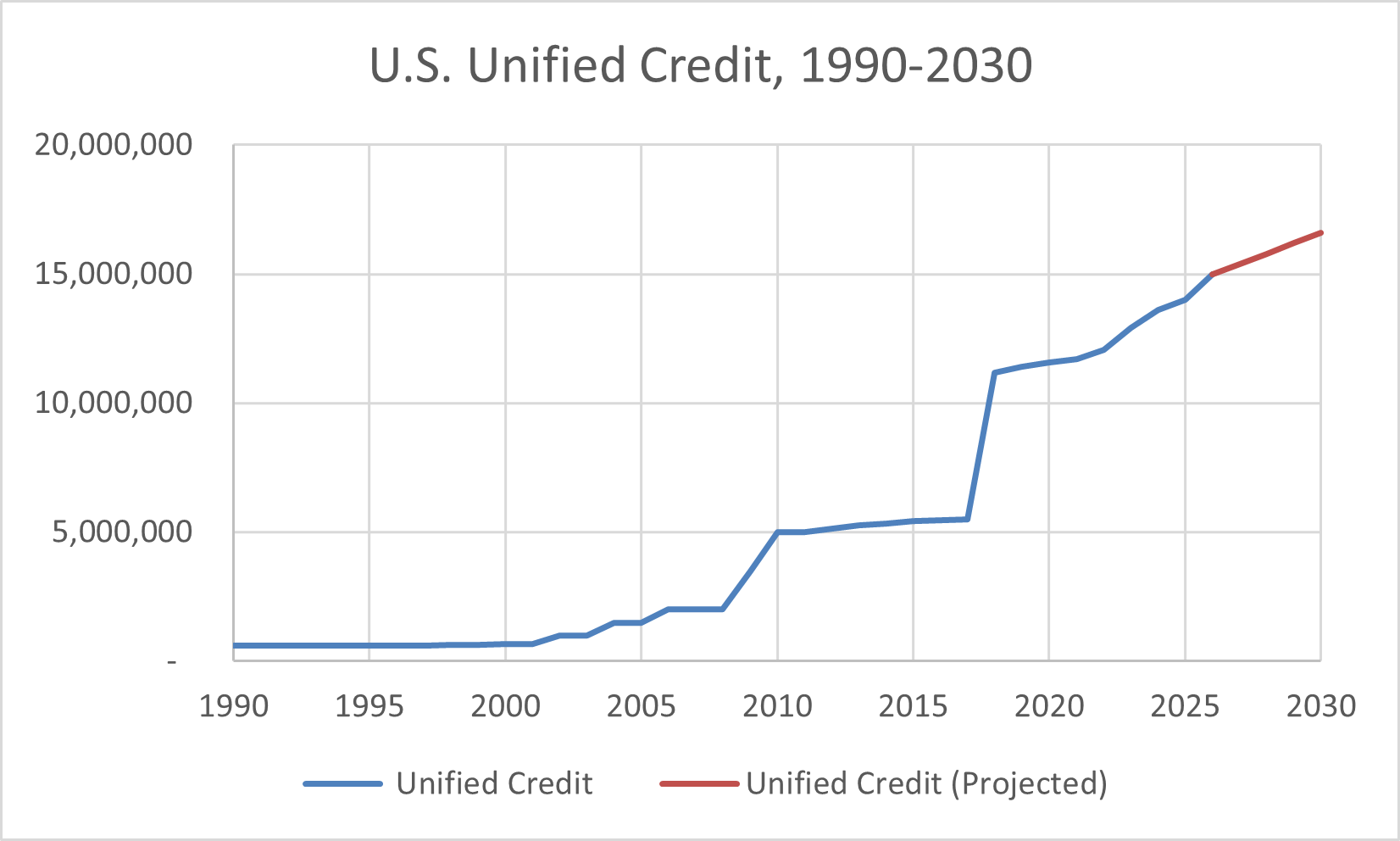
|
2025 |
|||
|
Gift |
$1,019,000 |
||
|
Annual exclusion |
Less: |
$19,000 |
|
|
Unified credit |
Less: |
$13,990,000 |
|
|
Taxable gift |
0 |
||
|
Gift tax due |
$0 |
||
|
Credit before gift |
$13,990,000 |
||
|
Credit used toward gift |
$1,000,000 (a) |
||
|
Credit remaining |
$12,990,000 |
(a) $1,019,000 gift less annual exclusion of $19,000 = $1 million credit used
132. Consider gifting income-producing or appreciated property. By gifting income-generating or appreciated property in lieu of cash, the donor can accomplish three important benefits. First and most importantly, the gift will serve the purpose of assisting the donee. Second, if the donee is in a lower tax bracket than the donor or exempt from the NIIT, the donor and donee will likely experience some collective tax savings by shifting the income to a lower bracket. Third, the value of the gift is also removed from the transferor’s estate. This is an easy, effective way to pass on wealth.
133. Consider making payments for tuition or medical expenses. Medical and education expenses paid directly to the providing institution are not subject to gift tax and generation-skipping transfer tax rules. Also, any such payments do not count toward the taxpayer’s annual gift tax exclusion. In addition, contributions to Section 529 plans may also qualify for special gift tax exclusion treatment. For example, should a grandparent make tuition payments and utilize up to $19,000 in gift exclusions to a grandchild, the yearly tax savings could be significant. Notably, these payments can be on behalf of anyone and are not restricted to immediate family members.
134. Utilize a spousal lifetime access trust (SLAT) to take advantage of currently high unified credits. With the permanent increase in the unified credit, married persons can continue to take advantage of the heightened credit by gifting the amount of the credit to a SLAT, utilizing the credit on the gift and paying no gift tax. In a SLAT, after the donor spouse gifts to the trust, the donee spouse can request distributions of income or principal from the trust, thus preserving access for the couple to the trust assets should the need arise. However, if principal is distributed, the SLAT assets distributed will be brought back into the estate, defeating the original intent of forming the SLAT―so exercise caution when taking distributions. Upon the donor spouse’s death, the assets in the trust (and subsequent appreciation) are not subject to the estate tax. When planning with SLATs, special care should be given to any divorce considerations and reciprocal trusts.
135. Tread carefully when considering the use of a grantor retained annuity trust (GRAT) for inter vivos wealth transfer. In a GRAT, a grantor contributes assets to a trust while retaining annuity payments for a defined period of time, with the remainder payable to beneficiaries. Depending on the structure of the GRAT, one can achieve maximum wealth transfer with little to no gift tax effect or use of the lifetime exclusion. However, should the grantor pass away prior to the completion of the annuity payments under the GRAT, at least a portion and possibly all of the GRAT assets are includible in the grantor’s estate.
136. Retain access to your home while passing it down to the next generation by utilizing a qualified personal residence trust (QPRT). By transferring a house to a QPRT, the grantor can continue to use the residence as their own for a specified period, after which the residence passes to the beneficiaries. At this point, and depending on the terms of the trust, the grantors may pay rent to remain in the home. The initial transfer to the QPRT is a taxable gift of the remainder interest in the home, using a rate published by the IRS. A QPRT allows the grantor to gift the home to the trust for a discounted value while using less of the exclusion, and shields future appreciation of the home from the estate tax. This is a particularly effective strategy in a high-interest rate environment because the higher the rate, the higher the present value of the grantor’s right to use the residence―and the lower the value of the gift of the future remainder interest.
When the QPRT term concludes and the house transfers to your daughter, any potential gift and estate tax will be calculated based on the original value of $1 million. This arrangement allows for the tax-free growth of the property's value during the QPRT period, providing a strategic advantage in passing on the asset to your daughter while minimizing potential tax implications.
137. Gift or sell assets to an intentionally defective grantor trust (IDGT). By gifting assets to an IDGT, donors can effect a completed gift during their lifetime for purposes of the estate and gift tax, which would use up some of their gift tax exemption but shield appreciation in the assets from the estate and gift taxes. However, the trust is disregarded for income tax purposes, meaning that the donor must report income from the gifted assets on their personal income tax return during their lifetime, further reducing the donor’s estate. Because of this, this strategy is best employed by gifting assets that are expected to increase the most in value.
138. Utilize a charitable remainder trust (CRT) or a charitable lead trust (CLT) to transfer wealth and benefit charity. As you would expect, both trusts involve the donation of a portion of the assets transferred into the trust to charity, but the timing and functions of both are very different. Both a CRT and CLT permit the donor to remove the asset from their estate. The differences arise in the areas of recipients of the annuity payments and the distribution of the remaining funds.
A CRT is created to ensure the donor’s financial future. Under a CRT, appreciating assets such as stocks are contributed to the trust and the donor receives an annuity for a term of years, even though the asset is no longer considered as part of the donor’s estate. Upon the donor’s death, a charitable organization receives the remaining assets.
A CLT is predominantly focused on the tax-efficient distribution of the donor’s wealth to beneficiaries. First, the donor makes a taxable gift equal to the present value of the amount that will be distributed to the remainder beneficiaries. In a CLT, the charities “lead” and receive the annual annuity payments. The amount remaining at the completion of the term is then distributed to the beneficiaries. The benefit of this type of trust is threefold: It allows for the reduction in the value of the settlor’s estate, while also providing for charities and beneficiaries.
139. Review trust residency qualifications often. The most difficult aspect of trust residency is that each state has different rules and qualifications for determining whether a trust is resident or nonresident. For example, most trusts created by a will of a decedent or funded while the donor was considered a resident of Pennsylvania are considered resident trusts. However, a state like Kansas only considers a trust as resident if it is administered in the state. Each state and situation differs for trust taxation, and laws are constantly changing. There is a myriad of other factors that may impact the nexus of a trust, such as beneficiary and/or trustee residence. We recommend contacting your tax advisor on any questions regarding trust residency.
140. Set up new intra-family loans while refinancing existing loans. Intra-family loans can still be beneficial for both the borrower/donee and the lender/donor. In this situation, the lender would be required to charge the minimum applicable federal rate. As of November 2025, that rate ranged between 3.69 percent and 4.62 percent, depending on the term. With volatility in the markets and high interest rates, it is not likely that borrowers would choose to invest proceeds and try to “beat” the intra-family loan rate at this time. However, if a donor chose to loan a beneficiary money to buy a home, with average mortgage rates currently anywhere between 5.8 percent and 6.5 percent, there is room to make an arrangement beneficial for both parties. For the donee, if the loan is secured and properly recorded, the interest could be deductible on their tax return while likely paying significantly less than what would be charged by a typical lending institution. For the donor in a volatile stock market, the mortgage could very well generate a better rate of return than a standard investment could, all while secured by real property.
The lender bears the responsibility of ensuring that appropriate tax forms are issued to the borrower, as applicable. The rules around deducting interest payments by borrowers are intricate―and are why taxpayers need to seek guidance from their tax preparers in order to ascertain whether interest payments may be deductible based on their specific circumstances.
To avoid the IRS asserting that loan is really a disguised gift, special care should be given to making regular debt service payments with respect to intra-family loans.
141. Consider the benefits of a revocable (living) trust. Generally, wills are drafted to specify how an individual’s assets should be distributed upon their death. However, a revocable trust can provide numerous advantages over a will. One significant benefit is the avoidance of the probate process, which is the process of the legal administration of a person’s estate in accordance with that person’s will or their state of domicile’s law if there is no will in place. Having a revocable trust that holds all of your assets eliminates any uncertainties that may arise within the probate process. Additional benefits of revocable trusts include the addition of privacy to the estate plan and protections against incapacity.
142. Utilize life insurance properly. Whether intended to pay estate taxes, protect the family of a deceased “breadwinner” or fund ongoing business structures, there are many reasons why taxpayers should obtain life insurance. Typically, there are two different types of life insurance policies taxpayers may select: term life insurance, which provides coverage over a specific period of time (the most popular option being “premium level”), and permanent life insurance, which provides coverage until the taxpayer dies or cancels the policy. A few examples of permanent life insurance include whole, universal and variable.
While life insurance may not be for everyone, it is worth looking into to see if your situation would benefit from it. For instance, business owners may want to guarantee they will be able to continue functioning after the loss of an important employee or ensure survivor income for the deceased’s family. In addition, the business may want to provide inheritance for family members who are not directly involved with the business. In terms of estate taxes, high-net-worth individuals may still be plagued with a financial burden after the death of a taxpayer. Those electing to use insurance proceeds in order to provide cash for the estate tax payment may soften the blow of having to resort to using other tactics, such as liquidating assets.
A taxpayer may also choose to establish an irrevocable life insurance trust, whereby the policy is considered an asset of the trust and ownership is effectively transferred to another person. Then, upon death, the benefits are not included in the decedent’s estate. Otherwise, the life insurance may be taxed in the deceased’s estate based upon the value of the death benefit, even for term insurance.
The advantages of acquiring life insurance within an irrevocable trust can be amplified when a married couple opts for the trustee to purchase a second-to-die life insurance policy. Typically, the cost of such a policy is lower than that of two individual single-life policies. Consequently, with the same premium, it becomes possible to secure a larger amount of coverage. This approach not only provides potential cost savings but also aligns with estate planning strategies, as the death benefit is triggered upon the passing of the second spouse, offering protection for heirs and assets within the trust.
When deciding who should fund the life insurance premiums, keep in mind that if a business owner is funding the premiums, there could be various related income tax issues. In addition, gift tax issues could arise if a life insurance trust is already set in place. For those reasons, it is imperative that taxpayers consult with a trusted tax advisor in order to determine what structure would work best for their specific situation.
143. Minimize the income taxes applicable to estates and trusts. The income tax rates that apply to estates and trusts continue to be significantly compressed. Estate and trust taxable income (exclusive of long‑term capital gain and qualified dividend income) of more than $15,650 for 2025 is taxed at a marginal tax rate of 37 percent. Therefore, it may be beneficial to distribute income from an estate or trust to its beneficiaries for the purpose of shifting the income to a lower tax rate. Additionally, trusts and estates can minimize income taxes by utilizing many of the tax planning strategies that are applicable to individuals, including the “bunching” of deductions and deferral of income strategies noted in strategies 23 and 33.
2025 Ordinary Income Tax Rates Applicable to Estates and Trusts
|
Taxable income |
Tax rate |
|
$0 - $3,150 |
10% |
|
$3,151 - $11,450 |
24% |
|
$11,451 - $15,650 |
35% |
|
Over $15,650 |
37% |
144. Consider an election under the 65-day rule. Considering the compressed brackets with extraordinarily high tax rates on income held within a trust or estate, it is advantageous in many scenarios to lessen the total income tax hit for the trust by distributing income to be taxed at the beneficiary level instead of the entity level.
With an election under Section 663(b), complex trust and estate distributions made within the first 65 days after the end of the calendar or fiscal year may be treated as paid and deductible by the trust or estate in 2025. The election of the 65-day rule is an invaluable asset, giving the trustee the flexibility to distribute income after the end of the year once the total taxable income of the trust or estate can be more accurately determined.
145. Consider private placement life insurance as a hedge fund alternative. Investors with significant income and wealth should consider private placement life insurance (PPLI), a type of life insurance that combines the benefits of traditional life insurance with the flexibility of private investments. This is an unregistered security that typically utilizes strategies associated with alternative investment funds; however, such funds are generally subject to high tax rates as many investments are made on shorter time horizons. A PPLI can help reduce the tax cost associated with investment in these funds, as assets can grow in the life insurance policy tax-free. PPLIs may be a particularly attractive alternative for those in states with higher taxes, like New York and California. PPLIs typically require funding of $3 million to $5 million in premiums per year.
146. U.S. citizen residents of a foreign country should consider the foreign earned income and housing exclusions. U.S. citizens and resident aliens who spend a significant amount of time out of the country and meet either the physical presence test or bona fide residence test can exclude up to $130,000 of income and some additional housing costs by using the foreign earned income exclusion. While the OBBBA introduces substantial reforms to international tax rules, including modifications to foreign tax credits, sourcing rules and deduction eligibility, it does not explicitly alter the core eligibility criteria for the foreign earned income exclusion itself, such as the physical presence or bona fide residence tests. Employees and self-employed individuals remain eligible to exclude qualifying foreign earned income and certain housing costs, provided they satisfy the statutory requirements.
There are several strategies to avoid double taxation for citizens and resident aliens with foreign income, and this approach is ideal for many of those at an income near the exclusion maximum. Your tax advisor can help you determine if you qualify and if this is the best personalized strategy to utilize.
147. Review your foreign bank account balance(s) during 2025 for FBAR preparation. If you have a financial interest (whether direct or as owner of record) or signature authority over foreign financial accounts with aggregate balances over $10,000 at any time during 2025, you are required to file FinCen Form 114, Report of Foreign Bank and Financial Accounts (FBAR). Willful failure to report these accounts can result in penalties of up to $165,353 or 50 percent of the account value, whichever is greater, on a per account basis.
In 2023, in Bittner v. United States, the U.S. Supreme Court held that a nonwillful reporting violation constitutes a single violation, regardless of the number of unreported or incorrectly reported accounts, and not a per account violation—and the penalty for such nonwillful violations can be up to $16,536 per form. The applicable sections of the IRC have not been updated yet, but a memorandum (SBSE-04-0723-0034) has been issued advising of the new limitation per form as well as eliminating the FBAR penalty mitigation guidelines for nonwillful violations.
Reporting of virtual currency accounts was not previously required for FBAR purposes. However, the Treasury Department has made plans to amend the disclosure requirements of virtual currency accounts held overseas. According to FinCen Notice 2020-2, while the current regulations do not define a foreign account holding solely virtual currency as a type of reportable account for FBAR purposes, if the account that holds the virtual currency is an otherwise reportable account, the total value of the holdings must be reported.
148. Maximize your foreign tax credit. For many taxpayers, the most exposure to international tax is paying foreign taxes on investment and other income earned abroad. While in many cases the calculation of a foreign tax credit is straightforward, for 2025, the OBBBA introduces several important changes to foreign tax credits, including modifications to the source-based requirements for certain taxes, as well as calculation of the net income subject to tax, and consequently, the availability of the credit for many taxpayers. An experienced tax preparer can assist to ensure you and your business receive the maximum credit for the foreign taxes you pay.
149. Avoid unintentional foreign trusts. Typically, a trust is viewed as a domestic entity for tax purposes if a U.S. court has primary supervision over its administration and one or more U.S. individuals have the power to make all substantial decisions. Therefore, it is important to consider not just the location of the trust’s formation, but also who will be in charge of the trust. If a nonresident alien becomes the successor trustee, or even a U.S. citizen if the assets are under foreign court jurisdiction, a U.S. trust could transform into a foreign trust when the original trustee passes away or steps down from their role. This change in classification could lead to significant modifications in U.S. and foreign reporting obligations and may also affect state-level obligations.
150. Plan for the expatriation “exit” tax if you are permanently leaving the country. For anyone residing in the U.S. considering renouncing their U.S. citizenship or terminating their resident status, the IRS will want one final bite of the apple, taxwise. The expatriation tax, first introduced in 2008, is generally calculated based on the fair market value of property on the day of expatriation. The tax is calculated as if the taxpayer had liquidated all of their assets on the date of expatriation and any unrealized gains are subject to tax. A “covered expatriate” is subject to the expatriation tax if the taxpayer’s net worth is over $2 million, their average annual income tax for the preceding five years is over a specified amount adjusted annually for inflation ($206,000 for 2025), or if they fail to certify that you complied with all federal tax obligations for the preceding five years. The IRS has increased its focus on enforcing these rules and has issued updated guidance and procedures to ensure compliance by covered expatriates, including detailed filing requirements and the use of Form 8854 to report expatriation and certify tax compliance.
151. Be aware of the new remittance tax. The OBBBA establishes a new remittance tax, which imposes a 1 percent excise tax on certain remittance transfers from senders in the United States to recipients abroad, effective for transfers after December 31, 2025. The remittance transfer provider is required to collect this tax at the time of the transfer and send it to the government. The new tax applies only to transfers where the sender provides cash, a money order, a cashier’s check or similar physical instruments to the provider (such as Western Union and similar transfer agents). Transfers funded by withdrawals from accounts at financial institutions or by debit/credit cards issued in the United States are excluded from the tax, so choosing the right payment method can be key to helping to avoid this new tax.
Table 1 – 2025 Federal Income Tax Brackets (Single Filers)
|
Rate |
Taxable Income Range |
Tax Liability |
|
10% |
$0 – $11,925 |
10% of taxable income |
|
12% |
$11,926 – $48,475 |
$1,192.50 + 12% of income over $11,925 |
|
22% |
$48,476 – $103,350 |
$5,578.50 + 22% of income over $48,475 |
|
24% |
$103,351 – $197,300 |
$17,651 + 24% of income over $103,350 |
|
32% |
$197,301 – $250,525 |
$40,199 + 32% of income over $197,300 |
|
35% |
$250,526 – $626,350 |
$57,231 + 35% of income over $250,525 |
|
37% |
$626,351 and above |
$188,769.75 + 37% of income over $626,350 |
Table 2 – 2025 Federal Income Tax Brackets (Head of Household)
|
Rate |
Taxable Income Range |
Tax Liability |
|
10% |
$0 – $17,000 |
10% of taxable income |
|
12% |
$17,001 – $64,850 |
$1,700 + 12% of income over $17,000 |
|
22% |
$64,851 – $103,350 |
$7,442 + 22% of income over $64,850 |
|
24% |
$103,351 – $197,300 |
$15,912 + 24% of income over $103,350 |
|
32% |
$197,301 – $250,500 |
$38,460 + 32% of income over $197,300 |
|
35% |
$250,501 – $626,350 |
$55,484 + 35% of income over $250,500 |
|
37% |
$626,351 and above |
$187,031.50 + 37% of income over $626,350 |
Table 3 – 2025 Federal Income Tax Brackets (Married Filing Jointly)
|
Rate |
Taxable Income Range |
Tax Liability |
|
10% |
$0 – $23,850 |
10% of taxable income |
|
12% |
$23,851 – $96,950 |
$2,385 + 12% of income over $23,850 |
|
22% |
$96,951 – $206,700 |
$11,157 + 22% of income over $96,950 |
|
24% |
$206,701 – $394,600 |
$35,302+ 24% of income over $206,700 |
|
32% |
$394,601 – $501,050 |
$80,398 + 32% of income over $394,600 |
|
35% |
$501,051 – $751,600 |
$114,462 + 35% of income over $501,050 |
|
37% |
$751,601 and above |
$202,154.50 + 37% of income over $751,600 |
Table 4 – 2025 Federal Income Tax Brackets (Married Filing Separately)
|
Rate |
Taxable Income Range |
Tax Liability |
|
10% |
$0 – $11,925 |
10% of taxable income |
|
12% |
$11,926 – $48,475 |
$1,192.50 + 12% of income over $11,925 |
|
22% |
$48,476 – $103,350 |
$5,578.50 + 22% of income over $48,475 |
|
24% |
$103,351 – $197,300 |
$17,651 + 24% of income over $103,350 |
|
32% |
$197,301 – $250,525 |
$40,199 + 32% of income over $197,300 |
|
35% |
$250,526 – $375,800 |
$57,231 + 35% of income over $250,525 |
|
37% |
$375,801 and above |
$101,077.25 + 37% of income over $375,800 |
Table 5 – 2025 Federal Income Tax Brackets for Estates and Trusts
|
Rate |
Taxable Income Range |
Tax Liability |
|
10% |
$0 – $3,150 |
10% of taxable income |
|
24% |
$3,151 – $11,450 |
$315 + 24% of income over $3,150 |
|
35% |
$11,451 – $15,650 |
$2,307 + 35% of income over $11,450 |
|
37% |
$15,651 and above |
$3,777 + 37% of income over $15,650 |
Table 6 – 2025 Long-Term Capital Gains Tax Brackets by Taxable Income and Filing Status
|
|
0% Bracket |
15% Bracket |
20% Bracket |
|
Single |
$0 – $48,350 |
$48,351 – $533,400 |
$533,401 and above |
|
Head of Household |
$0 – $64,750 |
$64,751 – $566,700 |
$566,701 and above |
|
Married Filing Jointly/Surviving Spouse |
$0 – $96,700 |
$96,701 – $600,050 |
$600,051 and above |
|
Married Filing Separately |
$0 – $48,350 |
$48,351 – $300,000 |
$300,001 and above |
|
Estates & Trusts |
$0 – $3,250 |
$3,251 – $15,900 |
$15,901 and above |
Table 7 – 2025 Payroll Tax Rates and Thresholds
|
Tax/Contribution Type |
Rate |
Taxable Wage Base/Threshold |
|
Social Security (FICA) — Employee |
6.20% |
First $176,100 of wages per worker |
|
Social Security (FICA) — Employer |
6.20% |
First $176,100 of wages per worker |
|
Medicare (FICA) — Employee |
1.45% |
All covered wages (no cap) |
|
Medicare (FICA) — Employer |
1.45% |
All covered wages (no cap) |
|
Additional Medicare Tax — Employee Only |
0.90% |
Wages over $200,000 (for single and head-of-household); threshold is $250,000 for married filing jointly; $125,000 for married filing separately. |
Table 8 – 2025 Phaseouts by Income for Key Tax Provisions
|
|
Single Phaseout Range (AGI/MAGI) |
MFJ Phaseout Range (AGI/MAGI) |
|
Personal deductions and credits |
|
|
|
Senior deduction |
$75,000 – $175,000 |
$150,000 – $250,000 |
|
Child and dependent care credit (from 35%-20%) |
$15,000 – $43,000 |
$15,000 – $43,000 |
|
Child tax credit (range varies based on No. of children) |
$200,000 - $244,000 (1 child) |
$400,000 - $444,000 (1 child) |
|
Credit for other dependents (range varies based on No. of dependents) |
$200,000 - $210,000 (1 dependent) |
$400,000 - $410,000 (1 dependent) |
|
Adoption credit |
$259,190 – $299,190 |
$259,190 – $299,190 |
|
Wage deductions |
|
|
|
Qualified tip deduction |
$150,000 – $400,000 |
$300,000 – $550,000 |
|
Qualified overtime deduction |
$150,000 – $275,000 |
$300,000 – $550,000 |
|
Other deductions |
|
|
|
Car loan interest deduction |
$100,000 – $150,000 |
$200,000 – $250,000 |
|
SALT deduction cap phase-down to $10,000 |
$500,000 – $600,000 |
$500,000 – $600,000 |
|
Qualified business income deduction for SSTBs |
$197,300 – $247,300 |
$394,600 – $494,600 |
|
Education phaseouts |
|
|
|
American opportunity tax credit |
$80,000 – $90,000 |
$160,000 – $180,000 |
|
Lifetime learning credit |
$80,000 – $90,000 |
$160,000 – $180,000 |
|
Student loan interest deduction |
$85,000 – $100,000 |
$170,000 – $200,000 |
|
Coverdell education savings account |
$95,000 – $110,000 |
$190,000 – $220,000 |
|
Retirement phaseouts |
|
|
|
IRA deduction – active participant |
$79,000 – $89,000 |
$126,000 – $146,000 |
|
IRA deduction – noncovered spouse |
N/A |
$236,000 – $246,000 |
|
Roth IRA contributions |
$150,000 – $165,000 |
$236,000 – $246,000 |
|
Retirement saver’s credit |
$23,750 – $39,500 |
$47,500 – $79,000 |
|
Alternative minimum tax |
|
|
|
AMT exemption (based on AMTI) |
$626,350 – $978,750 |
$1,252,700 – $1,800,700 |
|
Investment phaseouts |
|
|
|
Passive loss in active rental real estate |
$100,000 – $150,000 |
$100,000 – $150,000 |
|
Exclusion of interest from series EE and I U.S. savings bonds |
$99,500 – $114,500 |
$149,250 – $179,250 |
Table 9 – 2025 Retirement Contribution and Income Limits
|
Plan Type |
Limit Type |
2025 Amount/Range |
|
IRA contributions (traditional and Roth) |
Annual contribution limit (under age 50) |
$7,000 |
|
|
Annual contribution limit (age 50+) |
$8,000 |
|
Roth IRA MAGI phaseout |
Single/HOH |
$150,000 – $165,000 |
|
|
MFJ |
$236,000 – $246,000 |
|
Traditional IRA deduction MAGI phaseout |
Covered by workplace plan — Single/HOH |
$79,000 – $89,000 |
|
|
Covered by workplace plan — MFJ |
$126,000 – $146,000 |
|
|
Not covered, but spouse is covered — MFJ |
$236,000 – $246,000 |
|
401(k), 403(b), 457(b) contributions |
Elective deferral limit (under age 50) |
$23,500 |
|
|
Catch-up contribution (age 50+) |
$7,500 |
|
|
Super catch-up contribution (ages 60–63) |
$11,250 |
|
SIMPLE IRA contributions |
Employee deferral limit |
$16,500 |
|
|
SIMPLE catch-up contribution (age 50+) |
$3,500 |
|
|
SIMPLE super catch-up (ages 60–63) |
$5,250 |
|
SEP IRA contributions |
Employer contribution limit |
Lesser of 25% of compensation or $70,000 |
|
Defined benefit plan contributions |
Annual benefit limit |
$280,000 |
Table 10 – 2025 Tax-Advantaged Savings Accounts Summary
|
Account Type |
2025 Rule/Limit |
Details/Notes |
|
Health Savings Account (HSA) |
||
|
HSA contribution – self-only |
$4,300 |
Eligible individuals with self-only HDHP coverage |
|
HSA contribution – family |
$8,550 |
Eligible individuals with family HDHP coverage |
|
HSA catch-up (age 55+) |
$1,000 |
Fixed amount; not indexed |
|
Health FSA (Medical FSA) |
||
|
Max employee salary-reduction election |
$3,300 |
Per employee, per year |
|
Carryover cap (if plan allows carryover) |
$660 |
Maximum amount unpaid prior year can carry forward |
|
Dependent Care FSA (DC FSA) |
$5,000 (single/MFJ)/$2,500 (MFS) |
|
|
Commuter/Qualified Transportation Fringe |
||
|
Transit/commuter highway vehicle benefit |
$325 per month |
|
|
Qualified parking benefit |
$325 per month |
|
|
529 College Savings Plans (QTP) |
||
|
Federal annual “gift-tax-free” contribution per beneficiary |
$19,000 |
Tied to 2025 federal annual gift tax exclusion |
|
5-year “superfunding” election |
$95,000 per donor |
5 × $19,000; $190,000 married with gift-splitting |
|
Coverdell ESA |
$2,000 per beneficiary |
|
|
Trump Accounts (New Account Type Under OBBBA) |
||
|
One-time federal seed deposit for eligible newborns |
$1,000 |
For children born between Jan. 1, 2025, and Dec. 31, 2028 |
|
Annual contribution limit (before age 18) |
$5,000 per child (indexed starting 2028) |
Parents, grandparents, others may contribute |
|
Employer contribution limit |
Up to $2,500 annually |
Counts toward the $5,000 total |
|
Conversion at age 18 |
Account must convert to a traditional IRA |
Withdrawals subject to IRA rules |
At the time it was passed, the TCJA of 2017 was the largest tax reform legislation in over 30 years. With OBBBA extending or enhancing nearly all of the provisions in the TCJA and adding a few more of its own, we can safely say that this year’s tax bill is even more impactful on taxpayers. With effective dates ranging from January 2025 to 2027, careful analysis of when each provision will take effect and how it will impact your unique scenario is key.
With new deductions as well as new limitations, individuals, estates, trusts and businesses should model any new provisions to better understand the potential tax implications and to discuss tax planning strategies prior to execution.
Many of the 2025 tax savings opportunities will disappear after December 31, 2025. With careful consideration and by investing a little time in tax planning before year-end, you can both improve your 2025 tax situation and establish 2026 and future tax savings. Without thoughtful action, however, you may only discover tax saving opportunities (or tax costs) when your tax return is being prepared—at which time it may be too late.
If you would like to discuss the strategies and concepts indicated herein or have other concerns or needs, please do not hesitate to contact John I. Frederick, Michael A. Gillen or the Tax Accounting Group practitioner with whom you are in regular contact, as well as trust and estate attorneys David S. Kovsky and Erin E. McQuiggan of the firm’s Private Client Services Practice Group. For information on other pertinent topics, please visit our publications page.
Disclaimer: This Alert has been prepared and published for informational purposes only and is not offered, nor should be construed, as legal advice. For more information, please see the firm's full disclaimer.